
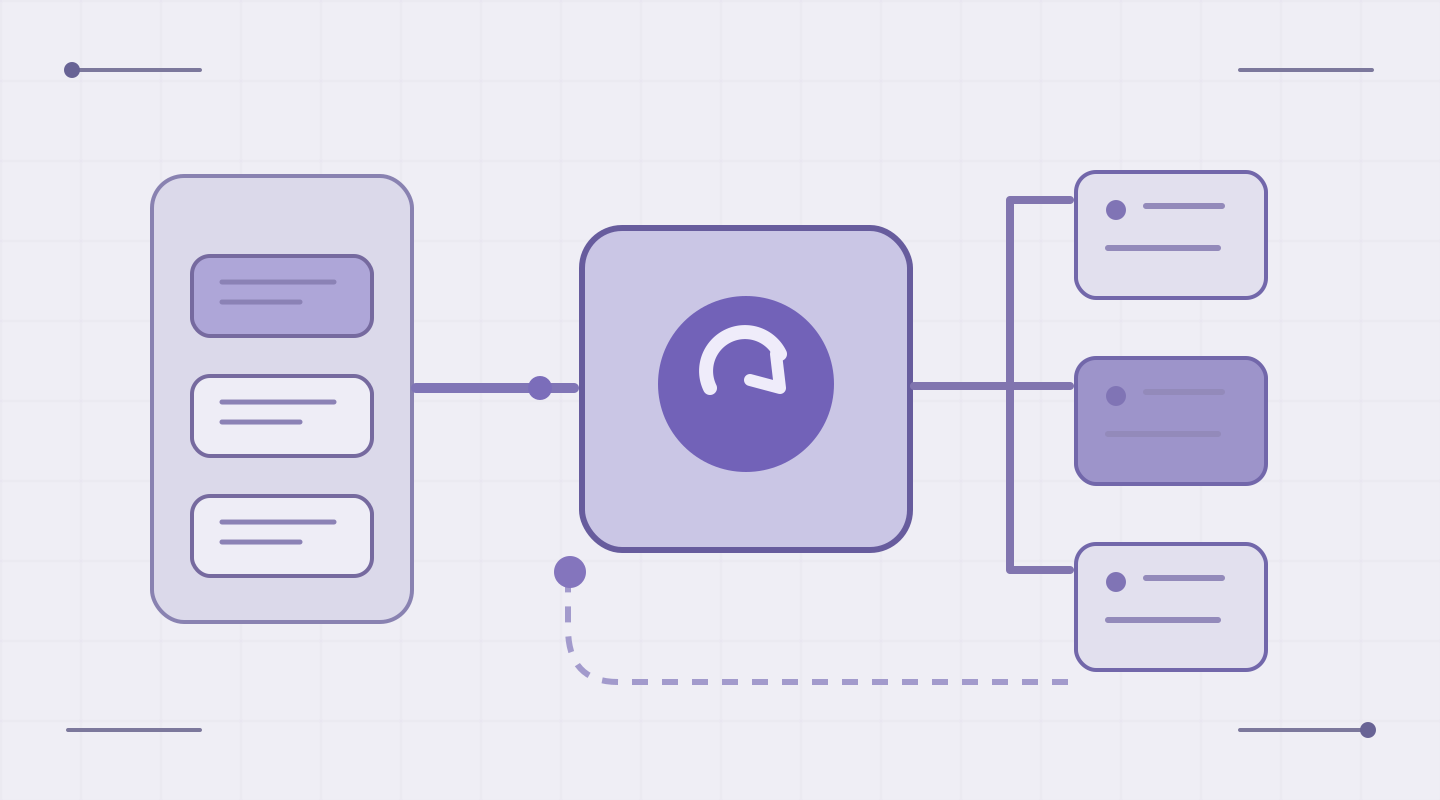
llm-d 1.0 was announced on October 20 as an open-source, Kubernetes-native system for serving AI models across infrastructure. Contributors report substantial savings in specific agent workloads. Cortist’s reading: smarter inference operations could matter as much as the next model release, but self-hosting is not automatically cheaper.
Source checked Oct 20, 2026 · Analysis by Cortist- llm-d 1.0 was announced on October 20 by contributors including IBM and Google Cloud; it is an open-source, Kubernetes-native inference-serving stack.
- The system combines model servers such as vLLM and SGLang with cache-aware routing, traffic controls and production operations.
- A 5–10× lower per-token cost comparison comes from project contributors’ specific self-hosted benchmark, not a universal price guarantee.
The Signal
A release for the work between model calls
IBM Research and Google Cloud announced llm-d 1.0 on October 20 at the PyTorch Conference. Rather than releasing a new language model, the project provides infrastructure for running existing models across accelerators and Kubernetes clusters. Its components coordinate requests, direct traffic toward useful cached context and support large-scale serving. The project is hosted as a Cloud Native Computing Foundation sandbox project. [1] [2]
Why agents make ordinary serving harder
A chat interaction may be a short exchange. A coding or business agent repeatedly sends model requests, revisits prior context, invokes tools and returns to the model. That pattern increases the operational importance of how requests are routed and whether earlier computation can be reused. llm-d 1.0 emphasizes session-aware scheduling, shared cache awareness, multi-tenant controls and high availability. Its release tracker details these as production-engineering priorities rather than new model capabilities. [2] [3]
The announcement matters because inference is becoming an ongoing infrastructure bill. A cheaper model alone cannot fix wasted GPU time, overloaded queues, idle accelerators or repeated processing of the same context.
The Shift
The benchmark is notable—and narrower than the headline
IBM Research reports that prefix-aware routing captured 97% of available cache reuse in a recent agentic coding test. In another demonstration, IBM and Red Hat say they operated 3,000 software-engineering agents concurrently and estimated serving costs 5 to 10 times below a comparison commercial API price for the same open model. The figures come from contributor-run workloads with specific hardware, traffic patterns and prices. They should not be treated as an independent cross-industry benchmark or a reduction that every team will achieve. [1] [4]
That distinction is economically significant. The comparison is between configurations, not a guarantee that any self-hosted cluster is 5 to 10 times cheaper than any hosted API. A fair analysis would include committed hardware, utilization, cloud discounts, model quality, system administration, outage risk and the expense of running at low traffic volumes.
Inference infrastructure becomes a competitive product
For large, predictable volumes, the serving stack can influence economics almost as strongly as model pricing. Optimized routing makes unused capacity and unnecessary recomputation visible cost centers. For smaller teams, however, managed API providers remove a significant operations burden. The same optimization can therefore be attractive to a hyperscaler but irrelevant to a startup with sporadic demand.
The open-source element provides another kind of choice: organizations can inspect and adapt the serving layer rather than relying solely on the internals of a commercial API. But an open serving stack does not remove hardware, integration or staffing dependencies. Portability is a testable property of a deployment, not a label.
The Cortist Lens
Measure accepted tasks—not discounted tokens
Cortist’s view is that the best metric for an agent platform is the cost of a successfully completed task at an equivalent quality target. Tokens per second and dollars per million tokens are useful inputs, not complete outcomes. A workload with cheap tokens can still waste money through retries, tool latency, failed jobs and human review.
An evaluation should therefore replay the same representative workload through two serving configurations and measure task completion rate, latency distribution, GPU-hours, cache hit rate, engineering time and recovery after failure. Compare a period long enough to capture uneven demand instead of only a saturated benchmark run.
Day-two reliability is the feature to scrutinize
The release tracker prioritizes multi-tenant quality of service, graceful load shedding, safe upgrades, session affinity and high availability. These are the details that determine whether a fast demonstration becomes an operable service. Ask whether a noisy tenant can starve other users, what happens during a model rollout, and how the system behaves when an accelerator fails mid-session. [3]
The right procurement question is not “Should everyone self-host now?” It is “At what scale and workload shape would we save enough, with equivalent quality and reliability, to justify owning the serving layer?” llm-d makes that choice more interesting. The answer still depends on the organization.
Do not confuse project results with independent validation
IBM and Google are participating contributors. Their statements are important primary evidence about the release and their own demonstrations, but are not neutral replication. Cortist has not deployed llm-d or independently measured the claimed cost savings. Further external benchmark data are needed before generalizing.
When should a team evaluate llm-d 1.0?
Cortist’s proposed assessment framework, not a universal infrastructure recommendation.
| Workload question | Evidence that would answer it |
|---|---|
| Repeated context? | Measure context reuse and actual cache-hit savings over realistic agent sessions. |
| Enough steady demand? | Compare utilization and committed GPU-hours with pay-per-request API usage. |
| Production reliability? | Test upgrades, overload, tenant fairness, rollback and failure recovery. |
| Real task economics? | Compare successful tasks per dollar at equivalent output quality, including operations. |
Questions that matter
What is llm-d 1.0?
llm-d 1.0 is an open-source, Kubernetes-native software stack for distributed large language model inference. It coordinates model-serving systems, routing and operational controls; it is not a new foundation model.
Does llm-d make AI inference 10 times cheaper?
Not in every case. Contributors reported a 5–10× per-token advantage in a particular self-hosted agent benchmark against a commercial API price for the same open model. Results depend on workload, utilization, hardware, pricing and operations.
Is llm-d 1.0 useful for small teams?
It may be, but running Kubernetes, accelerators and serving infrastructure has costs. A small team with unpredictable demand may still find managed APIs simpler and cheaper. Compare total successful-task costs before migrating.
Why does cache-aware routing matter for AI agents?
Agents often reuse long instructions, source files or conversation context. Sending a request to an instance that retains useful cached context can avoid repeating some computation and improve serving efficiency. The benefit is workload-dependent.
Watch for independent replications of the reported cache-reuse and 5–10× cost comparisons, compatibility across GPUs and TPUs, reliable zero-downtime upgrades, and transparent task-level comparisons against managed APIs. A repeatable production result—not the best-case token price—would establish the real shift.
A credible infrastructure milestone for agent economics. The opportunity is less wasted inference; the proof is lower total cost per reliably completed task.
Source & editorial note
Cortist is an early-stage, AI-assisted editorial project. This analysis draws on the primary sources below. The Signal attributes the reporting; The Shift, The Cortist Lens and the practical frameworks contain our interpretation. Company measurements and planned actions remain claims or intentions, not independently verified experimental results.
[1] IBM Researchllm-d 1.0 hardens open-source AI inference for day 2 production operations · Oct 20, 2026[2] Google CloudAnnouncing llm-d 1.0: Open distributed inference for agents · Oct 20, 2026[3] llm-d GitHubllm-d 1.0 release tracker and engineering scope · Sep 29, 2026[4] IBM Newsroomllm-d 1.0 Advances Open, Cost-Efficient AI Inference for Production Scale · Oct 20, 2026