
Can AI agents complete eight-hour tasks?
Will a publicly available AI agent reach an independently replicated 80%-success time horizon of eight human-expert hours by December 2028?
Understanding the Long-running agent tasks forecast
This is an editorial milestone candidate, not an approved official probability forecast. The proposed threshold and preliminary working model are not scored.
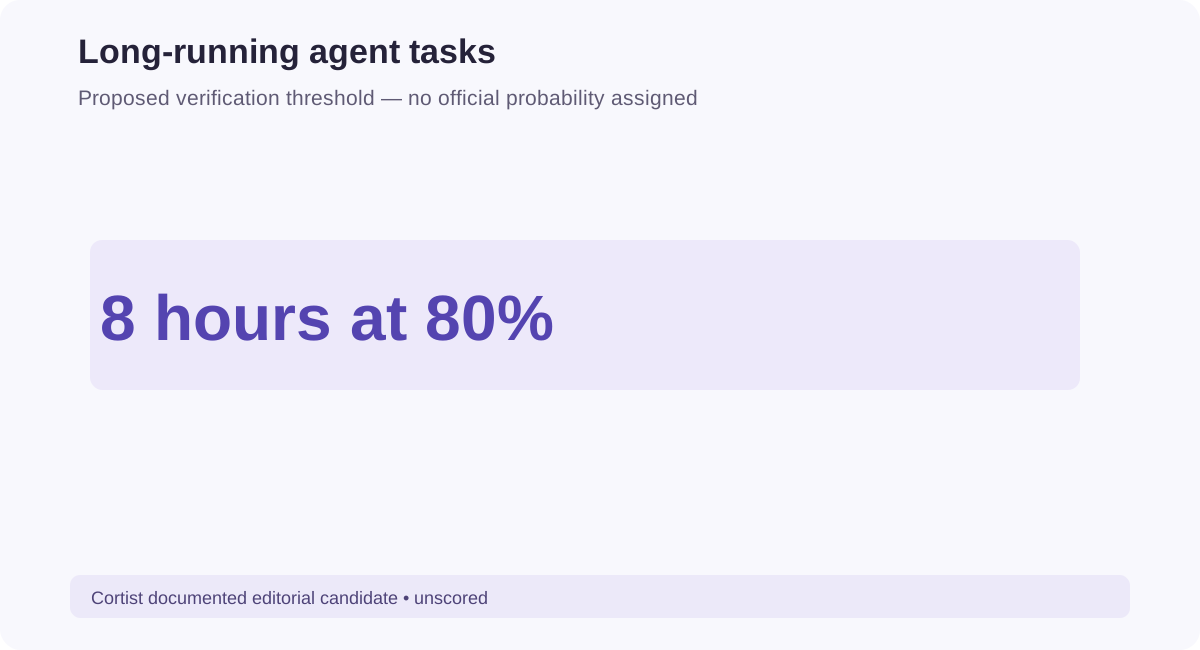
8 hours at 80% modeled reliability. A company announcement is not a substitute for independently verifiable evidence.
What the original data does and does not say
A model can execute for eight hours without reliably finishing an eight-hour human-expert task. METR's time-horizon construct instead relates success probability to the time a qualified person would need for a specific task distribution. The result depends on which tasks, environments and success checks are included.
An eight-hour time horizon does not mean every office job can be automated or that an agent can function with uninterrupted reliability in arbitrary real-world workplaces. The available task mix is narrower, and extrapolations from a fitted curve can be sensitive to modeling decisions.
What would make this claim checkable?
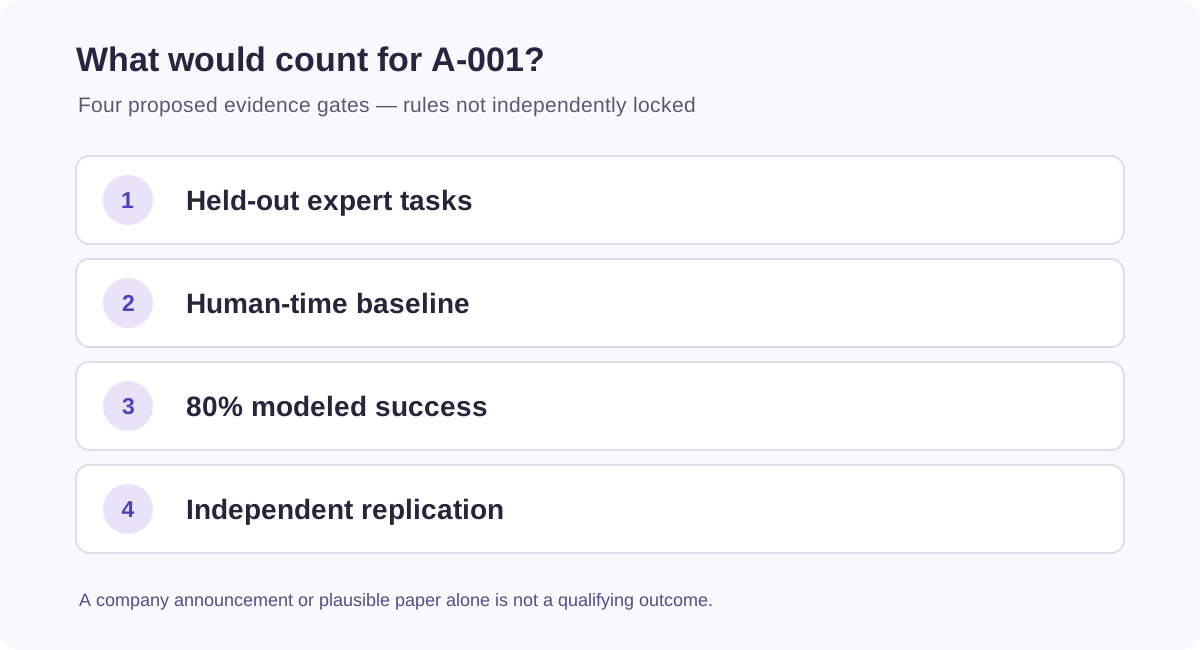
The candidate calls for a publicly available agent, a comparable held-out software or research task suite, an independently reproduced time horizon and transparent confidence and coverage assumptions. A frozen scoring protocol should specify which independent evaluator replaces or extends earlier METR measurements.
Required part of the proposed evidence path; one step alone cannot settle the question.
Required part of the proposed evidence path; one step alone cannot settle the question.
Required part of the proposed evidence path; one step alone cannot settle the question.
Required part of the proposed evidence path; one step alone cannot settle the question.
The historical forecast record above contains the complete original draft criteria. Those historical rules are not being retrospectively changed by this expanded explanation.
What evidence could change the assessment?
The decisive future evidence would be a preregistered replication on suitable tasks with clear human-time calibration, individual trial outcomes and uncertainty analysis. Cortist has not officially assigned or locked a forecast probability for A-001; any illustrative working model must remain distinct from a formal public forecast.
An announcement, a source-attributed observation, an independent replication and a formally resolved forecast are separate types of evidence. Cortist should preserve the difference when judging later developments. Until the rules are independently frozen, this question cannot add a legitimate score to a forecasting track record.
Frequently asked questions
Does an eight-hour time horizon mean eight continuous hours of autonomous work?
No. It describes performance on tasks whose estimated duration for human experts is about eight hours.
Is 80% a universal agent reliability guarantee?
No. It is a benchmark success criterion under specified tasks and statistical assumptions.
Has Cortist locked a probability for A-001?
No. It remains a candidate milestone with an unapproved editorial working model.
Published supporting sources
These source documents were already cited in the original forecast. The links support contextual review; their presence is not an independent replication or confirmation of an outcome.
- Originally cited research source 1
- Originally cited research source 2
- Originally cited research source 3
Explore original context
Substantive explanatory update: 29 October 2026. Historical data, original publication dates, probabilities, sliders and scoring eligibility are unchanged.
What is really
being measured?
A measurable future event needs clearer evidence than a technology headline.
METR's time-horizon measure compares agent success against expert human time on selected, mostly software and research tasks. It does not say an agent can do every job or operate autonomously for an entire workday. The crucial issue is reliable, independently reproduced performance across a frozen task suite. The previous METR public dashboard is no longer actively updated, and choices about task distribution and model-fitting influence the measured 80% threshold.
Rules before
results.
Deadline: 2028-12-31 (end of day UTC). Proposed outcome and source rules remain subject to independent review.
Will AI agents reach an eight-hour task horizon at 80% reliability by the end of 2028?
Measurement: At least 8 human-expert hours at 80% modeled task success
At least one publicly available frontier AI agent evaluated with a preregistered, independently replicated METR-style task-completion-time-horizon benchmark reaches an 80%-success time horizon of at least eight hours, where task duration means human expert time for comparable software or research tasks. The qualifying system and task suite must be publicly described before the outcome is judged.
What would count as yes?
- Independent evaluators publish an 80%-reliability time horizon of at least eight human-expert hours for a qualifying publicly available agent on a comparable held-out task suite.
- Reproducible task sampling, success tests, baseline estimates and uncertainty intervals are disclosed; an independent reviewer validates eligibility.
- The eligible result is achieved and documented by 23:59:59 UTC on December 31, 2028.
What would count as no?
- An eligible independent evaluation by the deadline demonstrates no qualifying agent meeting the threshold under preregistered and comparable tests.
- Evidence standards are complete, but all systems tested below the threshold with the stipulated coverage.
What must be resolved before locking?
- METR stopped actively updating the previous public dashboard in September 2026; a valid successor evaluator, comparable suite and sampling coverage must be formally selected.
- If no adequate independent evaluation exists by the deadline, label unresolved, not automatically false.
- Lock the software/research task-domain scope, confidence-interval rules and version-change policy before assigning a probability.
Important limitation: An eight-hour benchmark horizon does NOT mean all jobs can be automated; tasks are mainly software engineering, machine learning and security.
The evidence behind the estimate.
A transparent starting estimate. The figures are open to challenge and have not passed independent review.
A preliminary calculation, not an approved or locked Cortist forecast.
How the estimate was built
How close are AI agents to reliably completing much longer technical tasks? METR's results give us a starting point, but the future trajectory and the availability of comparable tests remain uncertain.
The assumptions are judgment calls, not measured success rates. An eight-hour benchmark measures task difficulty, not a full working day or the replacement of an employee.
The sensitivity figures illustrate alternative modeling choices, not a confidence interval. View the full calibration comparison and the independent-review requirements before interpreting them as predictions.
Evidence before
the percentage.
Original sources and explicit caveats, not made-up probabilities or unverifiable extrapolations.
View the versioned machine-readable research candidate (JSON). Created October 23, 2026. These are not locked or scored predictions.
What readers
should know.
Is this a locked Cortist prediction?
No. It is an editorial research candidate. Cortist has not assigned a probability, independently locked the criteria, or made it eligible for scoring.
What evidence could still be missing?
METR stopped actively updating the previous public dashboard in September 2026; a valid successor evaluator, comparable suite and sampling coverage must be formally selected.
Why might a claimed milestone not qualify?
If no adequate independent evaluation exists by the deadline, label unresolved, not automatically false.
What needs independent review?
Lock the software/research task-domain scope, confidence-interval rules and version-change policy before assigning a probability.