AI may automate some tasks without eliminating whole occupations. Task exposure, hiring changes and confirmed AI-caused job losses are different measurements. Cortist tracks the underlying labor-market evidence instead of inventing a percentage of jobs that will disappear.
Stronger evidence compares observed employment outcomes with relevant groups and competing economic explanations, not only tasks that a model could perform.
Guide clarified 3 November 2026 · Source findings and forecast assumptions below retain their original recorded dates · Editorial standards
AI & JOBS / TOPIC GUIDE · This evidence guide tracks occupation change, hiring and skills. The J-001 question remains unquantified; no validated job-replacement percentage is claimed. Editorial responsibility ↗
AI AUTOMATIONJOB DISPLACEMENTNEW CAREERSHUMAN SKILLSEMPIRICAL EVIDENCE
CORTIST REFERENCE GUIDE · 26 OCTOBER 2026 · SOURCE-FIRST
Will AI replace jobs? What the evidence actually shows
In brief
AI changes tasks and can alter hiring, output and workflows, but occupational exposure is not observed unemployment caused by AI. The ILO estimated in 2025 that around one in four workers globally held occupations with some generative-AI exposure. Cortist’s J-001 remains unquantified.
ILO / GLOBAL EXPOSURE1 in 4
Workers in an occupation with some generative-AI exposure. Not one in four jobs eliminated.
Evidence Pulse 2.0 checks the published Cortist News index when JavaScript is available. The source-linked, dated research articles remain accessible through Cortist News.
CORTIST / EVIDENCE PULSEIndex checked 27 Oct 2026
Evidence archive · 27 October 2026
Latest topic-linked reporting, compared with the separately versioned Cortist assessment. News does not automatically update a forecast.
Forecast / latest public versionNo official numeric forecastOriginal record: Research question / unquantified
Coverage since first draftEvidence tracking only; no probability to updateLatest linked news: Oct 26, 2026
Evidence interpretation: Task-based analysis and reported hiring observations make workforce changes more concrete.
What remains unproven: Neither alone establishes AI-caused net job losses across the labor market.
What to verify next: Employment, wage and task-level changes versus selection and macroeconomic effects.
Snapshot of 4 linked reports. Context is not independent proof or a measured probability change. Dated evidence index.
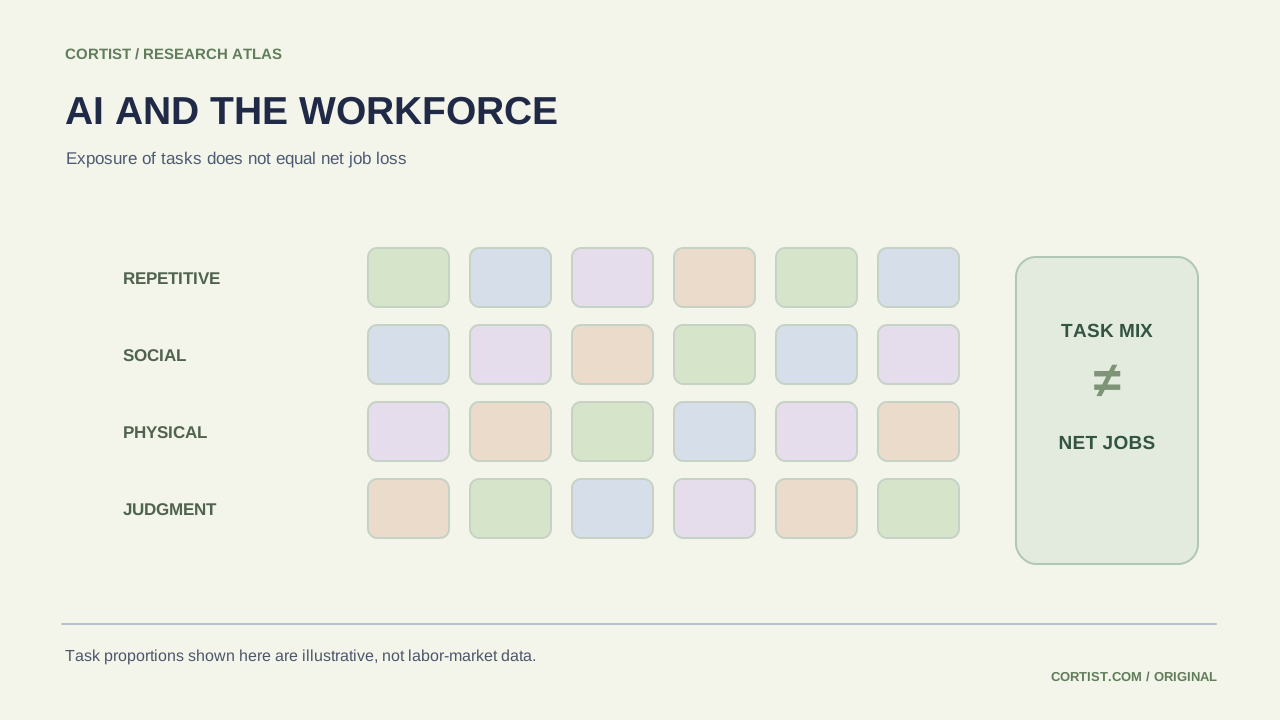
Original Cortist topic-specific research illustration. A conceptual task matrix shows why job exposure cannot be translated directly into job losses. Cells are illustrative, not statistical data.
Why “jobs exposed to AI” does not mean “jobs lost”
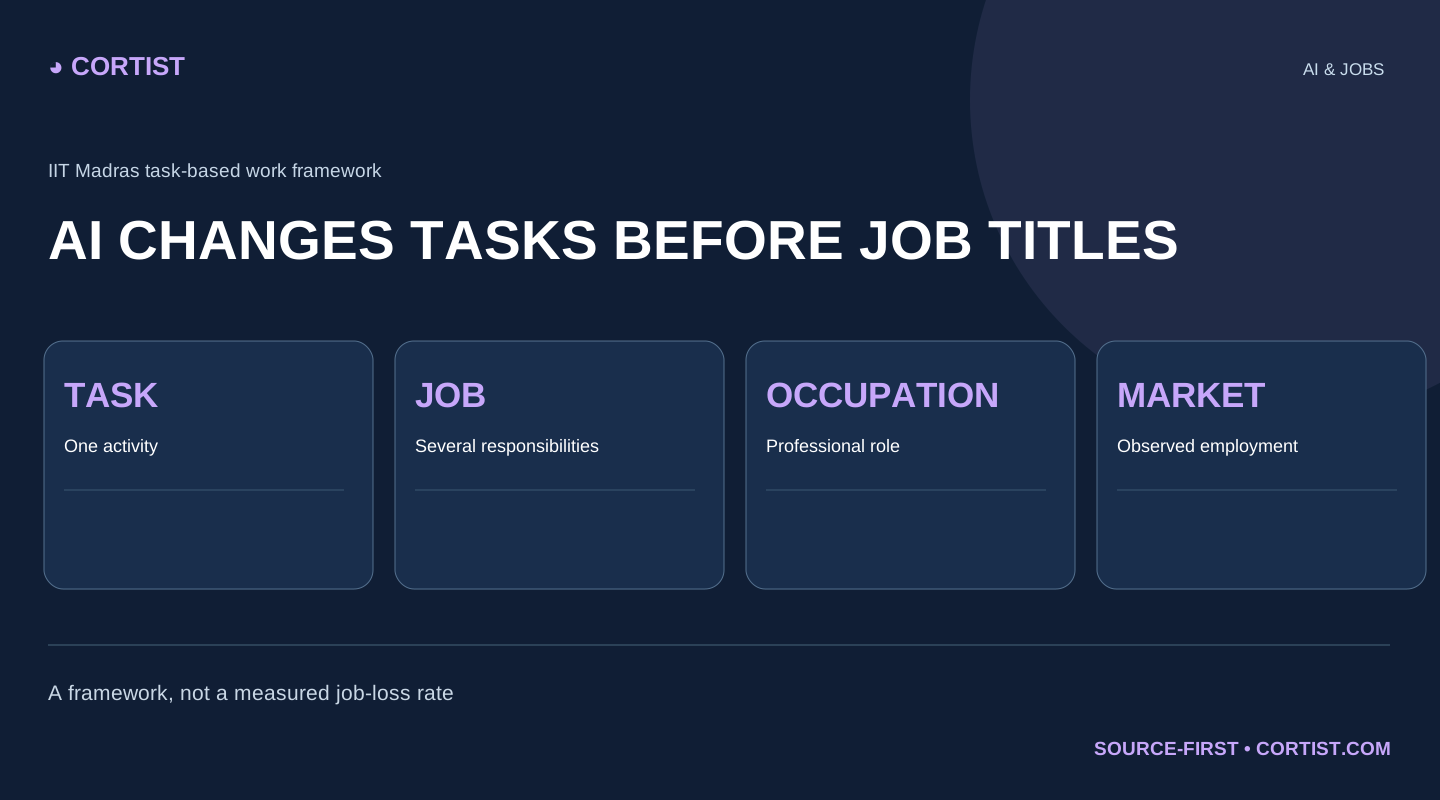
Most occupations contain many tasks, and a model’s ability to perform some of them does not establish that an employer can or will automate the entire job. Tasks may be redesigned, assisted or shifted toward human review. Adoption also depends on data quality, software integration, liability, employee preferences and the cost of checking results.
The ILO’s May 2025 refined global exposure index examines occupations through task-level evidence and identifies clerical work as relatively exposed. The study concludes that transformation is generally a more likely near-term impact than complete replacement because most occupations still involve tasks requiring human input. These are exposure estimates, not observed layoff counts.
What do employment studies really measure?
Labor-market evidence includes job openings, employment levels, wage changes, hours, worker transitions and within-firm task adoption. A decrease in the number of people employed in a highly exposed role can reflect AI, but also economic cycles, demographics, hiring freezes, outsourcing or changes in demand. Comparison groups and research design determine how far a causal claim can go.
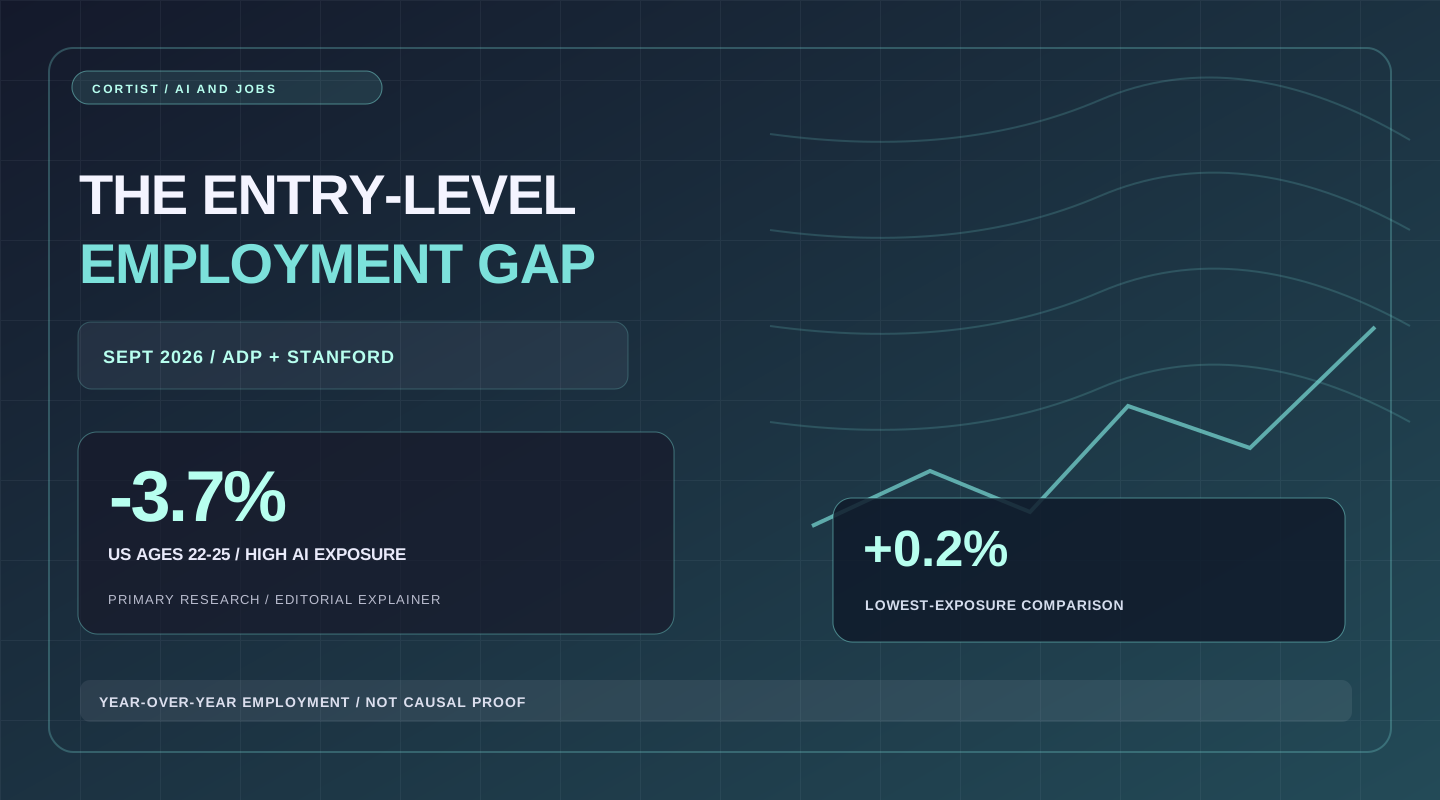
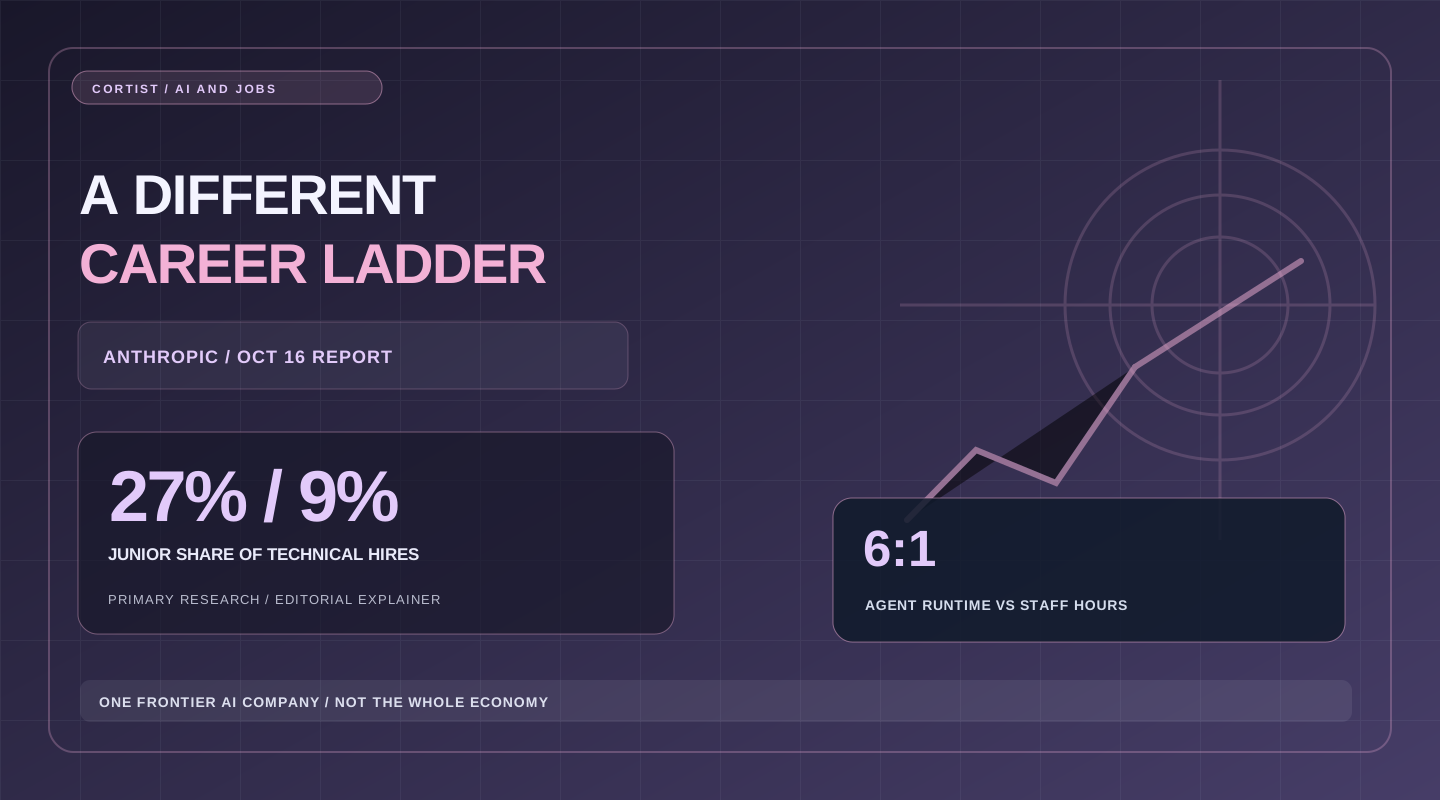
Cortist’s CL-0005 tracks an ADP/Stanford-reported change for younger US workers in AI-exposed occupations, including a 3.7% decline in one observed series. It must not be rewritten as “AI destroyed 3.7% of jobs.” CL-0006 separately documents Anthropic research into its own junior hiring patterns. Company-specific hiring evidence is not an economy-wide displacement rate.
From productivity to net employment
Even a real productivity gain does not settle the jobs question. Some firms may produce the same output with fewer worker-hours; others may expand output, cut prices, invent services or increase demand for complementary skills. New technologies can create tasks while removing others. Sector, region, worker seniority and adoption speed all matter.
For that reason, positive productivity benchmarks, survey expectations and employment outcomes should be displayed on separate lines rather than collapsed into a single “AI replacement score.” Longitudinal research with credible counterfactuals matters more than viral figures. The World Economic Forum’s scenario estimates are employer projections of many structural changes, not causal measurements of AI alone.
From AI exposure to actual employment effectsPotential task automation is not equivalent to measured displacement.
01ExposureTasks potentially affected
02AdoptionEmployers deploy systems
03RedesignTasks and output change
04EmploymentHiring, wages and roles
Cortist conceptual labor-market framework. Arrows describe questions to investigate, not established causal effects.
What evidence would change our view?
Useful updates include well-designed longitudinal employment research, transparent employer adoption data, credible natural experiments and independently checked wage or hiring changes. We would also track new tasks and employment growth, rather than monitoring losses alone. Short-run shifts should not automatically be extrapolated for a decade.
J-001 remains an open question with no assigned probability. Cortist preserves the original evidence records and their dates; later employment observations or stronger causal studies would be recorded as separate, sourced developments. The goal is to understand who is affected and how, not to convert uncertain forecasts into a false universal claim.
Task exposure does not equal job elimination
Occupations include varied tasks, human relationships, accountability and context. AI may improve drafting or analysis without performing all the work that defines a role. Exposure measures technical potential to change tasks; they do not show how many employers adopt AI or how many workers are displaced.
The ILO refined exposure index identifies clerical work as relatively exposed but emphasizes the likely transformation of jobs. Its global one-in-four estimate must not be repeated as “one in four jobs eliminated.”
What would prove a labor-market effect?
Employment counts, hiring, job openings, wages, hours and transitions answer different questions. A drop in job ads is not the same as layoffs. A decline in an exposed occupation may also reflect weak demand, restructuring or demographic shifts. Causal studies need plausible comparison groups and careful handling of these alternatives.
Cortist’s CL-0005 and CL-0006 document signals for young workers and company hiring patterns, each with limited populations and methods. These records should not be generalized into a global causal percentage. Read them in the Reality Ledger.
Productivity can produce multiple outcomes
When AI reduces the effort required for a task, employers may reduce hours, raise output, lower prices or create additional services. New demand can offset some work reductions while changing skill requirements. Net employment therefore depends on economic responses, not just the accuracy of a model or the speed of an AI agent.
Integration costs, workflow redesign, security requirements and regulation also affect adoption. A strong model benchmark is evidence about capability, not a direct forecast of staffing levels in 2030.
Which workers face different conditions?
Highly digitized roles often contain more automatable text and information tasks. Entry-level positions may face changing demand where routine work is important, but new tools can also help workers perform unfamiliar assignments. Physical work and roles requiring interpersonal trust, liability or local expertise face different constraints.
The ILO documents differences in exposure across countries and worker groups. Anyone interpreting a particular occupation needs local task, employer and labor-market evidence, not an internet-wide ranking of “jobs AI will replace.”
Reading 2030 projections without panic
Employer surveys and forecasts about 2030 combine changing technology, demographics, economic conditions and policy. Numbers describing all these changes cannot be relabeled as AI-caused job losses. A responsible scenario states geography, comparison year, assumptions and the outcome being forecast.
Cortist does not assign a current J-001 probability. Future updates will track sourced, dated outcomes and revise claims only as independent evidence changes. The related agent reliability page provides capability context without claiming a one-to-one mapping to employment.
Cortist evidence analysis · 26 October 2026
Expert assessment: what the research supports
The ILO refined occupational index measures exposure to generative AI rather than layoffs. Its task-based approach is useful for identifying where work might change, but it cannot by itself determine the speed of adoption, an employer’s staffing decision or the total number of displaced workers.
Individual employment and junior-hiring studies add observations about particular workers, firms and periods, not a universal causal estimate. Cortist tracks such claims in its Ledger and leaves J-001 unquantified. A defensible forecast must state geography, comparison group, outcome and counterfactual.
Research sources and limitations
Use each original source within its stated scope. An expert forecast is not evidence of a resolved event.
Curated from all 32 published Cortist reports · 4 relevant to this topic. Cross-topic links are context, not evidence that a forecast has resolved. Explore the complete news archive.
Research and analysis are dated news reports, not locked forecasts or items automatically enrolled in continuous monitoring. View all AI & Jobs news ↗
04 / DATED ORIGINAL STUDIES
The evidence. Not the headlines.
Eight source records covering employment, occupations, practical AI use and projections.
PRIMARY SOURCE
Stanford HAI
AI Economic Indicators
Monthly dashboards tracking AI-exposed employment; associations are not causal proof.
This source does not prove that all exposed jobs will disappear.
Summaries are editorial paraphrases with links to original publications. Working papers, observed payroll data and employer projections are distinct evidence types. Machine-readable source index ↗
05 / 2030 EMPLOYMENT SCENARIOS
92 million displaced. Not by AI alone.
A frequently repeated figure needs context before being presented as a prediction.
NEW JOBS170M
DISPLACED JOBS92M
NET PROJECTION+78M
What WEF actually projected
The WEF's Future of Jobs Report 2025 presents an employer-based scenario across technological, demographic, economic and environmental shifts by 2030. These are neither AI-only job losses nor measured outcomes.
No forecast is independently locked or scored. R2 retention is not an external immutable timestamp.
07 / CORTIST RESEARCH CANDIDATE
Will AI reshape entry-level hiring by 2030?
J-001 asks whether early-career hiring in AI-exposed occupations will diverge from a preregistered comparison group by 2030.
It needs exact thresholds, a frozen exposure index, population, data series and independent resolution rules before it could become a probabilistic forecast.
No credible study establishes that. Task automation can displace some labor while creating new work; the overall outcome is uncertain.
Which jobs are most exposed to AI?
The ILO identifies clerical work among the highest in generative-AI task exposure. Other digital occupations are exposed too, but exposure is not replacement.
Does Stanford's 19% figure mean that AI destroyed 19% of jobs?
No. It is a relative employment shortfall for US workers aged 22-25 in exposed occupations versus less-exposed peers through June 2026, not a causal job-loss total.
Does the WEF predict 92 million jobs lost specifically to AI?
No. The WEF 2025 scenario includes technological, demographic, economic and environmental changes, not AI alone.
How should workers prepare?
Assess your tasks, test AI tools responsibly, strengthen domain-specific judgment and communication, and follow local hiring statistics.
Does Cortist predict a percentage of jobs replaced by 2030?
No. J-001 is a research candidate with no probability, independent lock or scoring eligibility.
Explore the other Cortist research topics:AI Agents · AI in Medicine · AI & Energy. Each has a separate forecast with explicit evidence and uncertainty.