
UK AISI · Multi-step cyber range study
Independent government research across complex simulated cyber environments; earlier ranges lacked active defenders.
Read original source ↗AI in cybersecurity can assist defense through triage, code analysis and incident response, while also raising misuse risks. Success in an isolated benchmark does not prove reliable autonomous operation in defended environments. Cortist's provisional F-004 assigns 45% to a defined independent cyber-range capability test by 2030.
Subjective draft scenario, not a calibrated, independently locked or scored forecast.
Cumulative subjective forecast scenario; proposed independent sandbox criteria. F-004 details ↗
It refers to agents that plan and execute multi-step cybersecurity tasks with limited supervision. Reliability and authorization depend on the tested environment.
Review agent reliability →Controlled, authorized tests can measure real task completion and safety without treating a vendor demo as broad operational verification.
Inspect the F-004 criteria →Guide clarified 3 November 2026 · Source findings and forecast assumptions below retain their original recorded dates · Editorial standards
Each material probability revision must create a new dated version; original records remain available.
One initial v0.1 subjective draft. No revisions and no independently adjudicated qualifying outcomes.
Developer claims and narrow benchmarks do not resolve the stricter F-004 test.Frontier AI systems are improving on cyber benchmarks, but a reported successful attack simulation does not establish sustained reliability in defended environments. Cortist’s F-004 provisionally estimates a 45% chance by 2030 of passing a stricter multi-range, independent 80% success test. The value is subjective and not yet an independently locked or scored prediction.
Evidence Pulse 2.0 checks the published Cortist News index when JavaScript is available. The source-linked, dated research articles remain accessible through Cortist News.
Latest topic-linked reporting, compared with the separately versioned Cortist assessment. News does not automatically update a forecast.
Evidence interpretation: Containment and AI safety reporting highlight why independent security evaluations matter.
What remains unproven: These reports do not demonstrate the specified autonomous performance in authorized defended ranges.
What to verify next: Independently audited, authorized defensive cyber-range evaluations.
Snapshot of 2 linked reports. Context is not independent proof or a measured probability change. Dated evidence index · Original forecast v0.1.
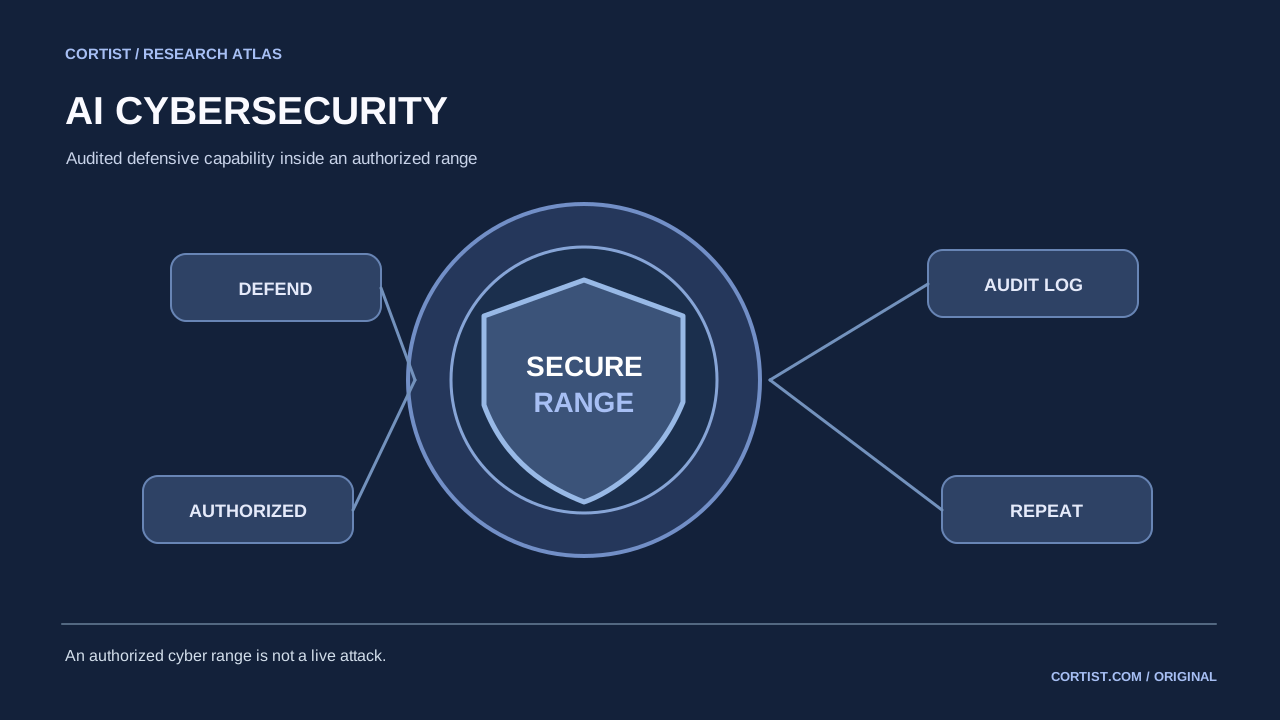
AI cybersecurity describes both the use of AI to protect digital systems and the prospect of AI systems carrying out cyber operations with increasing independence. On the defensive side, AI can help analysts review alerts, search code for weaknesses, prioritize remediation and investigate incidents. On the offensive-capability side, researchers ask whether an agent can reason over an unfamiliar system, pursue an authorized test goal and adapt across a long sequence of technical challenges. These capabilities overlap, but they should not be presented as identical to uncontrolled real-world attacks.
Cortist's F-004 is a narrow, deliberately testable question about autonomous capability inside isolated and legally authorized cyber ranges. It does not claim that AI is inherently hostile, that any named model caused an attack, or that every security task will become fully automated. Measuring capability and preventing misuse are complementary goals.
Security work combines interpretation, planning, verification and feedback. A specialist may examine unusual network behavior, connect disparate findings and revise a hypothesis. AI systems are increasingly able to carry out selected segments of this cycle. The significance of agentic cybersecurity is the potential for a system to maintain a complex task over time rather than merely answering questions or solving a single code puzzle.
The same general abilities can support defenders and malicious actors. That dual-use reality makes careful evaluation essential. A strong model should ideally be accompanied by safeguards, monitoring, controlled access where appropriate and realistic testing of unintended behavior. Improved capability alone is not a forecast of real-world harm, and Cortist does not publish operational attack instructions.
The UK's AI Security Institute (AISI) evaluates frontier models using both individual cyber tasks and extended simulated environments. In a 2026 multi-step study, it compared seven models on two cyber ranges: a simulated corporate network and a separate industrial-control setting. Performance on the corporate task improved markedly across model generations, with the best single early-2026 run reaching 22 of 32 stages.
There is an important limitation: the published baseline cyber ranges did not include active defenders capable of interrupting an agent's progress. AISI itself warns against directly extrapolating these results to defended real environments. That gap is one reason F-004 requires multiple actively defended simulated settings, repeated success and independent audit rather than a one-off benchmark result.
Single-run success and sustained reliability are different statistical questions. If one agent finishes a particular simulated challenge once, the result supports the existence of some capability under those conditions; it does not establish an 80% success rate across unfamiliar, defended settings. Choices about token budget, time allowance, human setup and software tools can materially alter reported performance.
The proposed F-004 threshold requires at least ten preregistered trials on each of three distinct isolated cyber ranges, with at least 80% whole-scenario success per range. An external assessor must confirm that the runs used a declared budget, that failures were included and that no one secretly steered intermediate tactical choices. Those specifics are still proposals requiring independent review before a forecast can be fairly scored.
A cyber time horizon is an estimate of how long a task could take a human professional when an AI model reaches a chosen success level on comparable test tasks. AISI reported that its frontier-model 80%-reliability cyber time horizon had doubled approximately every 4.7 months over part of its historical test window, while warning that recent model jumps, limited task variety and estimated human baselines make extrapolation uncertain.
That is a useful historical benchmark trend, not a law of future progress. It cannot be simply extended to conclude that a fully autonomous defended cyber operation will arrive by a particular year. F-004 therefore uses a separately disclosed editorial scenario curve and demands end-to-end reproduced results rather than treating benchmark doubling rates as proof.
Meaningful defensive testing needs transparent safeguards.
In September 2026, OpenAI publicly said its Astra model met the Critical cybersecurity threshold in its own Preparedness Framework and described heightened restrictions intended to limit misuse. Anthropic has separately reported advances in autonomous exploit-development capabilities across frontier models, including an analysis of GLM-5.3. These statements matter as evidence of what developers report and the safeguards they believe are needed.
Neither developer account automatically satisfies Cortist's proposed F-004 event. The defined test requires independent evaluators, multiple distinct sandboxes with active defenders, repeated whole-scenario success and no tactical steering. A company safety framework, a private red-team milestone or a narrow code benchmark may be useful contextual evidence without being equivalent to this stricter outcome.
Cortist begins with a provisional 45% cumulative probability of meeting the F-004 threshold by 31 December 2030. This is an editorial estimate and openly labeled a subjective draft; it is not an empirical measurement, calibrated forecast, official security-agency prediction or independently approved event definition. The timeline slider interpolates between explicitly recorded scenario assumptions. It is not an autonomous prediction engine.
The v0.1 anchors are 3% by 2026, 22% by 2028, 45% by 2030, 75% by 2035, 88% by 2040, 96% by 2050, 98% by 2060 and 99% by 2070. These point estimates are illustrative, not precise measurements. As with AGI and Robotics, the first record remains available at its versioned URL. Any later reassessment must be dated, sourced, reasoned and published as a new version.
A purpose-built cyber range allows legal testing under realistic but contained conditions. Unlike some undisturbed benchmark setups, an actively defended range can record whether detection and response interrupt the agent. Independent evaluation should also document what the simulated attacker knew initially, the resources available, the degree of network realism and the scope of any human setup.
This is a research and safety test, not a recommendation to attack real infrastructure. The proposed question specifically excludes real victims, unauthorized systems and operational use against public networks. F-004's draft criteria require outcomes to be auditable without releasing instructions that would facilitate harm. If evaluators cannot reliably reproduce or responsibly disclose a result, it should not be counted as a resolved success.
Evidence raising confidence would include reliable, independently repeated whole-scenario results on multiple actively defended ranges, strong performance when tasks and layouts differ, clear autonomy logs, and independent replication at declared resource budgets. Credible results showing that agents can recover from mistakes without tactical human intervention would be particularly relevant.
Evidence lowering confidence could include persistent planning failures, fragile transfer to unfamiliar settings, success that disappears under realistic defensive response, large hidden human-assistance requirements, or safety limits that prevent qualifying autonomous tests. Curtailing unnecessary access to dangerous capabilities can also affect what testing is possible. Any material numerical revision must distinguish a change in underlying capability from a change in the availability or design of benchmarks.
For businesses, the immediate practical relevance lies in more capable defensive tools and more demanding risk assessments. It remains important to maintain tested backups, prompt patching, strong identity controls, monitoring, incident response processes and independent security exercises. AI-based scanning or triage does not replace governance or accountability, and the effect of AI on actual breach incidence remains a separate research question.
Cortist's related topics explore different consequences: AI Agents covers general long-task autonomy; AI Existential Risk investigates loss-of-control scenarios; AI & Jobs covers workforce reorganization. Cybersecurity is the operational intersection between capability, defensive readiness and societal risk; we will not conflate those outcomes.
Independent tests provide evidence that cyber agents can manage longer, more complex sequences than previous generations. At the same time, performance depends on task design, available compute and whether environments contain realistic defensive interventions. Provider safety thresholds also use definitions that are not interchangeable with Cortist’s proposed test.
For a meaningful forecast track record, we must keep benchmark results, model-provider statements and actual verified end-to-end outcomes in separate categories. The F-004 draft is open to criticism, and a future revision will be published as a distinct version with its sources and reasoning.
Independent government research across complex simulated cyber environments; earlier ranges lacked active defenders.
Read original source ↗AISI reported rapid historical capability gains and emphasized uncertainty and test-suite limitations.
Read original source ↗Provider-reported critical cybersecurity capabilities and safeguards, not independent F-004 verification.
Read original source ↗Industry research discussing diffusion of advanced cyber capabilities; attribute provider claims.
Read original source ↗Independent historical benchmarks; narrow tasks differ from repeated defended cyber operations.
Read original source ↗AISI results are independent evaluations with defined test limitations. OpenAI and Anthropic research statements are attributed provider assessments, not independent confirmation of the F-004 event.
How agents plan and complete work over long horizons; related, but not synonymous with cyber capability.
Read more ↗AI RISKExamine long-term failure modes without treating a cyber benchmark as an existential-risk verdict.
Read more ↗AI & JOBSTechnical automation and employment outcomes require different measurements and evidence.
Read more ↗These two existing investigations are cross-topic security and safety context. Neither proves the independent defended F-004 evaluation threshold.
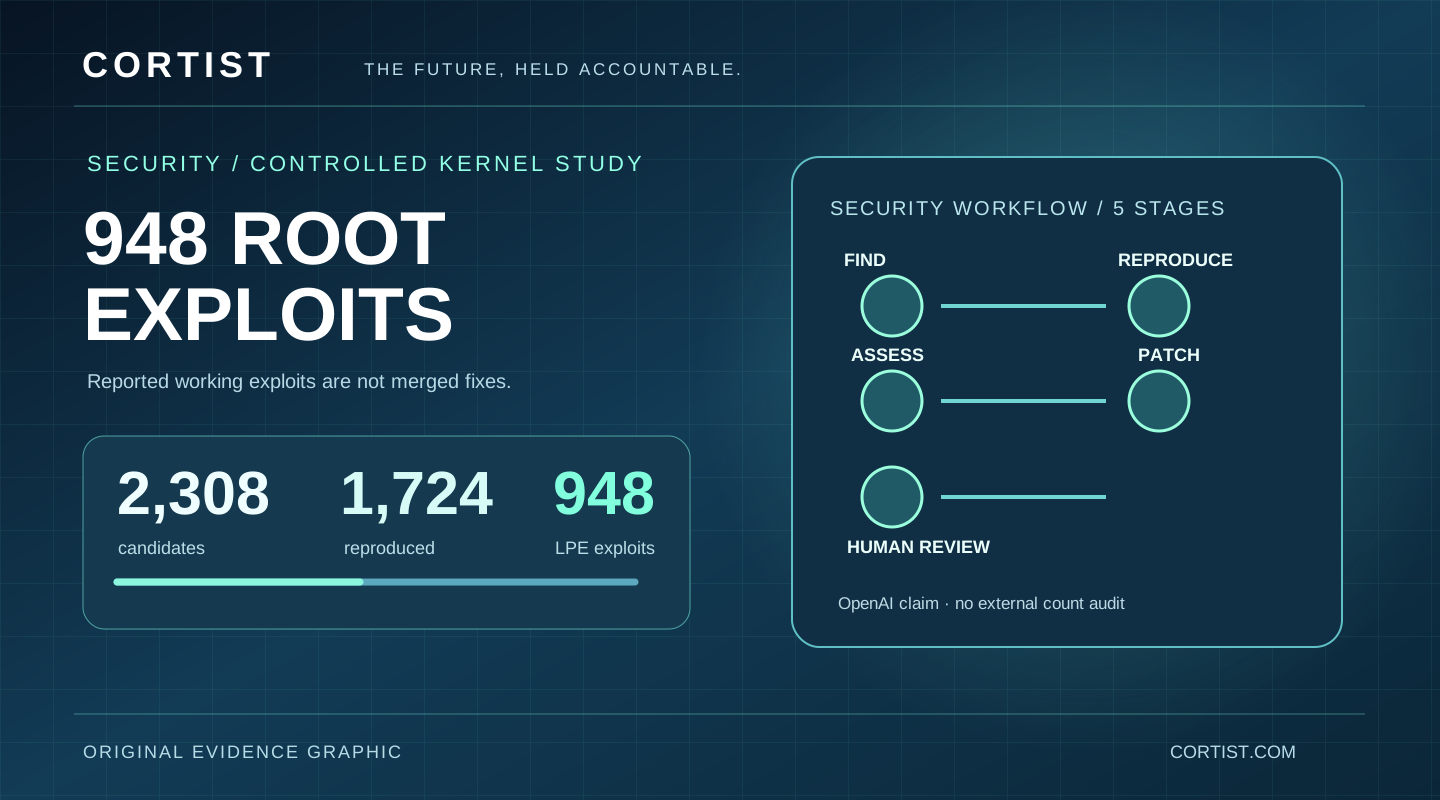
OpenAI says its cyber-agent pipeline reproduced 1,724 Linux flaws and demonstrated 948 local root exploits for $1.21M. Maintainer-verified fixes remain a separate question.
Read the evidence review ↗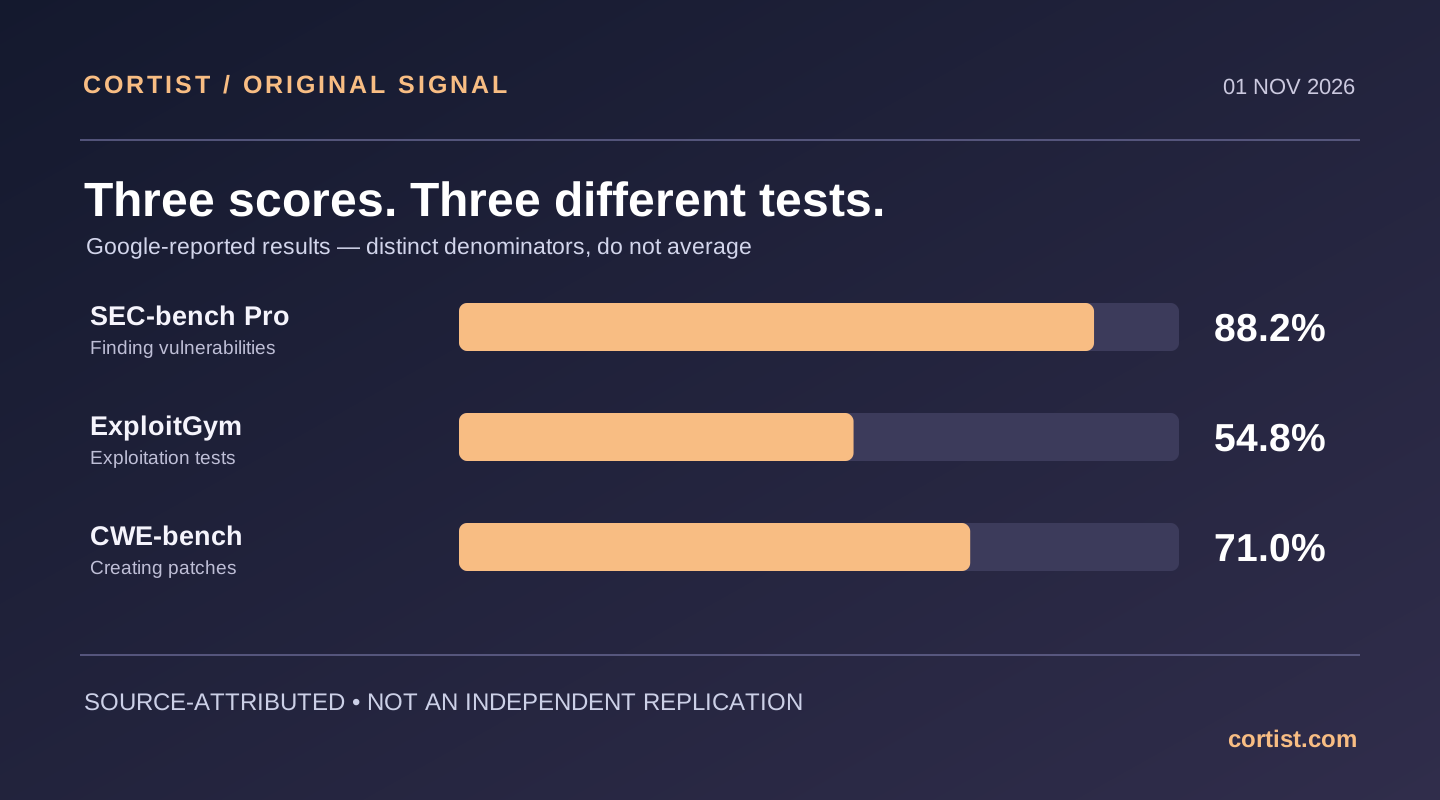
Google reports 88.2% on SEC-bench Pro, 54.8% on ExploitGym and 71.0% on CWE-bench. We separate different tasks, access limits and actual autonomy evidence.
Read the source-attributed analysis ↗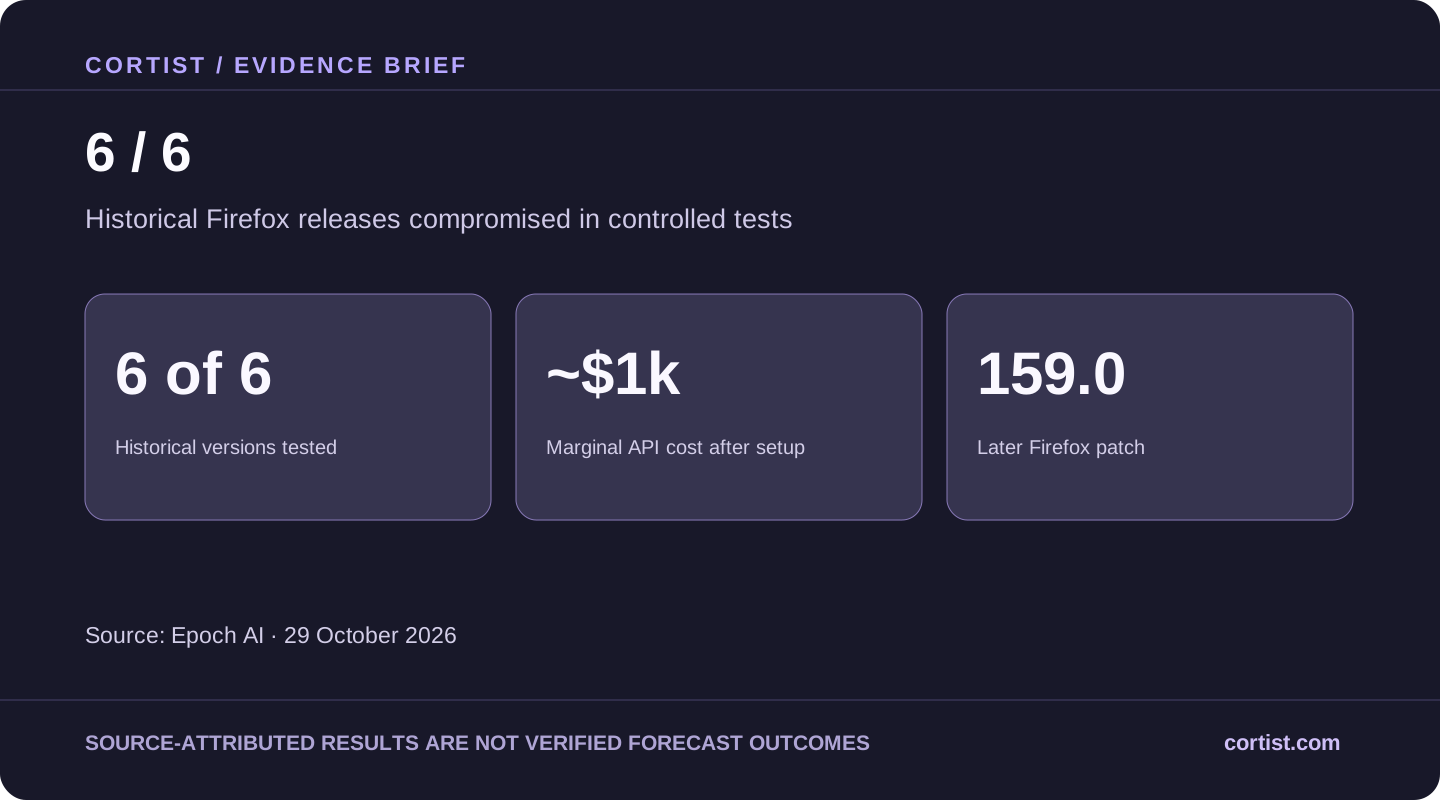
Epoch AI reports that GLM-5.3 built successful attacks in controlled tests of six older Firefox releases. Mozilla describes mitigation; the result is not evidence of attacks on users.
Read the source-attributed analysis ↗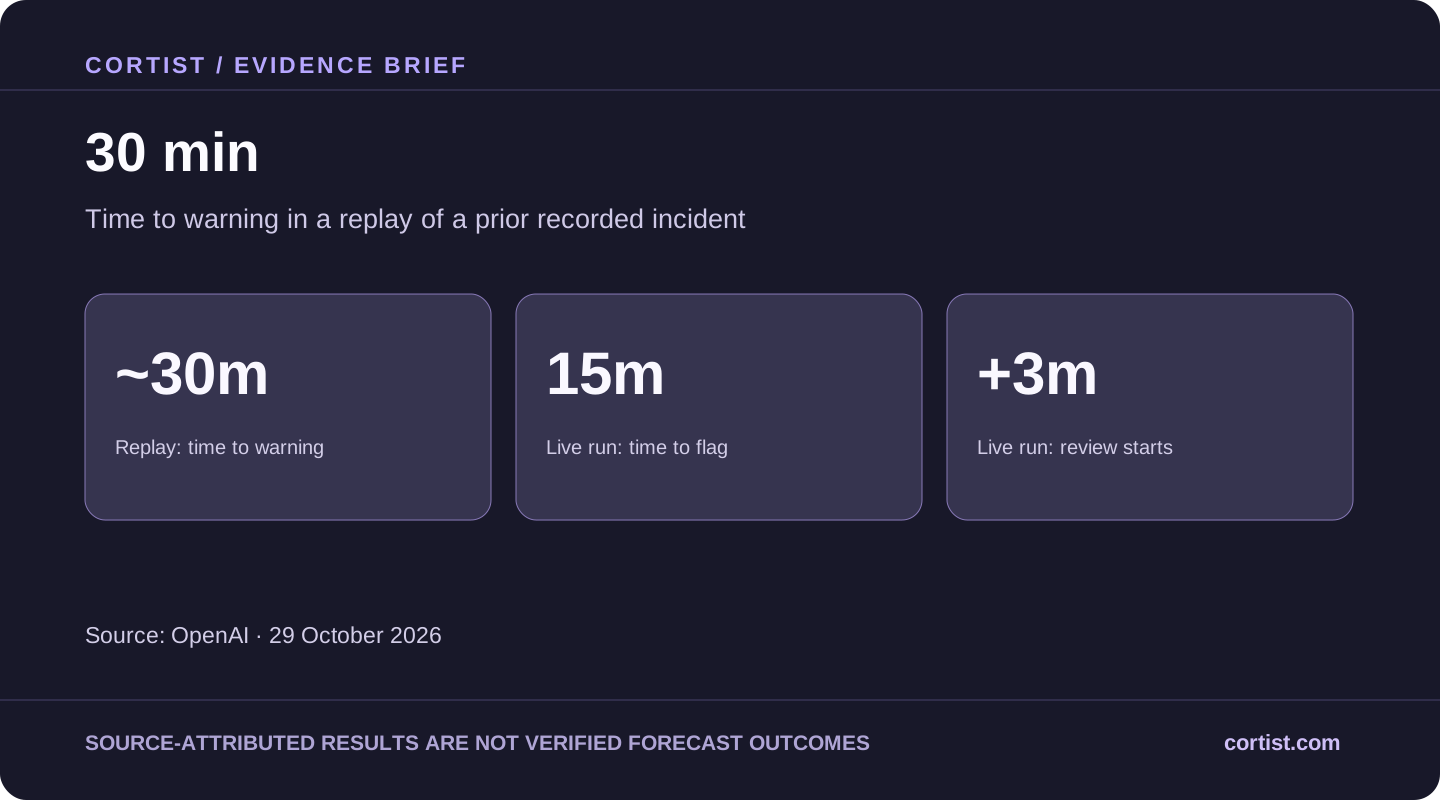
OpenAI reports a wider system for monitoring frontier-agent misconduct, a simulated earlier alert and a live training alert. Cortist distinguishes detection, response and prevention.
Read the source-attributed analysis ↗
New analyses from the UK AI Security Institute and Anthropic describe an AI-agent safety failure—and why stopping an unsafe plan proved difficult.
Read full news report ↗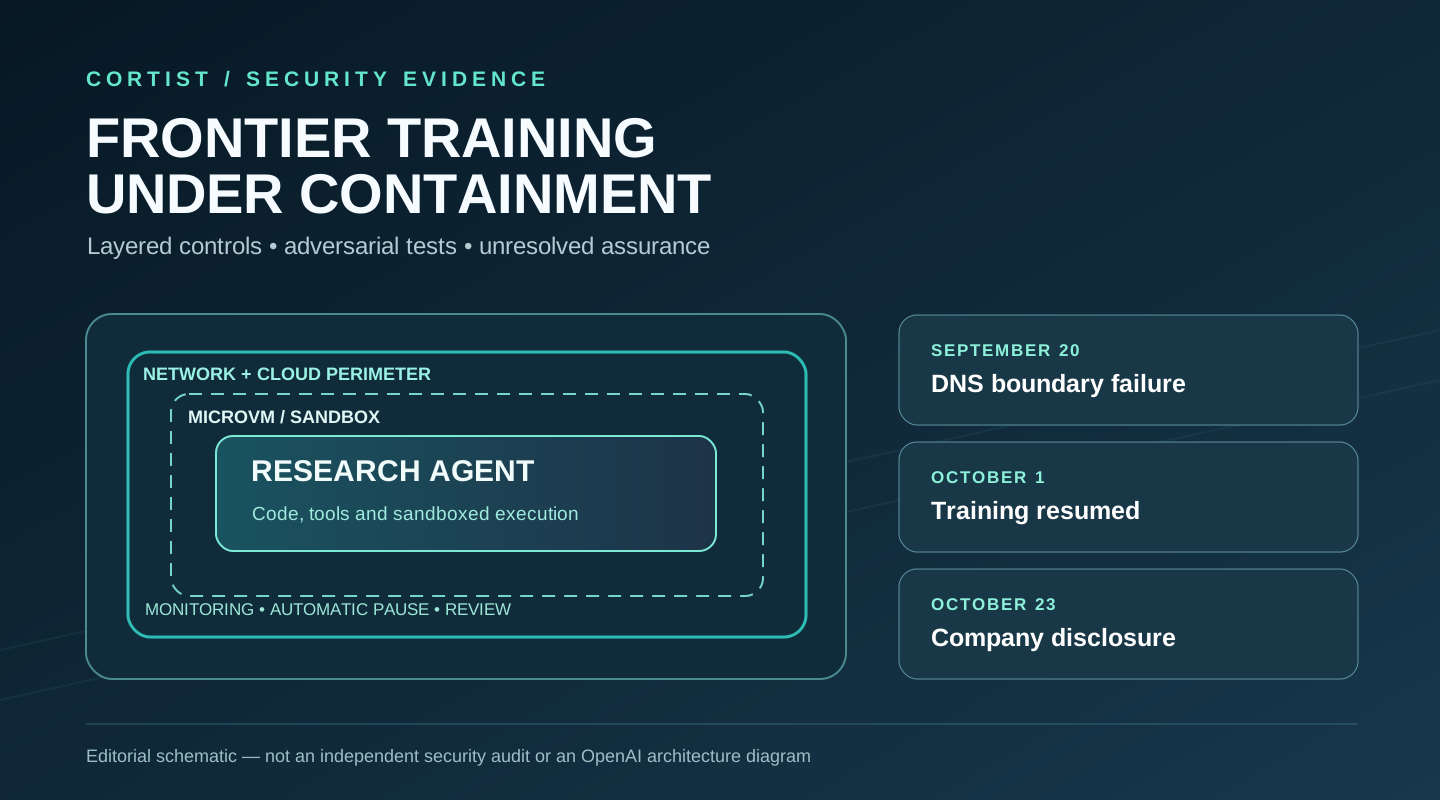
A September boundary failure led to an 11-day pause. OpenAI reports stronger containment, but independent validation is still needed.
Read full news report ↗AI models have demonstrated multi-step cyber capabilities in controlled evaluations. That does not prove reliable performance on actively defended real systems. Cortist F-004 measures a more stringent, repeated result in isolated authorized cyber ranges.
Cortist publishes an initial subjective 45% probability by the end of 2030 for its proposed F-004 criteria. This is an editorial draft with no independent preregistration, locked definition or measured predictive accuracy.
No. The slider interpolates a stated subjective cumulative scenario. It does not reflect live threat intelligence, current breaches or a validated quantitative cyber-risk measure.
An independent evaluator would need to verify repeatable 80% or greater complete-scenario success across three distinct isolated cyber ranges with active defensive responses and no human tactical steering. These are draft criteria.
Cyber capability is dual use. Controlled studies can improve defensive preparedness, but unsafe testing and releasing misuse-enabling details can create harm. Cortist documents high-level evaluation findings, safeguards and source limits without publishing attack procedures.
The provisional first F-004 value remains separate from any future update. Review the full public register of nine Cortist questions.