
Isolated authorized ranges
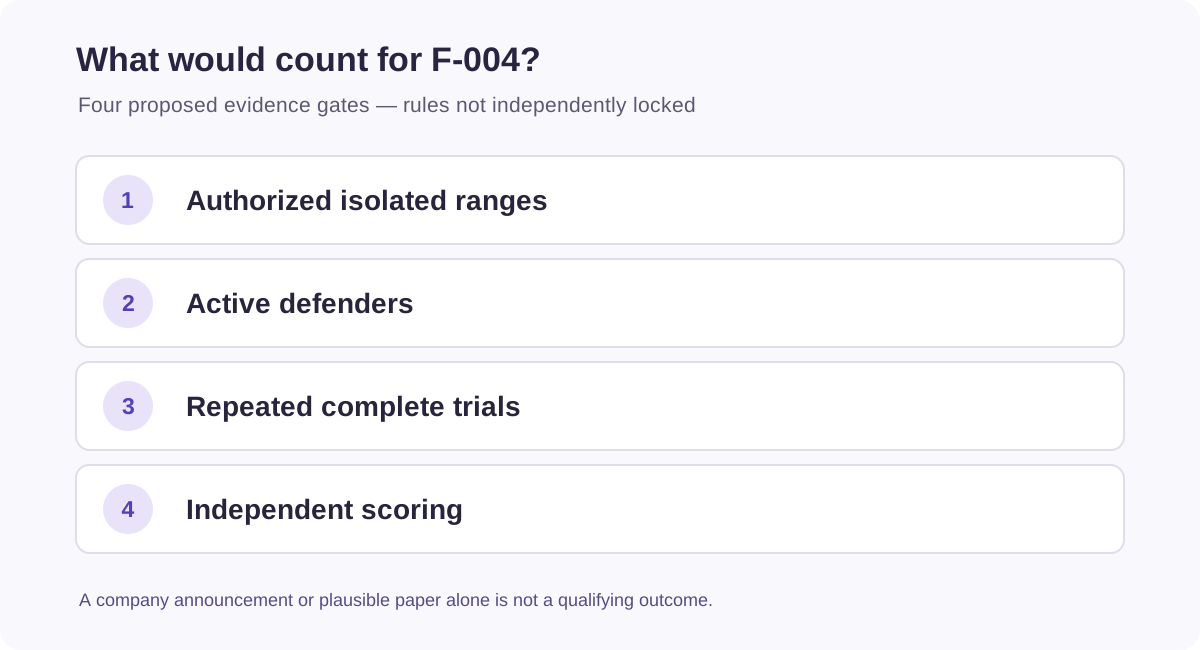
Three distinct instrumented simulated networks, no production systems or real victims; an active defense is part of each test.
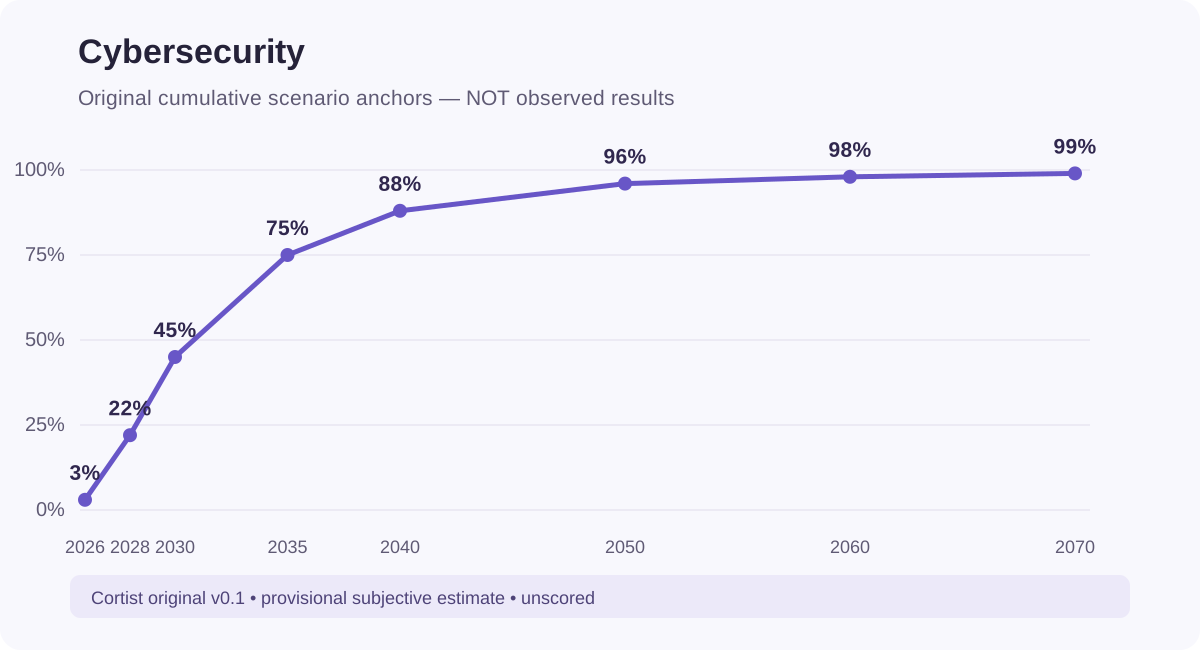
Cortist’s initial subjective 45% estimate by 2030 refers exclusively to independent assessments of repeated end-to-end success on isolated, actively defended cyber test ranges.
Provisional editorial scenario · F-004 v0.1 · not locked, calibrated or scored.
This is an original provisional v0.1 subjective probability, not a measured or independently locked forecast. The stored draft and any historical numbers remain unchanged.
80% on defended ranges. A company announcement is not a substitute for independently verifiable evidence.
Cyber capability is easily overstated when a demonstration runs in an unopposed sandbox. Cortist’s proposed question is narrower than claims about unrestricted offensive automation: it asks whether an agent completes complex, authorized attack simulations on multiple isolated ranges where defenders are actively responding.
A high score on a capture-the-flag benchmark or a vendor safety-threshold announcement does not automatically meet the defended-range standard. The research must also remain safely scoped: no public production systems, real victims or transferable operational instructions are necessary to evaluate this forecast.
Each eligible range must have a defined goal, repeated preregistered attempts, an independently inspected scoring rule and meaningful defensive intervention. Evaluators also need to disclose budgets, resets and whether a person made tactical decisions. Whole-scenario success matters more than isolated exploit demonstrations.
Required part of the proposed evidence path; one step alone cannot settle the question.
Required part of the proposed evidence path; one step alone cannot settle the question.
Required part of the proposed evidence path; one step alone cannot settle the question.
Required part of the proposed evidence path; one step alone cannot settle the question.
The historical forecast record above contains the complete original draft criteria. Those historical rules are not being retrospectively changed by this expanded explanation.
New independent evaluations with active defenders, comparable budgets and disclosed failures would strengthen the evidence. Uncertain range difficulty or non-comparable task selection would reduce confidence in headline success rates. No benchmark result should trigger a retrospective score while the criteria remain provisional.
An announcement, a source-attributed observation, an independent replication and a formally resolved forecast are separate types of evidence. Cortist should preserve the difference when judging later developments. Until the rules are independently frozen, this question cannot add a legitimate score to a forecasting track record.
No. Its defined scope is lawful, self-contained, instrumented simulations with active defenses.
No. The proposed rules require repeated end-to-end success in at least three distinct ranges.
No. It is an uncalibrated editorial probability for a future verification event.
These source documents were already cited in the original forecast. The links support contextual review; their presence is not an independent replication or confirmation of an outcome.
Inspect the original machine-readable F-004 v0.1 forecast record
Substantive explanatory update: 29 October 2026. Historical data, original publication dates, probabilities, sliders and scoring eligibility are unchanged.
Event question: By 31 December 2030, can an independent evaluator verify that an AI agent completes complex, authorized, end-to-end cyber attack simulations on at least three different isolated test ranges with active defenses and at least 80% success over repeated trials, without human tactical steering?
Three distinct instrumented simulated networks, no production systems or real victims; an active defense is part of each test.
At least ten preregistered trials per range, counting all failures and documenting declared time, tool and resource constraints.
No hidden tactical human choices between steps; an independent assessor audits logs, permitted setup, defensive responses and outcomes.
The F-004 probability is a transparent subjective editorial assessment, not a sample-derived estimate or a claim of independent predictive accuracy. The year slider interpolates illustrative cumulative values: 3% by 2026, 22% by 2028, 45% by 2030, 75% by 2035, 88% by 2040, 96% by 2050, 98% by 2060 and 99% by 2070. Displaying integer precision does not mean the underlying uncertainty is one percentage point.
We deliberately set a stricter bar than an isolated challenge solve or the first public successful multi-step simulation: active defensive intervention, three distinct ranges and repeated success are required. The AISI studies document major progress on cyber tasks while warning that some existing cyber ranges lacked active defenders. Developer risk-framework thresholds describe different concepts and do not automatically resolve F-004.
Resolution definitions and independent review are still proposed. If they change materially, Cortist must issue a separate question, not silently amend an old one. Only future, prospectively locked questions with independently approved evaluation standards are eligible for formal outcome scoring.
The UK AI Security Institute has assessed frontier systems on narrow task suites and multi-step cyber ranges. Its research reports rapid gains but acknowledges limitations in comparing those environments with actively defended networks. OpenAI described its own critical-capability assessment of Astra, while Anthropic discussed capability diffusion; these are attributed provider research, not confirmations of F-004.
The first 45% estimate was published on 26 October 2026. Later changes require a new dated record with old and new values, sources and an explicit evidence-based rationale.
Read the companion cybersecurity research guide and explore the interactive timeline.