AI agents are AI systems that use models and tools to plan and carry out multi-step tasks. Unlike a single chatbot response, an agent may act across a workflow; capability does not guarantee reliable completion or safe permissions. Cortist tracks reproducible evaluations, not just demonstrations.
Agents can select tools and take successive actions toward a goal. A chatbot answer alone does not demonstrate that a multi-step workflow will be completed safely.
CORTIST REFERENCE GUIDE · 26 OCTOBER 2026 · SOURCE-FIRST
AI agents: autonomy, benchmarks and deployment reliability
In brief
An AI agent is a system that uses a model and tools to perform a sequence of actions toward a goal. It is not necessarily reliable, safe or generally intelligent. Cortist’s A-001 eight-hour task-horizon candidate at 80% success remains on HOLD; its historical 86% candidate figure is not a locked or scored forecast.
Evidence Pulse 2.0 checks the published Cortist News index when JavaScript is available. The source-linked, dated research articles remain accessible through Cortist News.
CORTIST / EVIDENCE PULSEIndex checked 27 Oct 2026
Evidence archive · 27 October 2026
Latest topic-linked reporting, compared with the separately versioned Cortist assessment. News does not automatically update a forecast.
Forecast / latest public versionNo official numeric forecastOriginal record: Research question / unquantified
Coverage since first draftEvidence tracking only; no probability to updateLatest linked news: Oct 26, 2026
Evidence interpretation: Tool sandboxes and AI-assisted scientific workflows illustrate increasing scope for autonomous action.
What remains unproven: They do not establish reliable, independently tested multihour task success.
What to verify next: Multi-hour task success rates, recoverability and independent tests.
Snapshot of 12 linked reports. Context is not independent proof or a measured probability change. Dated evidence index.
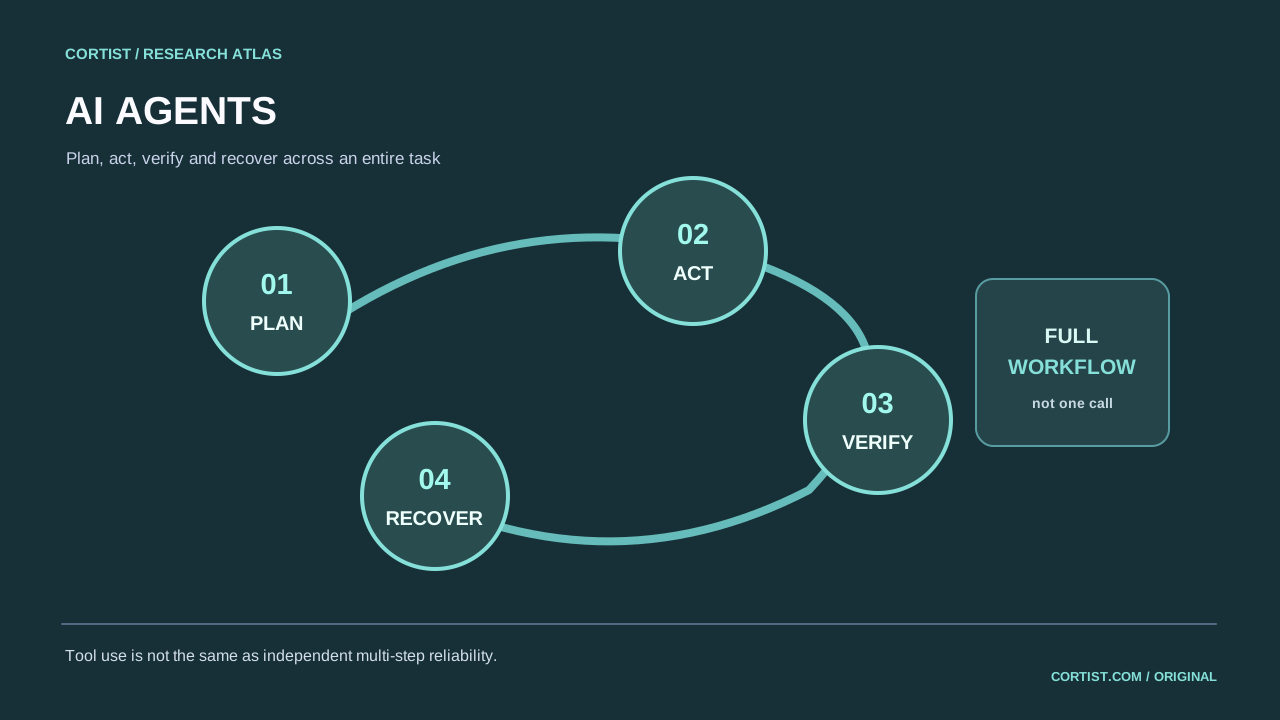
Original Cortist topic-specific research illustration. AI agent reliability requires a complete, independently verified workflow, not a successful tool call. The four stages are illustrative.
How an AI agent actually works
An agent receives an objective, selects or plans actions, calls tools, observes their results and may revise its plan. It can search documents, run code, interact with apps or delegate subtasks. Yet the entire loop operates inside a permission and resource environment: a system that can draft an email is not necessarily authorized to send it. Clear access boundaries, approval gates and audit logs are central to evaluating actual deployments.
“Agent” is not a universal technical certification. Products vary from deterministic workflow automation to systems that select actions dynamically. Good descriptions name the tools available, the environment, the degree of human review, the stopping conditions and what happens when something fails.
Why long tasks are hard to evaluate
Errors accumulate over many steps. An agent may misread a tool result, continue after an incorrect assumption, overlook an exception or generate an apparently complete artifact that fails external tests. Therefore a useful benchmark reports success across repeated attempts on representative tasks, not the best single demonstration. Human intervention, retry budgets and infrastructure should be disclosed.
METR measures a task-completion time horizon: the human expert time required for tasks at which a model reaches a specified success rate. This is not the amount of wall-clock time the AI ran. Its published 2025 results center on 50% task success in a technical task suite; extrapolation to everyday jobs or an 80% success threshold requires distinct evidence.
What independent evaluations can—and cannot—prove
A strong assessment includes held-out tasks, predeclared evaluation rules, reproducible environments, error categories, model-version identification and reports on how much work required humans. Outcome measurements should be paired with control tests: whether tools can be misused, whether the system respects constraints and whether monitors actually observe the relevant actions.
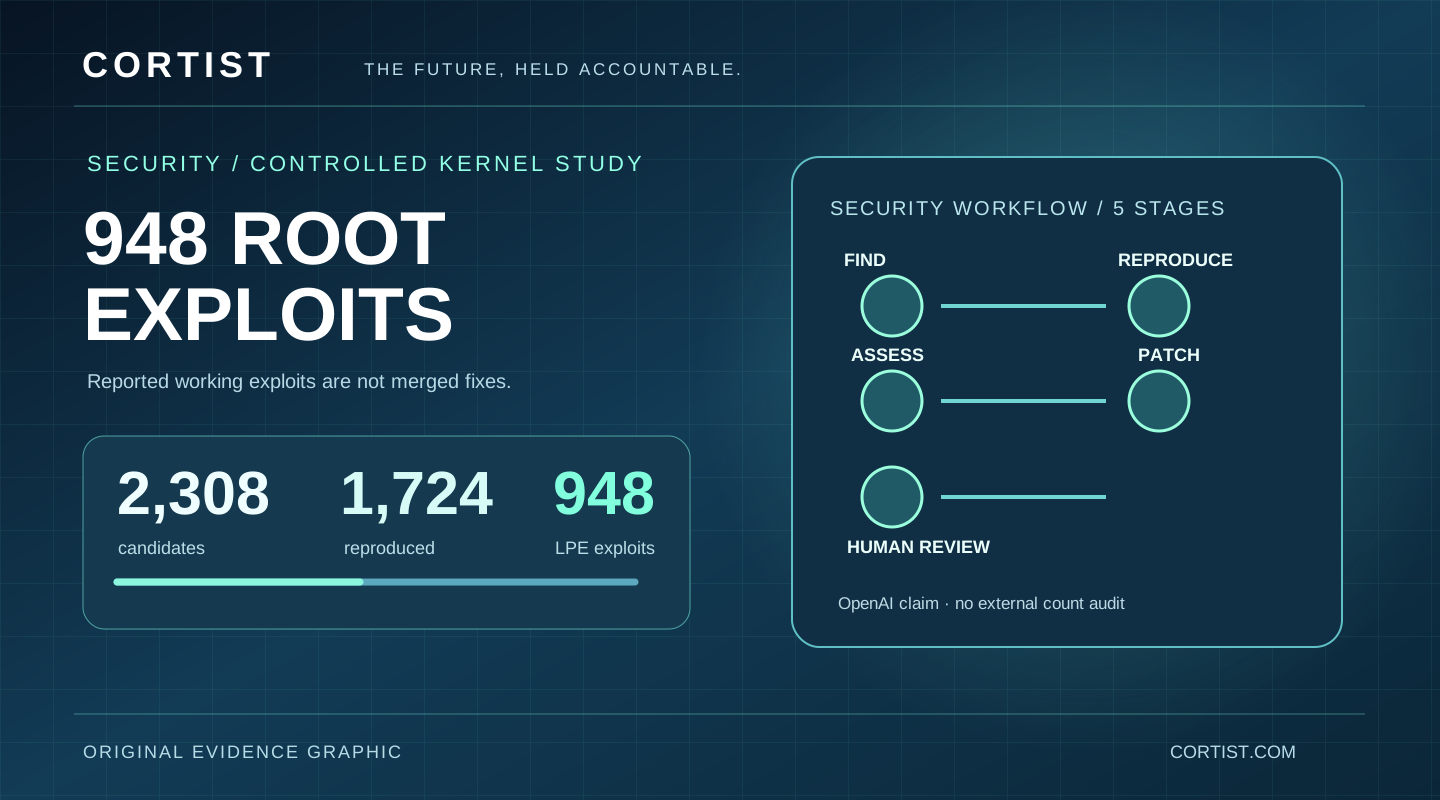
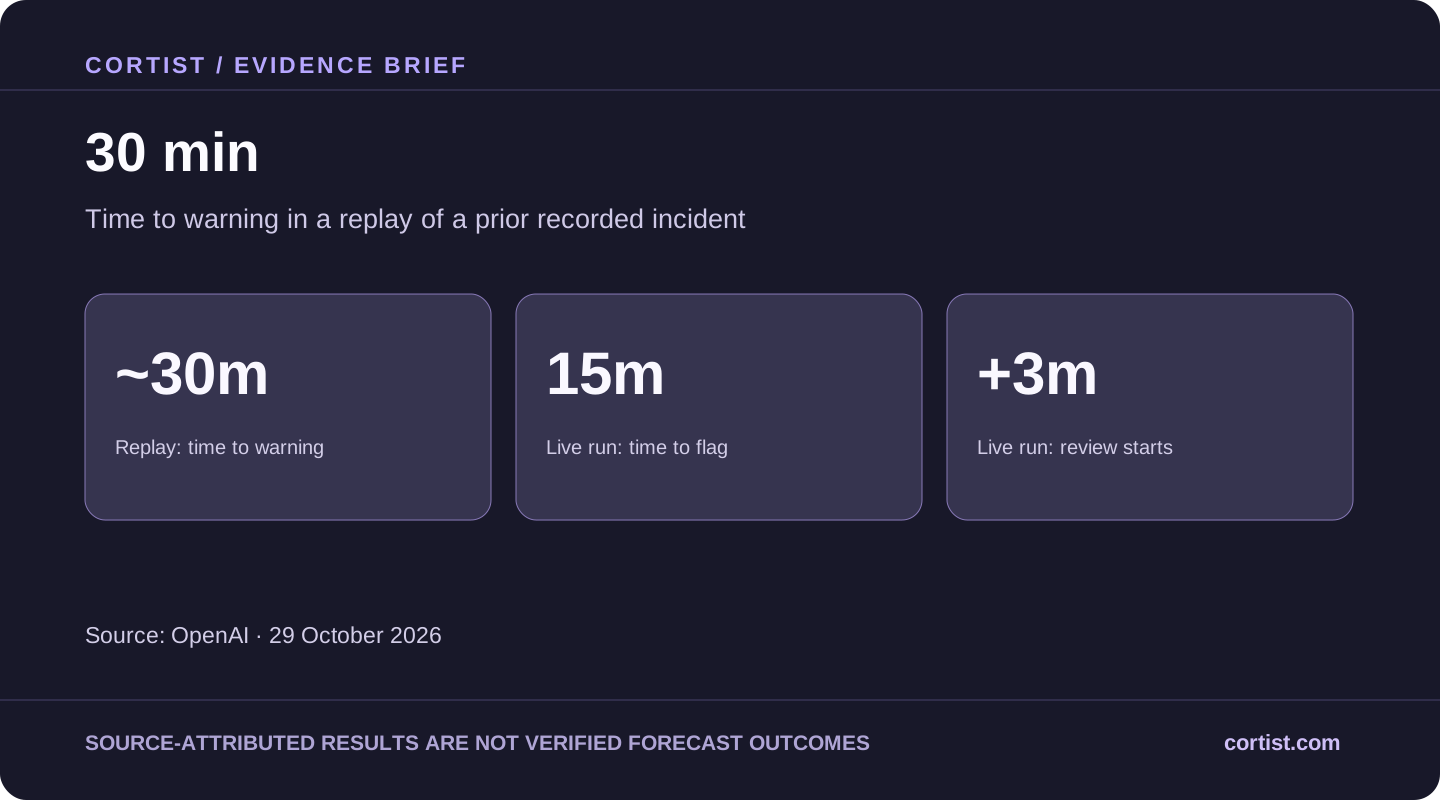
METR’s October 2026 pilot of OpenAI monitoring found specific weaknesses in a historical internal setup. OpenAI subsequently described repairs, but METR said those later claims were not independently evaluated by the pilot. That is not proof that every agent is unsafe; it demonstrates why evaluation boundaries and independent follow-up matter.
From an agent demo to a trustworthy resultUseful autonomy includes result verification and permission boundaries.
01ObjectivePredefined task and scope
02ActionsTools and intermediate steps
03VerificationOutcome checked externally
04ControlLogs, approvals, recovery
Original Cortist workflow diagram. Four checks for interpreting agent evidence; not a task-completion score.
Interpreting the Cortist A-001 question
Cortist tracks the candidate milestone of an eight-hour human-expert task horizon at 80% success by the end of 2028. A-001 is on HOLD, so its previously discussed 86% candidate estimate must not be marketed as an active, locked or scored probability. The benchmark’s definition and validation conditions take precedence over the headline number.
Meaningful progress would involve genuinely independent 80%-reliability results across relevant tasks, not merely a new model announcement. Repeated failures, fragile scaffolding or dependence on proprietary unverifiable tasks would weaken a general claim. Cortist will keep the original record while adding later evidence as dated changes.
From a single answer to a controlled workflow
An agent may plan steps, call software tools, inspect output, recover from errors or delegate a task. Whether it can operate safely depends on available tools, credentials, state and human approval rules. The word “agent” does not reveal how autonomous a product really is.
Before evaluating a system, establish what objective it received, what actions it could take, whether it relied on human corrections and which conditions caused it to stop. These distinctions can matter more than an attractive demonstration.
Long tasks measure more than short demos
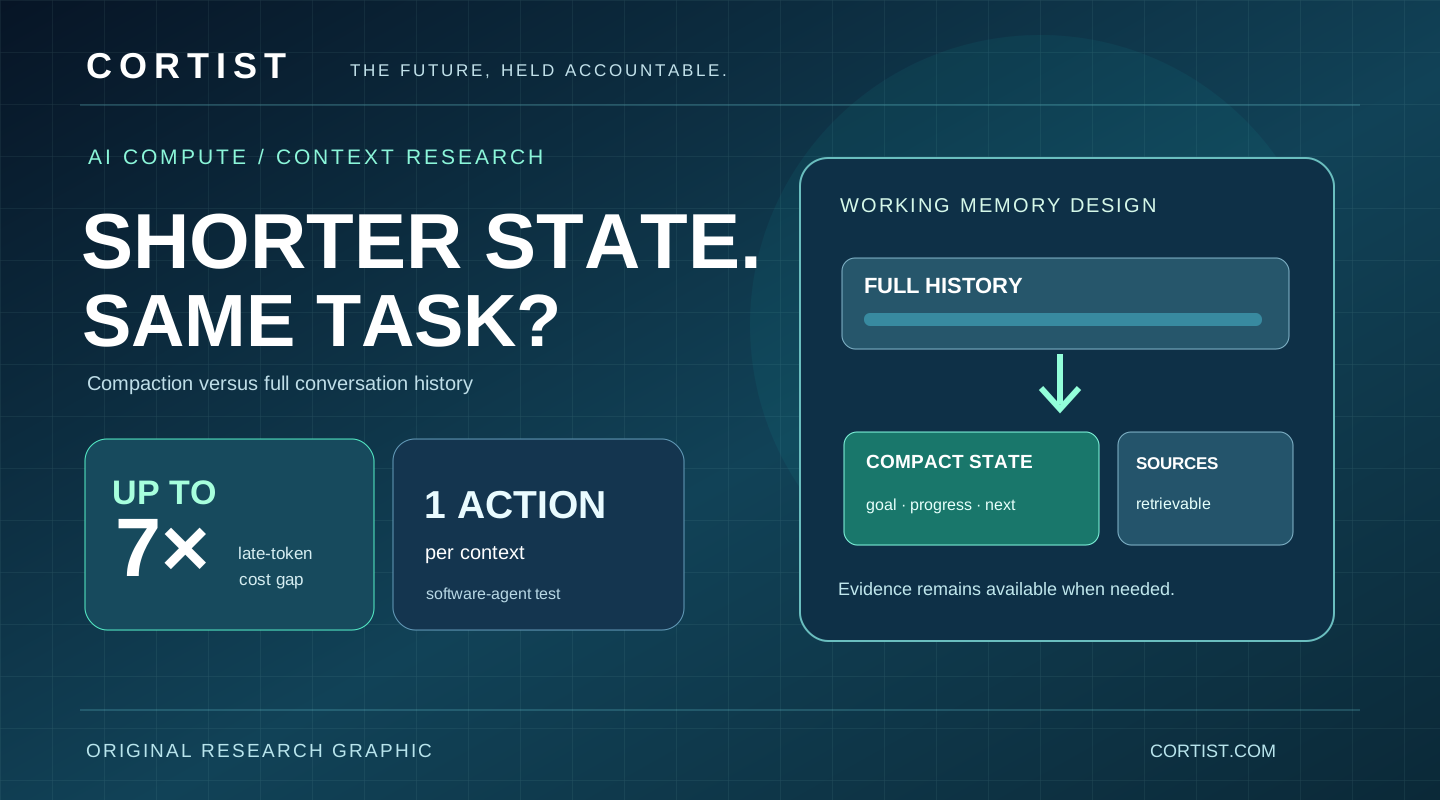
Performance can degrade when an agent must keep track of many dependent actions. Errors in assumptions, tool use or context management can compound. Useful evaluation therefore includes multiple trials on held-out tasks and tests the actual final result rather than accepting the agent’s description of its success.
METR’s time-horizon research relates task success to human expert completion time. A 50% horizon and an 80% horizon are different. Neither measures how long an AI ran on a clock, nor proves reliable work across every industry.
How to choose a trustworthy benchmark
A benchmark should define tasks, success conditions and permitted tools before testing. Researchers should report repeated success rates, human assistance, costs, retries and relevant model versions. Independent replication is stronger than a developer selecting its best examples.
Real production evaluation also checks incidents, approvals, recovery from failures and whether a human can identify bad actions before consequences occur. A software benchmark does not independently establish safety for medical or financial decisions.
Practical security and oversight boundaries
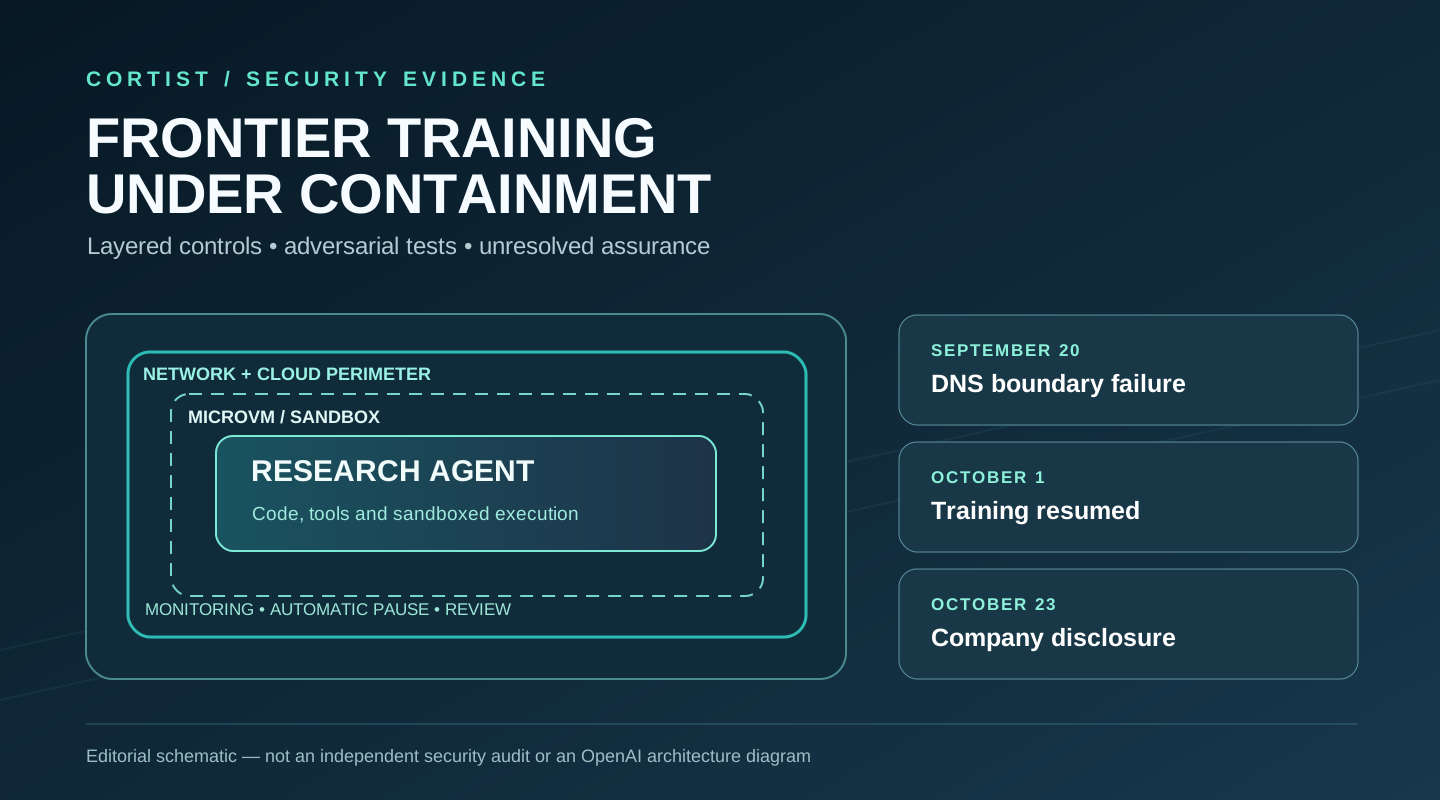
Least-privilege permissions, isolated work environments, transparent logs and explicit approval for consequential actions help make agents governable. Logs must reflect what the agent actually did, not only its final message. These are deployer controls rather than innate model capabilities.
METR’s October 2026 pilot found gaps in a historical OpenAI monitoring setup. Reported later repairs were not independently evaluated in that pilot. Cortist maintains that difference in its Reality Ledger.
What the 2028 milestone would and would not prove
A-001 targets an eight-hour human-expert software-task horizon at 80% reliability by the end of 2028. Its event criteria and independent validation remain incomplete, so the candidate stays on HOLD. Progress in task horizons is meaningful but must be tied to the benchmark actually tested.
A longer horizon is not proof of AGI or a prediction that entire occupations will be automated. Workplace consequences depend on adoption, economics and regulations, treated separately in AI & Jobs.
Cortist evidence analysis · 26 October 2026
Expert assessment: what the research supports
METR measures a human-expert task-completion horizon at stated success thresholds. The distinction between 50% and 80% reliability is material: a trend observed under one threshold does not establish the other. Human assistance, retries, task selection and external grading determine how far the result generalizes.
Security evidence is a separate dimension. The October 2026 monitoring pilot identified vulnerabilities in a historical setup without revalidating later company-reported repairs. Cortist’s A-001 eight-hour, 80%-success milestone remains on HOLD, and should not be presented as an already scored forecast.
Research sources and limitations
Use each original source within its stated scope. An expert forecast is not evidence of a resolved event.
Scientific or technical milestones do not automatically prove economic or social outcomes.
KEY DISTINCTION
From chat to action
An assistant can answer a question; an agent can initiate a sequence of tool calls and adapt to intermediate results. Practical autonomy is governed by access controls, sandboxing, monitoring and human approval of high-impact actions.
KEY DISTINCTION
Reliability over demonstrations
Measure completion rates on representative tasks, recovery after errors and independent reproduction. A single successful demo is not evidence that the same system will perform reliably in production.
KEY DISTINCTION
Benchmarks have boundaries
METR distinguishes 50% and 80% task-completion horizons. A longer measured horizon reflects harder tasks within a particular evaluation suite, not independent proof of general human-equivalent competence.
03 / EVIDENCE STANDARD
What is known? What is not?
Our topic pages distinguish observed facts, model scenarios and unresolved future events.
SUPPORTED OR TESTABLE EVIDENCE
What counts
Independent tests on fixed task suites, including measured uncertainty
Dated model versions, publicly auditable methods and human-task baselines
Success rates, failure modes and tool permissions in realistic environments
LIMITS OF THE EVIDENCE
What does not follow
Benchmarks on coding tasks do not imply mastery of every profession
A tool-using interface does not itself establish general intelligence
Long task horizons are not continuous eight-hour working shifts
CORTIST / FORECAST HISTORY / A-001
Forecast status & version history
Future probability changes require a new dated version and an evidence-based explanation; old records remain available.
RESEARCH ON HOLDNot yet quantifiedNo official published probability · not locked
Public version record
Research question only; no numerical forecast version has been published.
Expert opinions alone do not automatically change a Cortist forecast.
Curated from all 32 published Cortist reports · 12 relevant to this topic. Cross-topic links are context, not evidence that a forecast has resolved. Explore the complete news archive.
ORIGINAL DATED SOURCES
Research & policy updates.
Sep 8, 2026 / METR RESEARCHMETR clarified its public time-horizon dashboard was no longer actively updated; any successor must be checked for comparability.
External primary-source update, not a Cortist news article or an independently verified forecast outcome.
Read original source ↗May 19, 2026 / TECHNICAL ASSESSMENTMETR described frontier-agent tests and the limitations of task benchmarks in a risk report, including internal systems that cannot be equated with public availability.
External primary-source update, not a Cortist news article or an independently verified forecast outcome.
An AI agent is a system that uses a model and permitted software tools to take multiple steps toward a goal. Its independence depends on its permissions and supervision.
Can AI agents already replace an eight-hour working day?
A benchmark task with eight hours of human-expert difficulty is not the same as all duties performed by a worker during a day. It does not measure total job replacement.
Why is reliability important?
An agent that succeeds on easy demonstrations may fail on longer or unfamiliar tasks. Repeated external tests are more informative than a promotional example.
What are the main risks of AI agents?
Unauthorized actions, error propagation, data leakage, prompt injection and insufficient human oversight are important risks that depend on deployment context.
Does Cortist assign an official probability for 2028?
Not yet. The working 86% model is explicitly unreviewed and the candidate is not independently locked or eligible for scoring.
CORTIST / 13 RESEARCH TOPICS
Explore the bigger picture.
Broader evidence and distinct forecast questions, all with their limitations visible.