
- Google's 13 October 2026 developer post says Gemini 4 Argon built a physics-calibrated MuJoCo simulation from a real tabletop image and produced more than 4,500 domain-randomized training episodes.
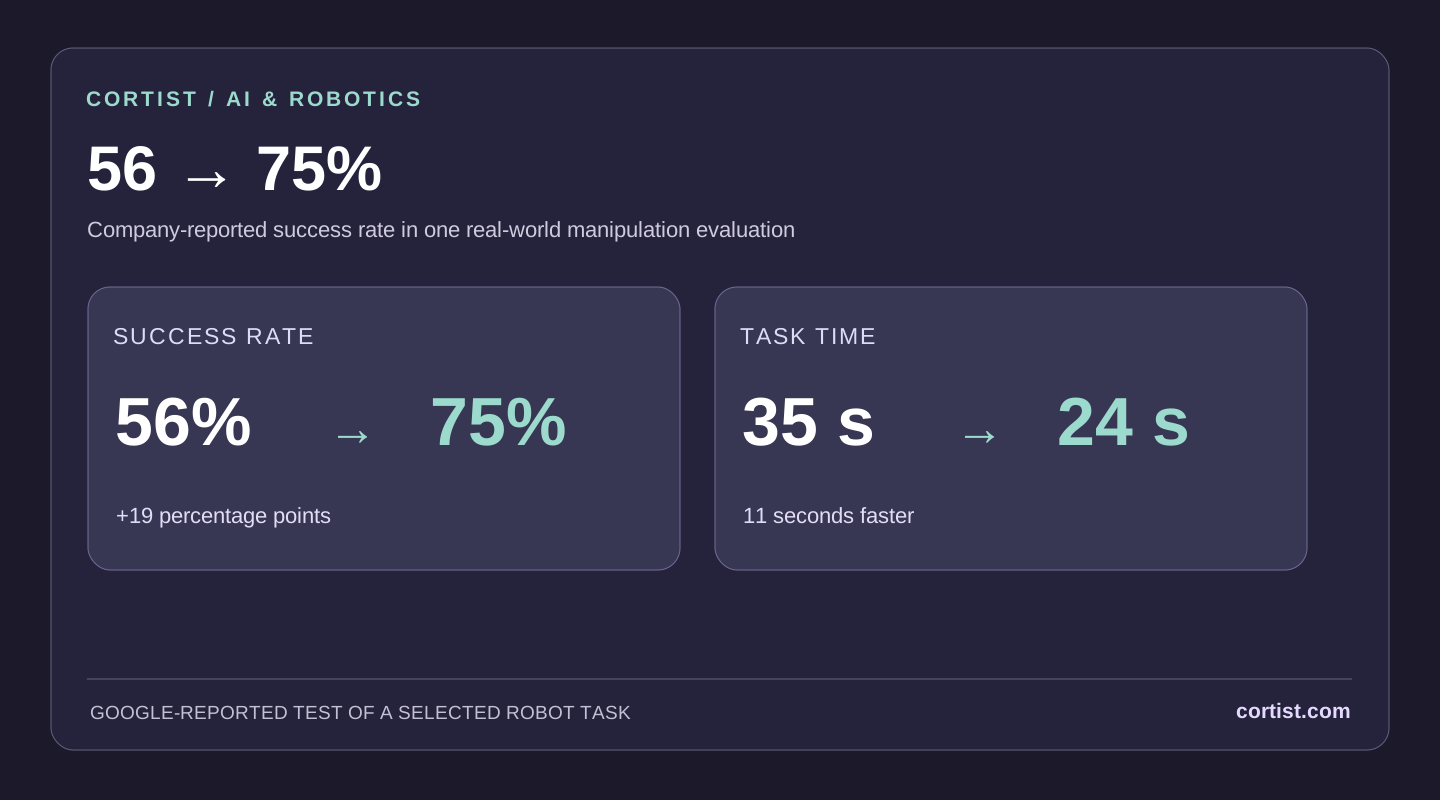
- In the reported real-world evaluation, the robot manipulation task's success rate improved from 56% to 75%; execution time fell from 35 to 24 seconds.
- The cited example uses a bounded tabletop task curriculum with robot arms and simulation fine-tuning. It is not an independently published general humanoid-shift reliability measurement.
The Signal
Google's Gemini 4 Argon announcement contains a robotics claim more informative than a polished demonstration video: a before-and-after evaluation that specifies both success and task duration. In Google's example, the model reconstructed a calibrated MuJoCo simulation of a photographed workspace, generated a curriculum of robot tasks and collected more than 4,500 synthetic episodes for subsequent fine-tuning.
The company reports a real-world evaluation improvement from 56% success to 75%, alongside a reduction in average completion time from 35 to 24 seconds. The demonstration describes a tabletop setting with two seven-degree-of-freedom Franka FR3 arms and manipulable props. Those details matter because they define what improved—and what was never tested.
The Shift
Simulation-to-reality transfer is a central bottleneck for robotics. A visual or language model may generate a plan that looks plausible in software but fails when a physical object slips, collides or moves unexpectedly. Generating useful variations in simulation can reduce the amount of expensive real-robot data needed, if the simulated physics, camera geometry and action controls are sufficiently representative.
But a narrow gain on selected physical manipulation tasks is not a general statement about any robot following any instruction. Google describes the work in a developer announcement; Cortist has not seen an independent replication with open trial-level logs, held-out scenarios and matched comparison conditions. The source does not establish continuous workplace autonomy or general industrial safety.
The Cortist Lens
The 19-percentage-point difference is valuable contextual evidence if reproduced under a fixed evaluation protocol. It should not be interpreted as the fraction of all robot jobs that can now be automated. The denominator is the reported set of physical evaluation tasks, not a representative sample of factory operations.
For Cortist F-003, the decisive standards are extended mixed-task performance, intervention records, recovery behavior and independent inspection over multiple full shifts. A fast tabletop demonstration can improve the engineering toolkit without resolving any of those requirements. We therefore retain the forecast's original probability and unresolved status.
Independent replication on new physical workspaces, predeclared evaluation trials, performance under unfamiliar objects, and longer-horizon tasks with audited interventions.
An encouraging company-reported sim-to-real improvement in a defined task—not independently established general-purpose robot autonomy.
Does a robot complete repeated, independently verified eight-hour industrial shifts without hidden teleoperation? These reports do not meet that specific target. Read the unchanged provisional forecast and evidence rules →
Primary sources and evidence limitations
These figures come from the researchers or companies cited below. Cortist has not independently reproduced the trials or audited operational logs. The reported findings do not resolve F-003 or change its provisional probability. See our editorial and correction rules.
Google Developers: Gemini 4 Argon for RoboticsKanishka Rao; official product research post, 13 October 2026