
OECD 2026, Digital technology diffusion
Adoption and productivity premia are partly explained by human and technology capital.
Read original evidence ↗AI may change economic growth through productivity, investment, task costs and labor demand. Company revenues and compute contracts do not by themselves show a sustained national productivity gain. Cortist's F-007 is a provisional 35% editorial scenario for a defined US productivity milestone by 2035.
Subjective editorial scenario, not a measured or independently calibrated prediction.
Illustrative cumulative probability. Not automatically inferred from sources. Draft event criteria ↗
AI could increase output per hour or reshape costs and investment. Establishing economy-wide impact requires observed productivity data and credible attribution.
Review the 2035 productivity test →No. Contracts show obligations or investment intentions; economic returns depend on delivery, utilization and measured output.
Read the SEC evidence review →Guide clarified 3 November 2026 · Source findings and forecast assumptions below retain their original recorded dates · Editorial standards
A later evidence-based probability update must be published as a new date-stamped version. The initial record remains unchanged.
The initial subjective scenario is now documented. No newer public version or independently scored result exists.
Resolution criteria require independent review before a prospective forecast lock.Macroeconomic productivity, attribution, employment transformation and AI investment. At least two independent macroeconomic studies attribute an additional one percentage point or more of annual US labor-productivity growth to AI over the same three-year observation period ending by 2035. Cortist provisionally assigns 35% by 2035. The value is a subjective public draft and should not be mistaken for an independently scored statistical prediction.
Evidence Pulse 2.0 checks the published Cortist News index when JavaScript is available. The source-linked, dated research articles remain accessible through Cortist News.
Latest topic-linked reporting, compared with the separately versioned Cortist assessment. News does not automatically update a forecast.
Evidence interpretation: Task redesign, skills and inference-cost reporting illuminate plausible economic pathways.
What remains unproven: These reports do not establish a causal one-percentage-point US labor-productivity uplift.
What to verify next: Comparable observed labor-productivity windows with transparent AI counterfactuals.
Snapshot of 3 linked reports. Context is not independent proof or a measured probability change. Dated evidence index · Original forecast v0.1.
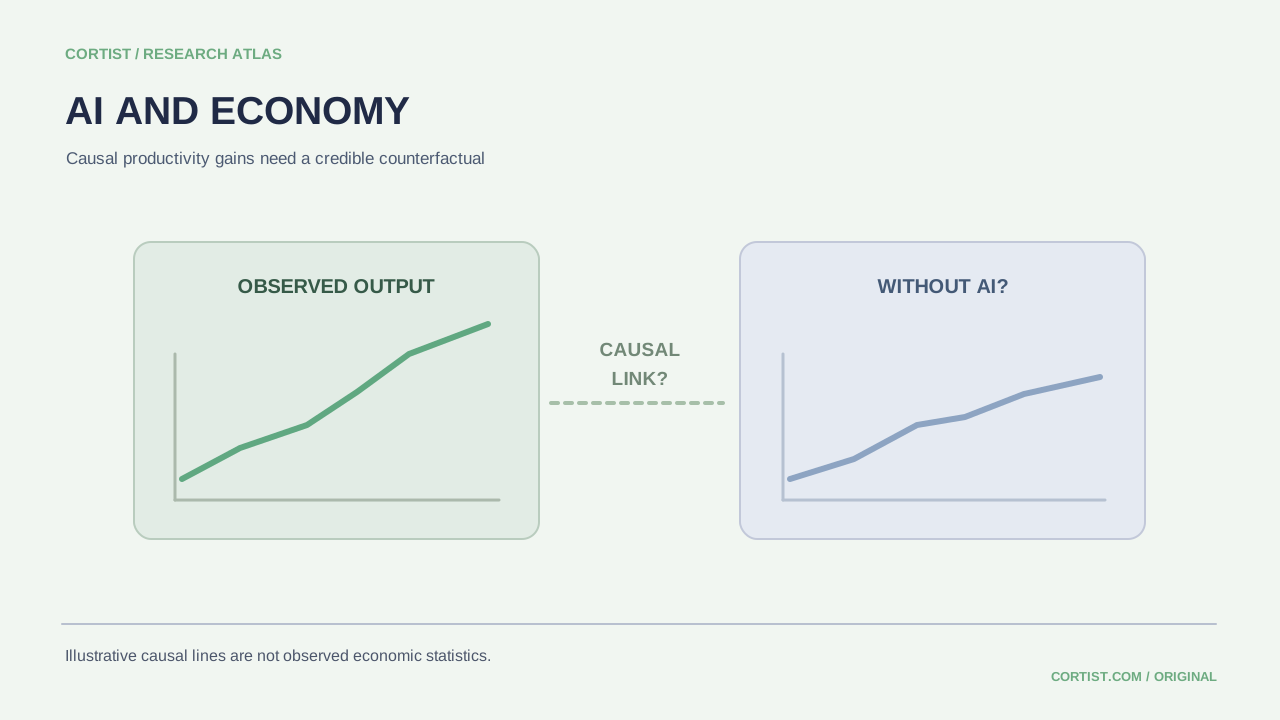
Companies can invest heavily in AI, deploy new tools and report employee time savings without generating a proportional macroeconomic productivity gain. An increase in usage is not the same outcome as higher output per hour of work. Cortist tracks the difference between adoption, investment, firm-level experiments and national productivity statistics.
An OECD 2026 study covering 15 countries finds that larger firms tend to adopt advanced technologies more widely and that skill and digital infrastructure differences help explain productivity premia. This cautions against treating the observed success of adopters as the causal impact of AI alone. Sector and firm comparisons must control for selection.
The IMF discussed AI-related technology investment as a contributor to recent US growth but described productivity gains as still unfolding and partly uncertain. OECD indicators show US labor-productivity acceleration but warn about causal interpretation. Neither report alone establishes a one-percentage-point AI-caused gain across a shared three-year window.
Productivity is affected by business cycles, ordinary capital deepening, wages, regulation, demographic change, training and measurement practices. A single estimated AI contribution could rest on unverified assumptions. The proposed F-007 test therefore calls for independent analyses using a documented no-AI counterfactual and comparable observed years.
If labor productivity would have grown 1.5% per year without AI, an additional one percentage point would mean an AI-attributed growth rate around 2.5% annually. That example is explanatory, not a prediction of the actual series. The outcome refers to additional annual growth rather than a one-off level gain or a company revenue multiple.
Distinguish company anecdotes from economy-wide outcomes.
Successful organizational integration, worker training, complementary software, reliable automation and competition could turn potential time savings into output gains. Bottlenecks include poor work redesign, integration costs, trust problems, energy constraints and uneven diffusion. The Jobs forecast concerns hiring; it cannot substitute for measured macro productivity.
The draft F-007 estimate assigns 35% by 2035 to this stringent, causally attributable outcome. This is a subjective judgment; the interpolated year-slider values are assumptions, not official economic forecasts. If the data begin to support a stronger conclusion, we will publish a new version alongside the older estimate.
Independent reviewers still need to agree on acceptable counterfactual identification, confidence levels and whether the studies truly share an observed three-year period. It may prove impossible to settle definitively without new measurement practices. If it cannot be scored fairly, the model must keep a HOLD or unresolved status rather than pretend certainty.
Cortist monitors original datasets, official measurements and independent evaluations rather than treating manufacturer, researcher or policymaker claims as settled outcomes. Any material reassessment must disclose the previous value, the new evidence, counterarguments and the reason for changing the subjective assessment. The older snapshot will remain at its original versioned URL.
Before this question becomes eligible for formal scorekeeping, independent reviewers must agree on the boundary of the event, adjudication rules, data sources and any necessary fallback measurement. If an essential definition changes, a fresh forecast question will be published instead of rewriting an old one.
Adoption and productivity premia are partly explained by human and technology capital.
Read original evidence ↗Labor productivity context; observed growth cannot be attributed to AI without controls.
Read original evidence ↗AI investment contributes to growth but productivity attribution remains difficult.
Read original evidence ↗Source summaries distinguish historical measurements, institutional research and forward-looking claims. None independently validates the 35% draft probability.
General intelligence is not established by progress on any single specialized metric.
Explore AGI ↗CONNECTED RESEARCHCompute and AI deployment depend on physical infrastructure and electricity.
Explore energy ↗CONNECTED RESEARCHLabor-market outcomes must be measured independently from technical capability.
Explore jobs ↗Three existing Cortist articles with related research, economics or governance context. Original articles and their primary classifications remain unchanged.

Lambda plans a $33.1B Alabama AI campus, with power approval pending and tax, jobs and water claims still forecasts. We separate announced commitments from delivered outcomes.
Read the evidence review ↗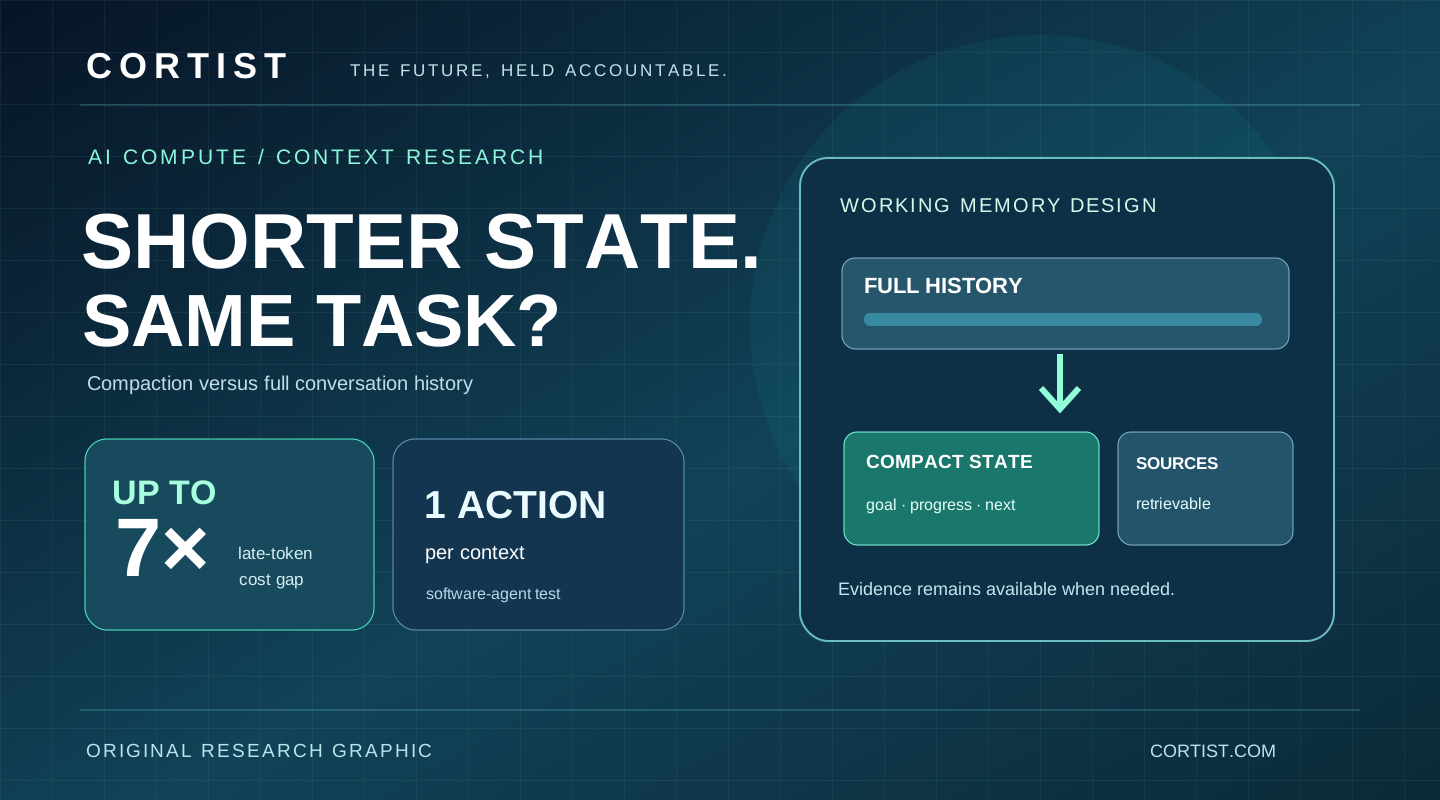
New research questions the economics of keeping all tokens in an active agent context; actual end-to-end cost savings remain unverified.
Read the evidence review ↗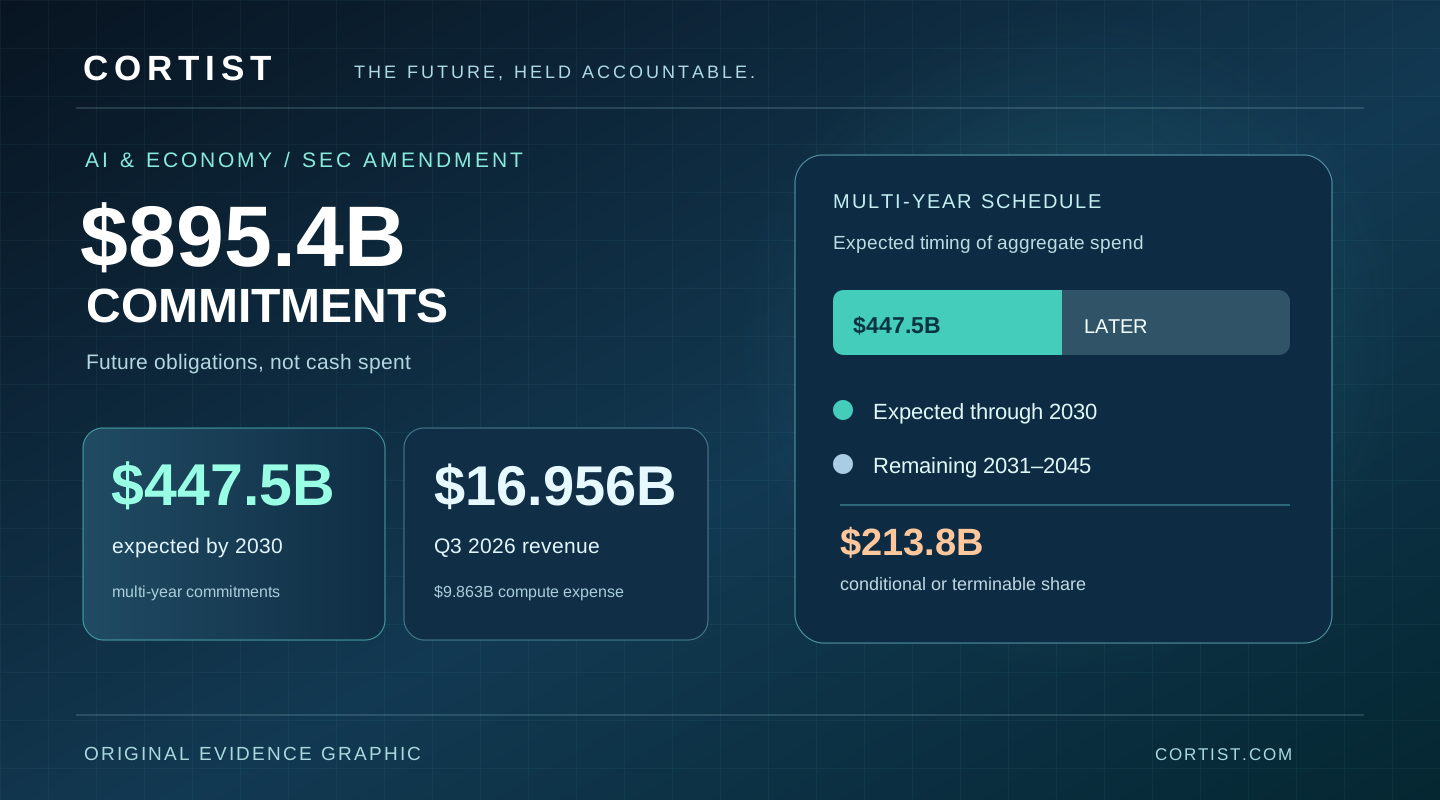
Anthropic’s November 2 S-1 amendment adds Q3 figures and $895.4B in compute-heavy commitments. Cortist separates obligations, costs and profit.
Read the source-attributed analysis ↗
OpenAI’s Grid Protectors program cites a 1,000 MW Georgia demand-response agreement. The capacity is contracted, not a measured delivery result.
Read the source-attributed analysis ↗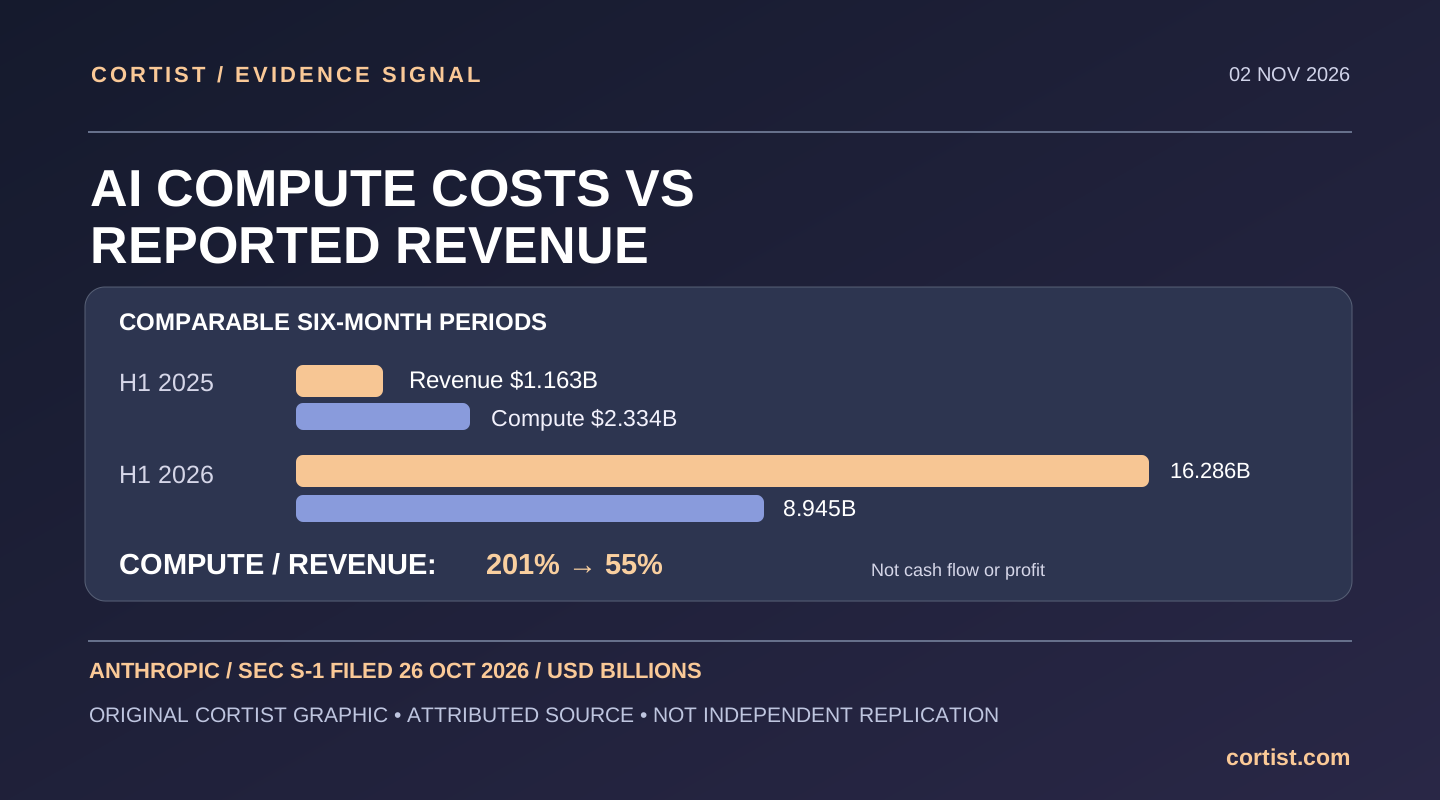
Anthropic's SEC S-1 reports $16.286B revenue and $8.945B compute expense over six months. Cortist separates growth from accounting losses.
Read the source-attributed analysis ↗Related editorial context; this story does not independently verify the F-007 milestone.
Read source-checked report ↗Related editorial context; this story does not independently verify the F-007 milestone.
Read source-checked report ↗Related editorial context; this story does not independently verify the F-007 milestone.
Read source-checked report ↗No. Firms may adopt AI without converting the investment into broad measurable economic output per hour.
At least one additional percentage point of annual US labor-productivity growth attributable to AI, not a company-level adoption rate.
Causal economic estimates rely on models; independent agreement and transparent counterfactuals reduce false certainty.
No. It is Cortist's provisional editorial judgment for its own strict proposed event.
No. Jobs examines labor markets and hiring, while Economy tracks aggregate productivity attributable to AI.
See the publicly documented Cortist forecast history and separate the latest estimate from every earlier one.