
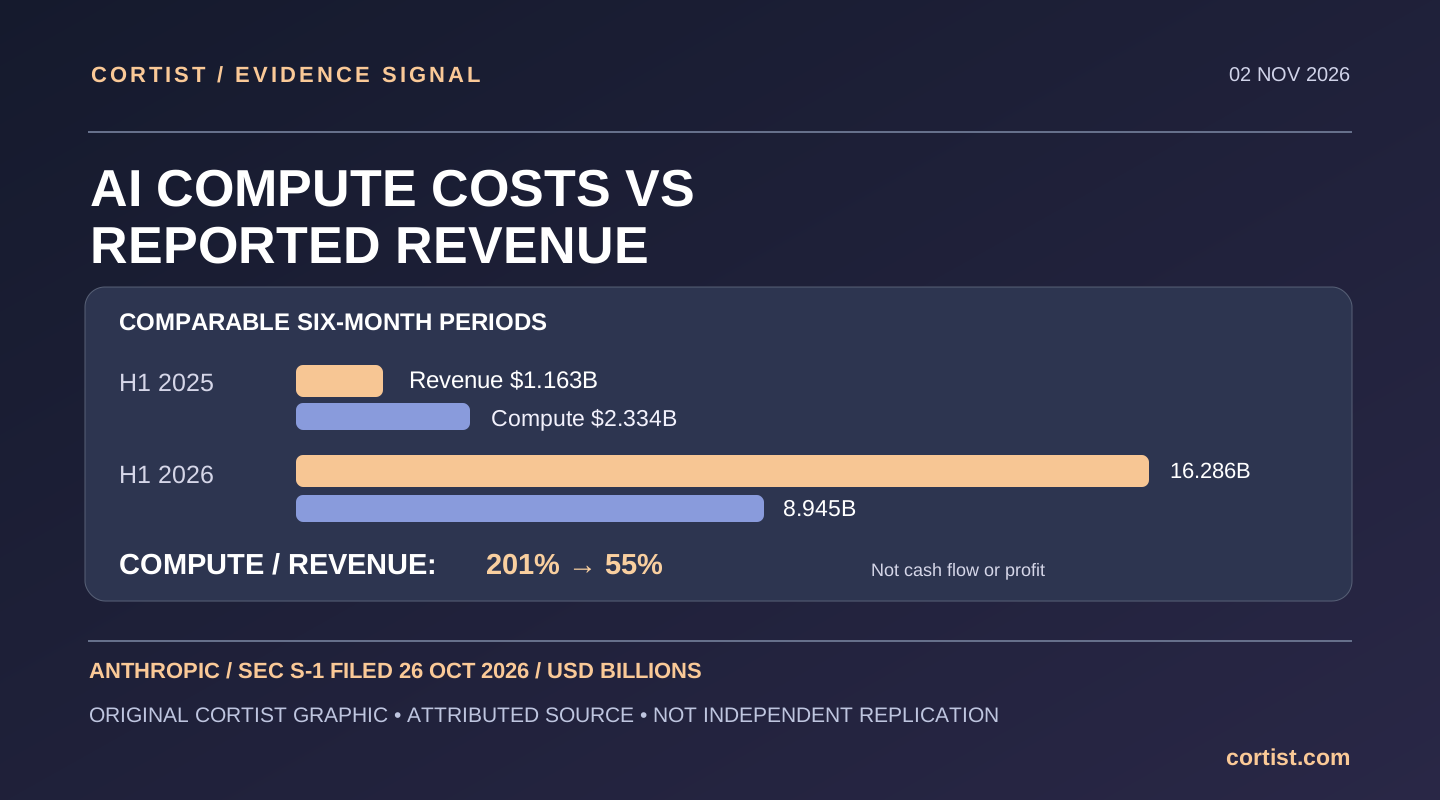
- Anthropic's 26 October 2026 preliminary SEC S-1 reports $16.286 billion revenue in the six months through June 30, 2026 versus $1.163 billion in the corresponding 2025 period.
- It reports $8.945 billion compute-and-infrastructure expense, equivalent to 55% of revenue, down from 201% of revenue a year earlier. Dollar compute spending still increased 283%.
- The S-1 also discloses approximately $417 billion of aggregate future minimum payments from new or amended infrastructure commitments after December 2025; this is a multi-year contractual amount, not current annual spending. The filing includes a large non-cash fair-value adjustment in the reported net loss.
The Signal
An unusually transparent window into frontier-model economics opened with Anthropic's public S-1 registration statement, filed with the U.S. Securities and Exchange Commission on 26 October 2026. Although the filing is preliminary and its eventual offering terms may change, it reports actual historical operating numbers that let readers test claims about the cost of scaling frontier AI against a consistent accounting period.
For the first six months of 2026, Anthropic reports revenue of $16.286 billion, up from $1.163 billion in the first half of 2025. The year-on-year increase is 1,300%. Compute-and-infrastructure expense rose from $2.334 billion to $8.945 billion. The company's compute-expense-to-revenue ratio therefore fell from 201% to 55%, even while absolute compute spending rose 283%. That difference between margin improvement and rising absolute demand is central to understanding AI infrastructure economics.
The registration statement also lists aggregate future minimum payment obligations of approximately $417 billion related to new and amended compute and infrastructure commitments since December 2025. The stated obligations span commitments with terms ranging from under a year to 20 years and beginning between 2026 and 2027. They should not be presented as a single year's electricity bill, capital expenditure or cash expense.
The Shift
AI model economics have two simultaneous dynamics. Usage growth can improve the revenue generated per dollar of committed compute, while capacity planning still requires very large, often front-loaded infrastructure contracts. The filing states that much of Anthropic's compute base had been committed in advance, which helps explain why revenue can grow faster than in-period compute expense.
The SEC filing reports a first-half 2026 net loss of approximately $80.7 billion. That figure cannot responsibly be used as a proxy for the cash burned by training models. The statement identifies about $72.4 billion of changes in fair values of convertible notes, derivative liabilities and SAFEs, driven largely by higher enterprise valuation, as a major component. Operating performance, cash flow, stock-based compensation and valuation-driven financing remeasurement require separate interpretation.
Some future commitments are subject to final contractual terms. The filing refers to a further estimated $125 billion to $150 billion under expanded commercial agreements for capacity to be delivered between 2028 and 2031, with terms not finalized at the filing date. Readers must not automatically add every quoted amount and treat the result as a binding, undiscounted, non-overlapping total liability. Different commitment disclosures can involve distinct conditions, timeframes and accounting treatment.
The Cortist Lens
Cortist follows the economic and compute constraints that shape real AI progress. This S-1 adds a source-of-record view of revenue scale, rising compute costs and contracted infrastructure risk. It does not measure national productivity gains, does not establish the outcome of F-007 on AI-driven growth, and does not prove performance-per-dollar gains under F-005. Corporate revenue and macroeconomic productivity are different metrics.
The right next evidence checkpoints are revised SEC filings, independently audited accounting statements, actual delivery of compute facilities, cash-flow disclosures and evidence of broad productivity gains outside one model provider. The filing's primary value for Cortist is a transparent baseline, not a reason to move forecast probabilities.
Amended S-1 statements, finalized offering terms, revenue recognition and cash-flow reconciliation, committed capacity delivered versus obligations, and independent sector-level productivity metrics.
The frontier AI business can improve compute-cost ratios while its absolute capacity obligations grow. Anthropic's primary filing shows both—and why headline net losses need careful accounting context.
Primary sources and evidence limits
Original SEC registration statement filed 26 October 2026; preliminary filing and first-half figures, not a 2 November earnings release. Cortist reviewed original research or SEC documentation; we have not independently rerun the experiments or audited the financial statements. This article does not score or change any provisional forecast. Read the editorial standards.
Anthropic PBC preliminary Form S-1SEC filed registration statement, 26 October 2026; sections on operating results, compute and infrastructure and contractual obligationsSEC filing index and accession dateEDGAR accession 0001628280-26-067168, accepted 26 October 2026