
Drug discovery and clinical trials
Generative systems and predictive models can propose and prioritize candidate molecules. Laboratory and trial outcomes remain indispensable, and Phase III entry does not predict approval by itself.
AI in medicine can support imaging, clinical documentation, decision support and drug research. A high model benchmark score is not proof that patients receive safer or more effective care. Cortist separates retrospective tests, clinical workflows and independently confirmed patient outcomes.
Test accuracy alone is insufficient. Patient benefit needs measured changes in real care, with safety, follow-up and appropriate clinical oversight.
Explore a clinical workflow study →No. A proposed molecule still requires preclinical testing, clinical trials and regulatory assessment before proven treatment claims.
Explore medical forecast milestones →Guide clarified 3 November 2026 · Source findings and forecast assumptions below retain their original recorded dates · Editorial standards
AI is used in medical imaging, decision support, drug discovery and research. A high retrospective benchmark score is not proof of improved clinical outcomes. External replication, prospective evaluation, appropriate oversight and regulation are essential. Cortist’s M-001 drug-approval question remains on HOLD, with its historical 46% candidate estimate unscored.
Evidence Pulse 2.0 checks the published Cortist News index when JavaScript is available. The source-linked, dated research articles remain accessible through Cortist News.
Latest topic-linked reporting, compared with the separately versioned Cortist assessment. News does not automatically update a forecast.
Evidence interpretation: Early clinical and diagnostic research adds concrete performance and trial milestones.
What remains unproven: Promising results are not independent proof of better patient outcomes or regulatory approval.
What to verify next: Prospective clinical trials, independent validation and patient outcomes.
Snapshot of 4 linked reports. Context is not independent proof or a measured probability change. Dated evidence index.
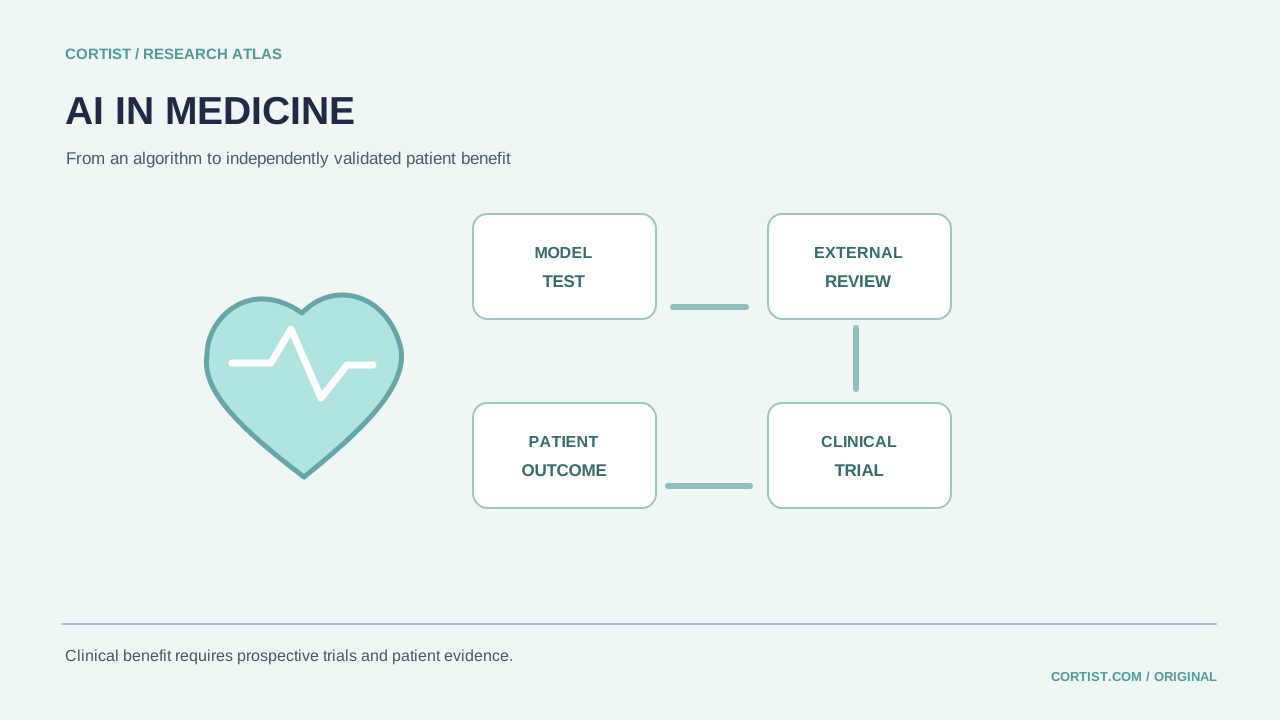
Retrospective diagnostic benchmarks test whether a model can solve cases assembled from historical information. These tests can be rigorous, but they are not equivalent to treatment decisions in a busy hospital, where data arrive unpredictably, patients differ from training samples and clinicians must communicate uncertainty. Scores also depend on which tools and references each comparator may use.
Microsoft’s October 2026 MAI-DxO report describes strong results on complex retrospective cases, including a set of 304 clinical cases. Cortist’s CL-0002 highlights the limitations of its 56-physician comparison subset and the difference between benchmark accuracy, estimated test cost and prospective patient outcomes. These numbers should not be represented as a completed clinical trial showing superior patient care.
A useful progression begins with technical performance on representative data, external replication across institutions, prospective testing within a workflow, evaluation of actual clinical endpoints and post-deployment surveillance. Each step addresses a different source of uncertainty. A model may be accurate on average but make dangerous mistakes for a subgroup or be difficult for clinicians to supervise.
Prospective trials should define patient populations, comparators, safety thresholds and meaningful outcomes in advance. Human oversight and clear accountability remain essential. Microsoft’s announcement described prospective work as a next step, which is distinct from reporting the results of that work.
Regulators distinguish devices, intended use, risks and evidence requirements. The FDA maintains a public list of AI-enabled medical devices authorized for marketing in the United States; listing is specific to each device and its regulatory route, not a general claim that every AI medical application improves health. Drug discovery systems involve different evidentiary steps from diagnostic software.
A molecule proposed with AI support still needs testing for safety and efficacy. Successful early discovery is not proof of an approved medicine or a better treatment. Claims about clinical deployment should specify geography, product version, patient group and the meaning of the regulatory decision.
M-001 concerns a verifiably AI-designed novel drug receiving FDA approval by the end of 2032. The forecast candidate is on HOLD. Its historical 46% candidate figure must not be presented as a locked or independently scored probability. In particular, defining “AI-designed” and establishing the contribution of AI to discovery are prerequisites to a fair resolution.
Material evidence would include documented discovery provenance, publicly checkable regulatory decisions and independent clinical results. Cortist keeps benchmark claims, company announcements, clinical evidence and the forecast question in separate records so a promising study cannot silently become proof of a patient benefit.
An AI imaging system, medical note assistant and drug-discovery model solve very different problems. A useful report identifies the intended use, patient group, comparator and decision-maker. A model that predicts chemical properties has not thereby demonstrated a safe or effective medicine, while accuracy on curated cases is not proof of successful deployment in a hospital.
Research tools can be valuable without reaching clinical use. Transparent reports distinguish laboratory findings, external validation, prospective clinical studies and regulatory decisions.
Retrospective studies can show whether a system handles selected examples, but cases may not reflect everyday clinical practice. Independent external validation checks performance in other hospitals or populations. Prospective trials test how a system behaves in real workflows and whether it changes outcomes and harms.
Cortist’s CL-0002 Ledger entry covers Microsoft’s 2026 MAI-DxO claims. The 304 historical cases and the 56-case physician comparison subset must not be treated as an independently completed clinical trial establishing better patient care.
The FDA regulates AI-enabled medical devices according to intended use and applicable routes, including clearance, De Novo authorization and premarket approval. Inclusion in a list of authorized devices is not approval for every possible function.
AI-assisted drug development is a different regulatory question. The FDA’s January 2025 draft guidance proposes a risk-based approach to credibility for a particular context of use, but it is not a final binding rule or evidence that an AI-generated medicine has been approved.
Models can perform differently across patient groups, devices, languages and hospitals. Undetected errors and unjustified confidence matter especially when clinical decisions carry risk. Evaluations should report subgroup performance, adverse outcomes and what happens when clinicians disagree with the model.
The WHO’s health AI governance guidance emphasizes transparency, appropriate human oversight and equity. A clinical tool should be judged on net benefit and safety, not polished answers alone.
M-001 asks whether a verifiably AI-designed new drug receives FDA approval by the end of 2032. Important unresolved questions include the meaning of “AI-designed,” documentation of the AI contribution and the exact FDA decision that qualifies. Its 46% figure is historical and on HOLD.
Relevant new evidence would include identifiable regulatory decisions, clinical trial results and independently checkable discovery provenance. A corporate announcement of Phase III entry is a milestone, not drug approval. The forecast index separates candidates from locked, independently scored forecasts.
The FDA’s AI-enabled device information differentiates authorized products and their intended uses. Marketing authorization for one device and clinical setting should not be generalized to all medical AI tools, and a retrospective benchmark should not be described as a prospective demonstration of patient benefit.
Diagnostic-assistant results and AI-assisted drug discovery answer different questions. M-001 concerns a verifiably AI-designed novel drug receiving FDA approval by the end of 2032; the historical 46% candidate remains on HOLD. Its evidence requirements include identifiable regulatory decisions and trustworthy development provenance.
Research results, company claims and provisional Cortist forecasts remain distinct.
Scientific or technical milestones do not automatically prove economic or social outcomes.
Generative systems and predictive models can propose and prioritize candidate molecules. Laboratory and trial outcomes remain indispensable, and Phase III entry does not predict approval by itself.
AI can help interpret images and clinical records but must be evaluated for the intended population, setting, safety and human oversight. A model benchmark alone cannot establish patient benefit.
FDA drug approval is distinct from acceptance of an AI development tool. For the Cortist forecast, official authorization and separately verifiable documentation of substantive AI design are both needed.
Our topic pages distinguish observed facts, model scenarios and unresolved future events.
Future probability changes require a new dated version and an evidence-based explanation; old records remain available.
Research question only; no numerical forecast version has been published.
Expert opinions alone do not automatically change a Cortist forecast.Separate the broader topic from a specific dated and independently reviewable event.
The 46% working model relies on subjective assumptions and is not a locked or independently validated Cortist probability.
Open the detailed forecast ↗Relevant original Cortist reporting is shown separately from external research announcements and company claims.
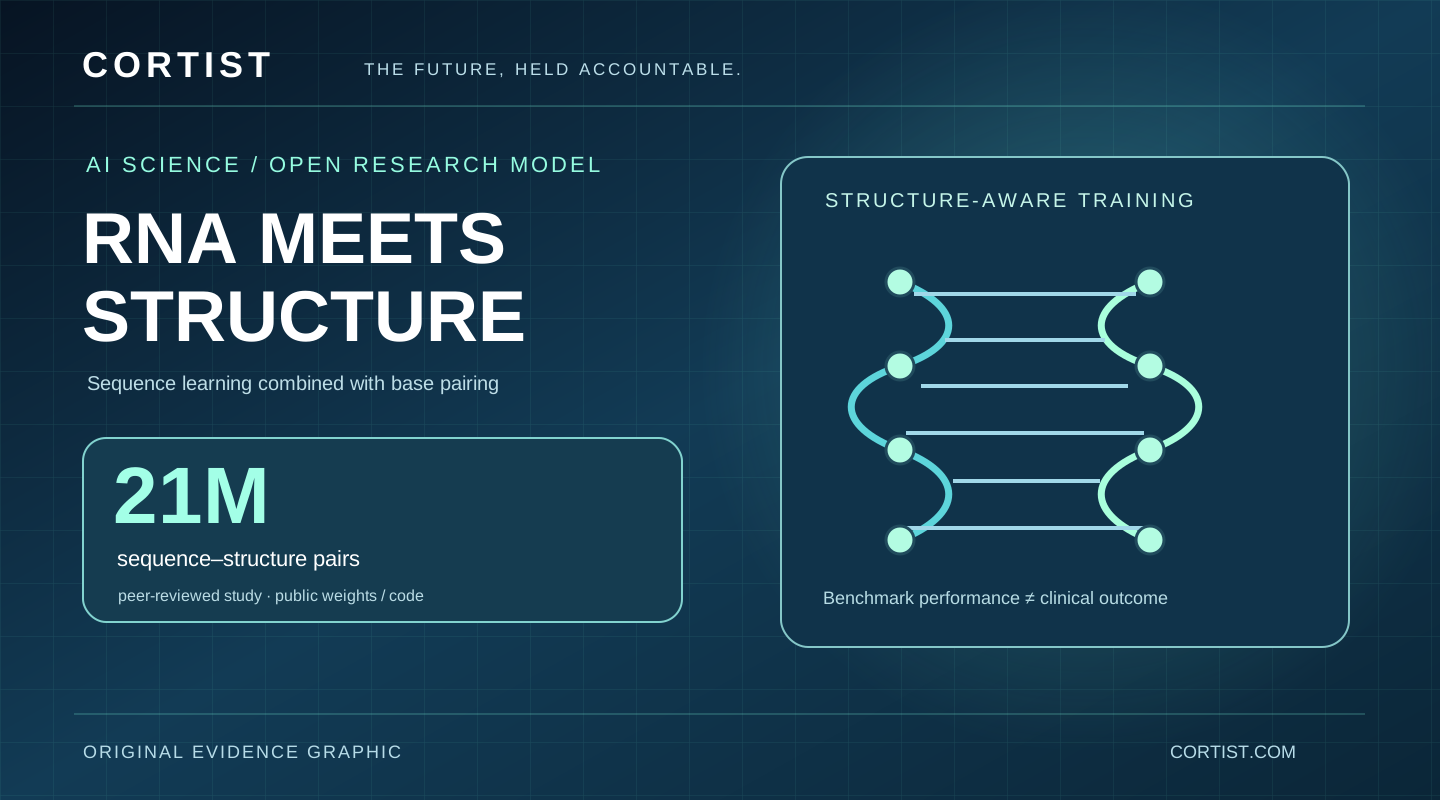
Nature reports structRFM, a sequence-and-structure RNA model trained on 21M pairs with open weights and code. Selected structural benchmarks improve; therapeutic benefit is unproven.
Read the evidence review ↗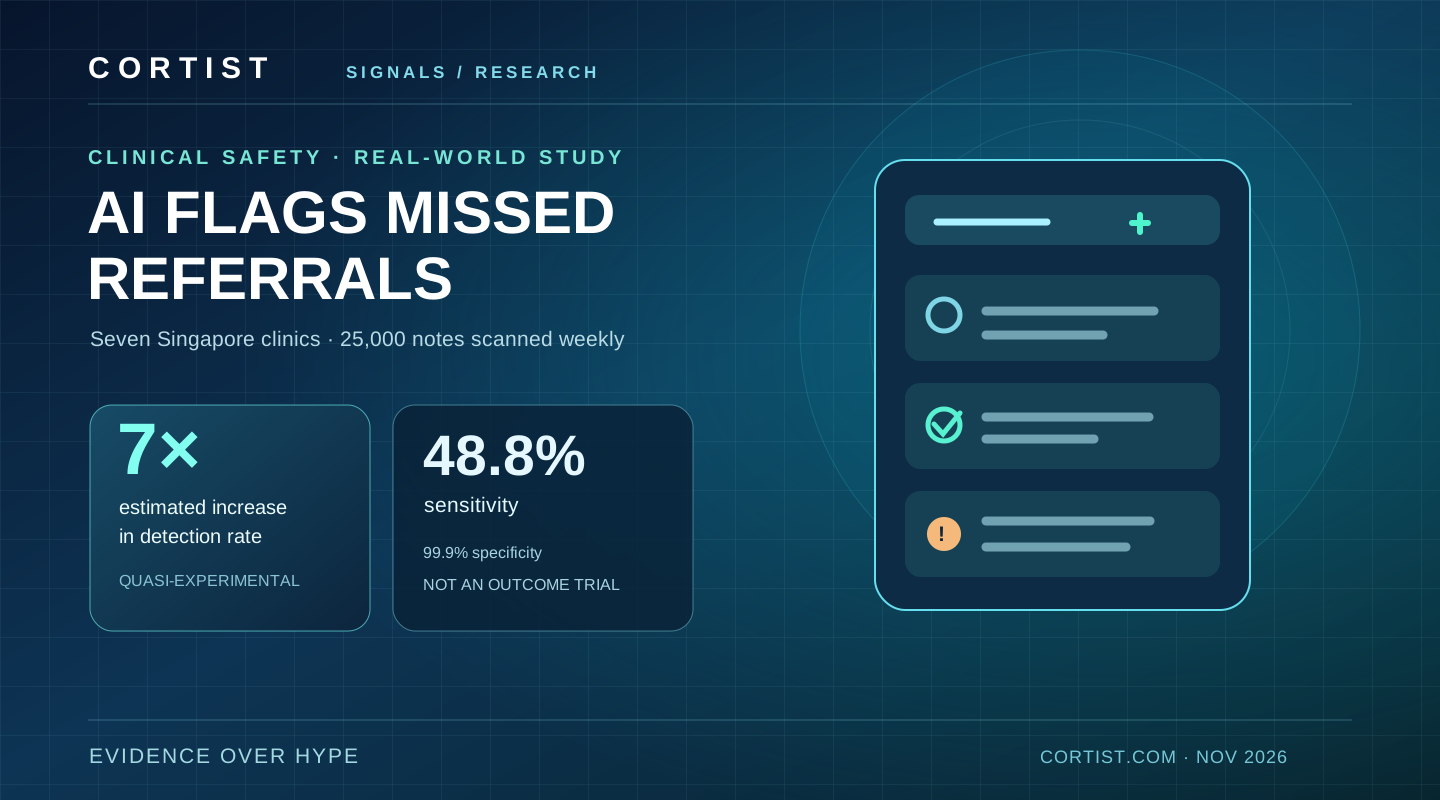
In seven Singapore clinics, MR-AI raised missed-referral detection sevenfold, but 48.8% sensitivity shows why human follow-up remains essential.
Read the source-attributed analysis ↗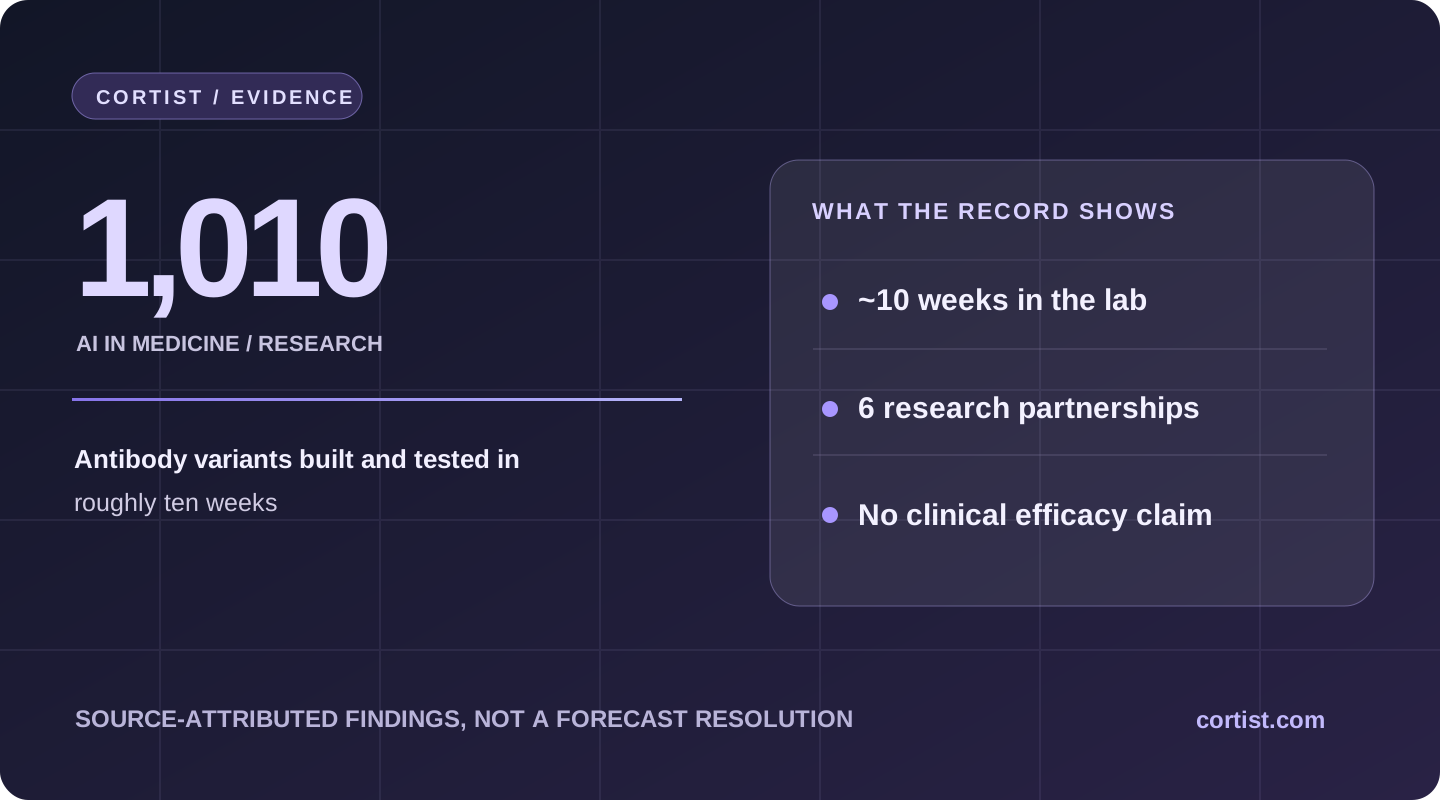
AI-assisted research demonstrated laboratory progress, not proof of treatment efficacy.
Read full news report ↗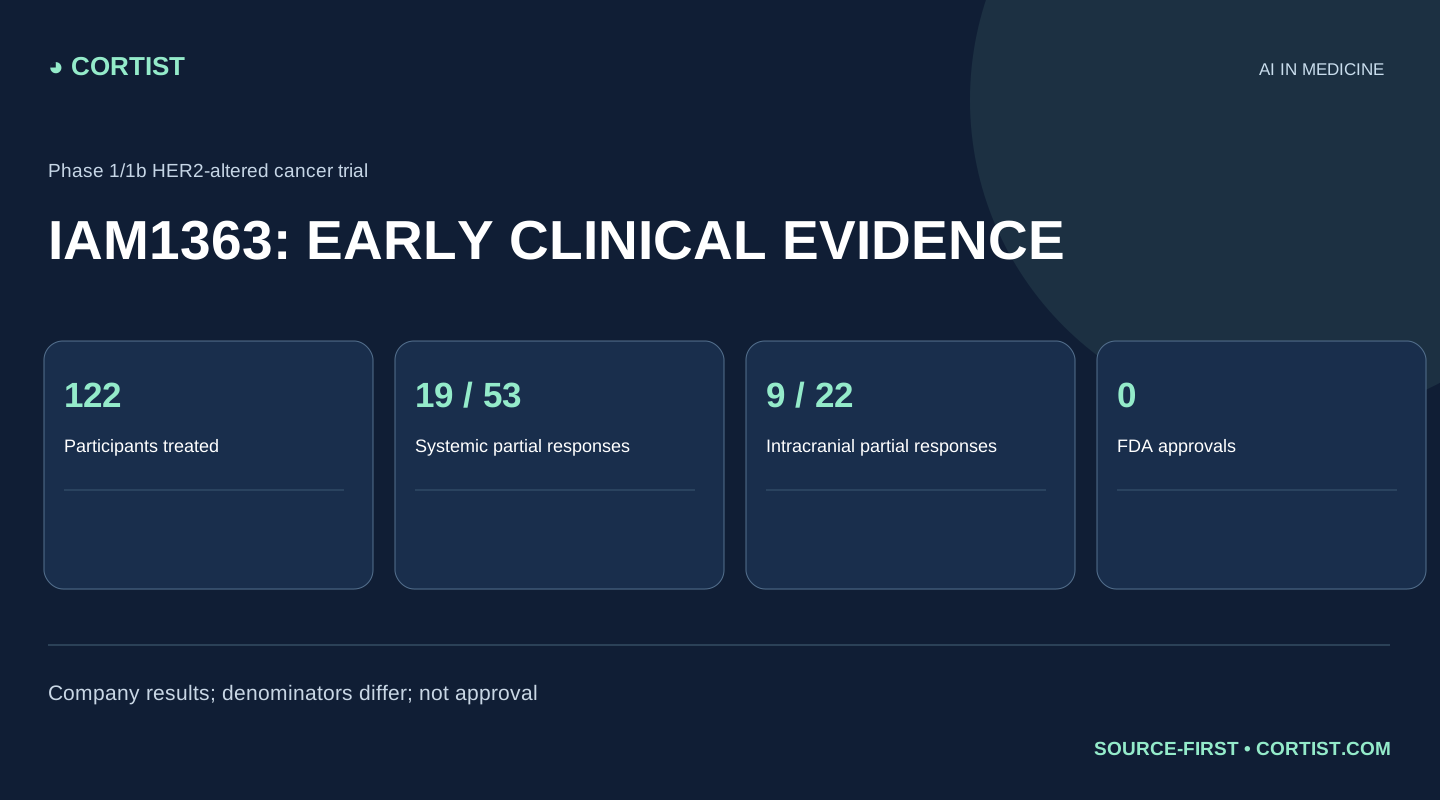
Iambic reports Phase 1/1b signals in carefully defined subgroups. No FDA approval or proof of superiority.
Read full news report ↗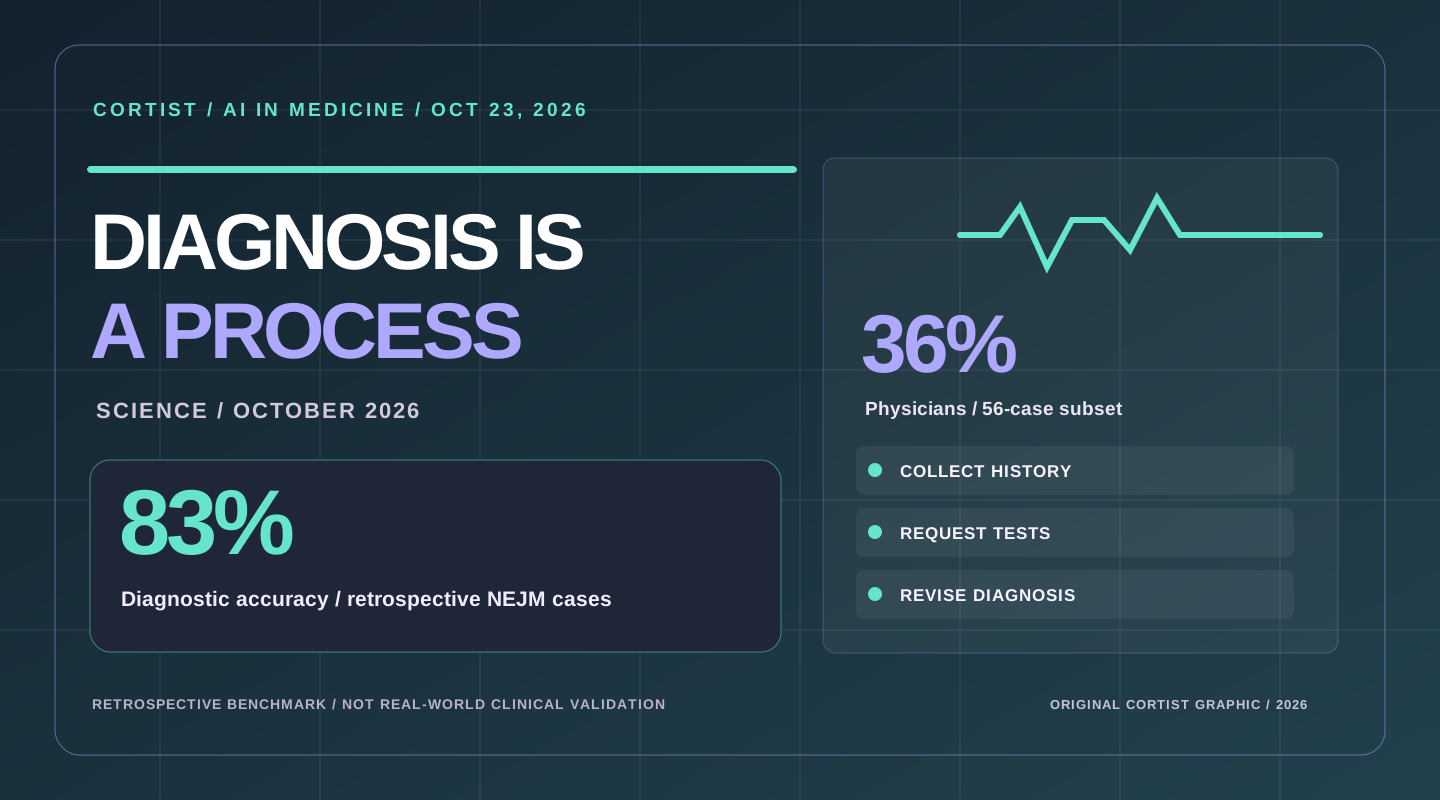
A Science study found striking results for sequential diagnosis. Real-world patient benefit remains unproven.
Read full news report ↗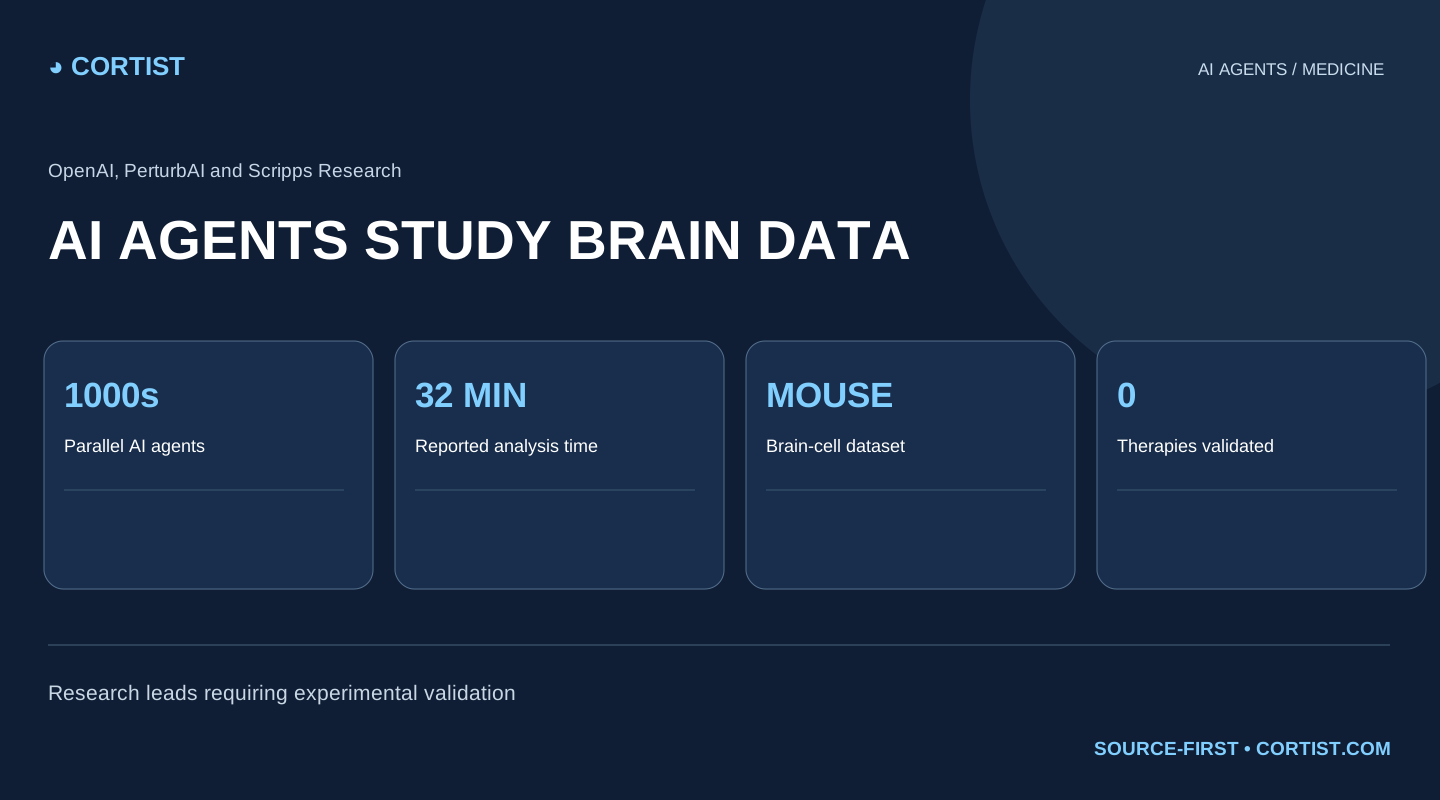
A reported 32-minute GPT-Rosalind analysis yielded research hypotheses, not validated treatments.
Read full news report ↗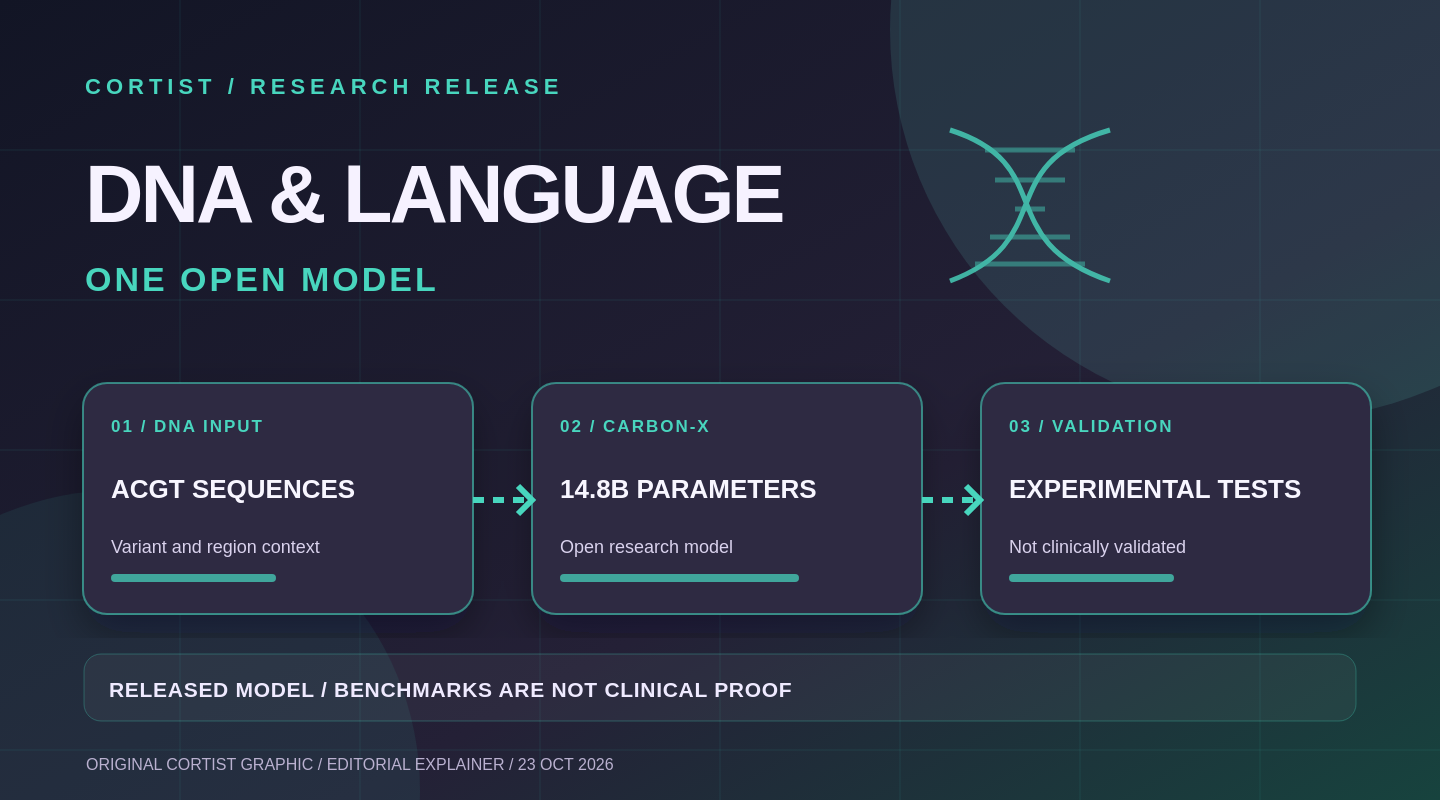
An open 14.8B model brings DNA into a chat interface. Developer benchmarks are promising, but clinical validity is unproven.
Read full news report ↗External primary-source update, not a Cortist news article or an independently verified forecast outcome.
Read original source ↗External primary-source update, not a Cortist news article or an independently verified forecast outcome.
Read original source ↗Current published news can be explored in the Cortist News archive. Editorial topic associations are documented in our topic-source record.
Original papers, regulatory records or laboratory reports. We distinguish sources from our own forecasts.
AI can support imaging, documentation, candidate discovery and clinical research. Its clinical validity depends on the specific product, patient population and independent evaluation.
A valid claim needs an official drug authorization and separate evidence of AI's material role in designing the approved molecule. Participation in a trial alone does not establish approval.
It can accelerate some early search and experimental steps, but overall approval times and safer outcomes are not guaranteed. Translation to human benefit remains a core evidence challenge.
Clinical responsibility, complex judgment and informed consent are not established by model performance alone. AI-assisted workflows require medical governance and validation.
No. It is an editorial scenario calculation, not an official locked or scored Cortist forecast.