
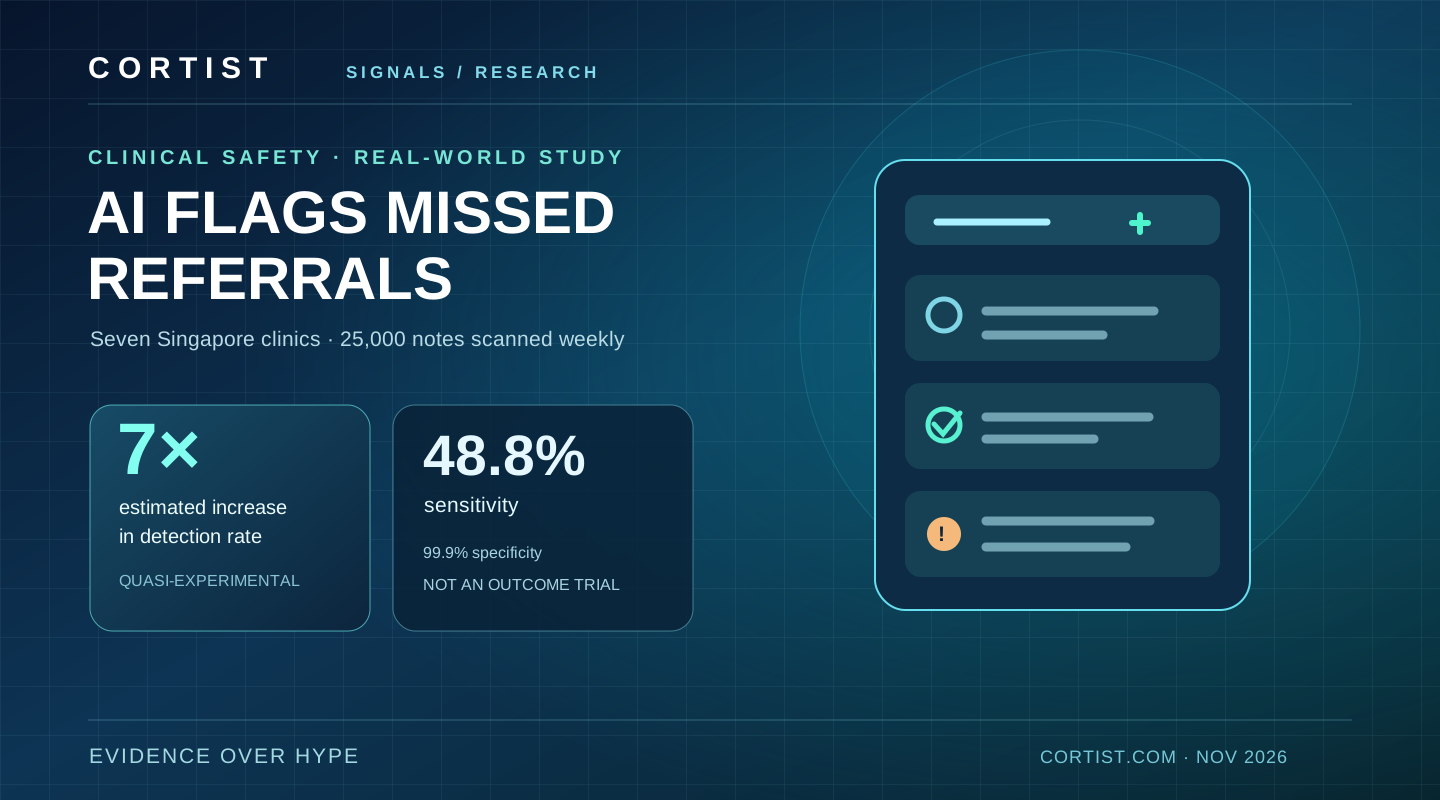
- An accepted peer-reviewed study published in npj Digital Medicine on 30 October 2026 tested MR-AI at seven primary-care clinics in Singapore; about 25,000 consultation notes were scanned each week.
- Researchers estimate a sevenfold increase in detected missed referrals, corresponding to a 4.7-percentage-point level increase (95% confidence interval: 2.4 to 6.9 percentage points).
- The report lists 428 AI flags, 225 clinician-verified flags and 31 patient-reported cases, yielding 256 detections. It also reports 99.9% specificity and 48.8% sensitivity; these measure different aspects of performance.
The Signal
An AI system that helps doctors identify a specialist referral that was discussed but never ordered is tackling a concrete safety failure rather than attempting to replace clinical judgment. A peer-reviewed study published on 30 October 2026 reports a quasi-experimental evaluation of MR-AI across seven Singapore primary-care clinics. The system looked for signs of referral intent in consultation notes and checked whether a corresponding order existed.
The deployment processed roughly 25,000 consultation notes per week. Researchers report an estimated sevenfold increase in weekly missed-referral detection after implementation, described as a 4.7-percentage-point level increase with a 95% confidence interval of 2.4 to 6.9 points. The design supports evidence of an operational improvement in detecting previously unnoticed referrals; it is not the same as a randomized trial demonstrating fewer complications or deaths.
The reported case accounting deserves care. Of 428 cases flagged by MR-AI, clinicians verified 225, and 31 additional cases were reported by patients. That produced 256 total detected cases according to the study. Those denominators should not be blended into a single measure of precision, sensitivity or final patient benefit: each comes from a different part of the evaluation.
The Shift
The headline sevenfold increase is meaningful only alongside the sensitivity result. The researchers report 99.9% specificity, meaning the system rarely classified non-missed-referrals as missed in its measured setting. Sensitivity, however, was 48.8%: the system did not capture every genuine missed referral. A workflow that relies on an AI flag as the only safety net would therefore be poorly justified by this evidence.
In a blinded one-week comparison involving seven physicians and 83 flagged cases, the study gives MR-AI a positive predictive value of 61.8% and reports a 51.8% human confirmation rate. The authors also project approximately 41 staff-hours saved. These are operational comparisons under a specific protocol, not a claim that an autonomous system is more medically accurate than physicians across referral decisions. Projected time savings are not the same as a realized, audited financial saving.
The system appears to work as a second reader for a narrow administrative-clinical gap: it reviews existing documentation, surfaces an inconsistency and asks a clinician to determine what action follows. Whether patients then obtain timely specialist care still depends on human action, order-entry integration, staffing and follow-up. The paper itself calls for preventive workflow changes and future cost-effectiveness analysis.
The Cortist Lens
Cortist tracks the difference between laboratory accuracy, real workflow improvements and patient outcomes. This study belongs in the middle category: it offers a concrete, measured change inside primary care and reports important failure characteristics. It does not show that medical AI has safely achieved general clinical autonomy or that every missing referral was recovered.
The distinction also matters when comparing this finding with earlier medical-AI headlines. Microsoft's MAI-DxO evaluation involved retrospective diagnostic questions; the Singapore MR-AI deployment concerns a real operational detection process in clinics. Neither study alone establishes improved long-term health outcomes across populations. The two can be read together as evidence that evaluation must match the task actually being claimed.
For wider deployment, independent health systems should report how many true cases are missed, how many flags are clinically actionable, whether referral completion rises, how quickly patients are seen and what administrative burden the system adds. Results may change with clinical note styles, referral pathways, languages, patient mix and hospital infrastructure. The measured seven clinics are a starting point, not global proof.
Independent multi-site replication; prospective measurements of completed referrals and patient outcomes; false-negative audits; workload and cost-effectiveness; clear governance of who reviews each flagged case.
The safety gain is plausible and operationally measured, but a 48.8% sensitivity is a warning against treating this alerting system as a complete clinical safeguard.
Primary sources and evidence limits
Study evidence is quasi-experimental, comes from seven clinics in Singapore and measures referral detection rather than randomized patient-outcome improvement. Cortist reviewed the source publication but has not independently replicated the study, audited underlying data or changed any forecast.
See our editorial standards and source-specific limitations.
MR-AI primary-care missed-referrals studyLee and colleagues, npj Digital Medicine; accepted peer-reviewed article, 30 October 2026Permanent DOI and article provenanceSame primary study in DOI form; not an independent validation