
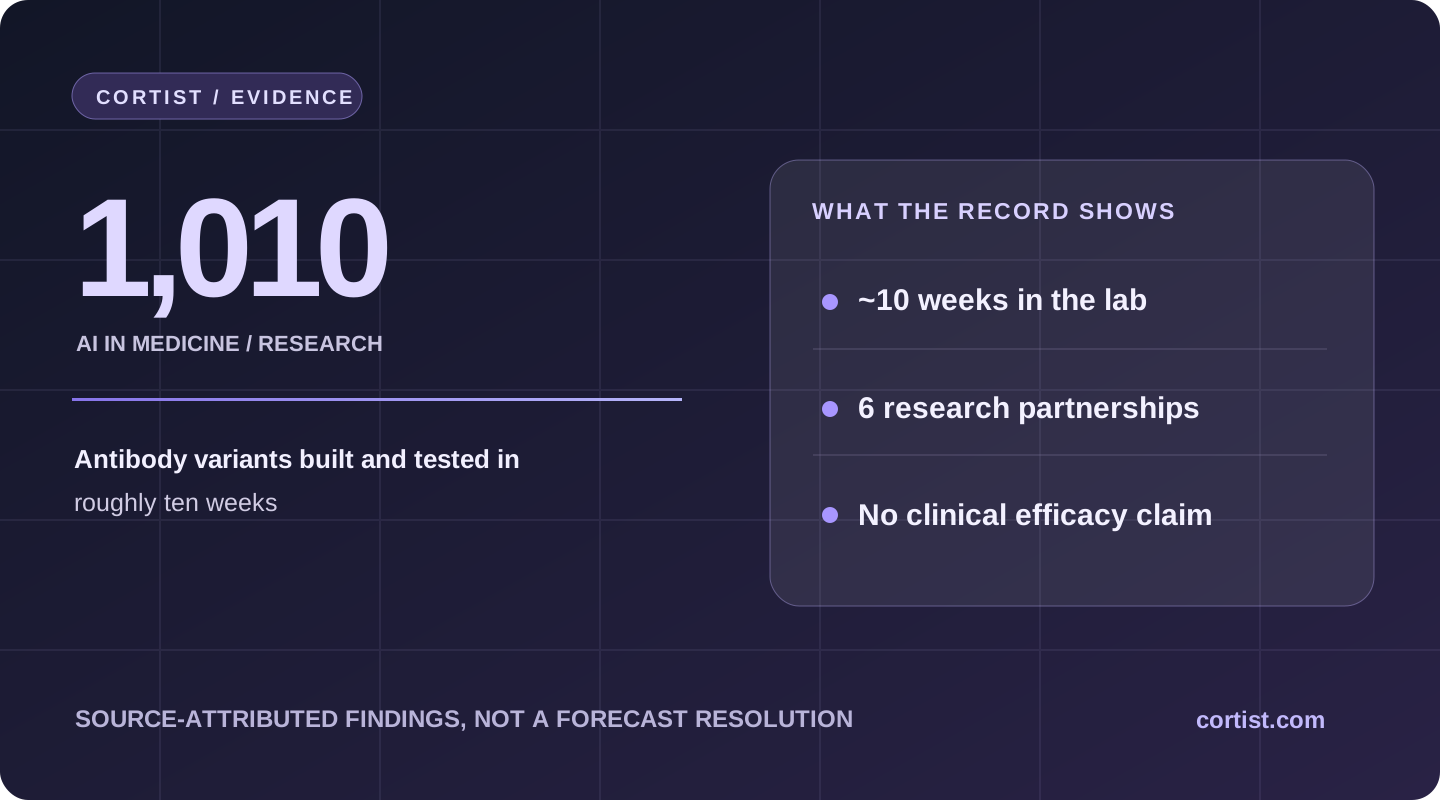
- Anthropic reports active drug-development research partnerships with six organizations, including BigHat Biosciences and Generate:Biomedicines.
- In one BigHat collaboration, a researcher using Claude proposed antibody-fragment changes and the laboratory made and tested roughly 1,010 variants in about ten weeks.
- Selected variants showed stronger binding and improved stability in laboratory measurements. This does not demonstrate clinical efficacy, a completed trial or a regulatory approval.
The Signal
On October 27, Anthropic published a detailed account of Claude's involvement in medicine-development research. Its collaborations span drug design, laboratory experimentation and clinical-trial planning. The report names six partner organizations and emphasizes that much of the work remains preclinical.
One tangible case comes from BigHat Biosciences. A researcher working with Claude used laboratory results to suggest changes to two antibody-fragment leads. BigHat then built and tested about 1,010 variants over roughly ten weeks. The report says the strongest binders improved by more than tenfold relative to the starting materials; the candidates chosen for balance improved across binding, stability and aggregation measures.
The Shift
These are experimental outputs, not drug outcomes. Better molecular binding in a lab does not tell us whether a treatment is safe, effective or manufacturable at clinical scale. The tested candidates face many subsequent stages, including more preclinical work and potentially human trials. Anthropic's partner collaborations and its own participation should also be disclosed when interpreting the results.
The report describes other candidate designs, including work on components of CAR T-cell therapy and early mouse experiments for muscular dystrophy. Each uses a different endpoint and cannot be combined into a single success rate for AI-discovered medicines.
The Cortist Lens
Cortist separates four levels: AI-generated suggestions, experimentally tested molecules, controlled human evidence and regulatory approval. So far the reported BigHat case reaches laboratory validation for specified properties. It cannot be used as evidence that Claude has cured disease or improved patient outcomes.
The independent question is whether AI-assisted programs consistently outperform strong conventional teams on prespecified endpoints while controlling for laboratory resources, cost and failed experiments. This is where future quantitative claims should be tested. Our existing AI-in-Medicine forecast records stay unchanged.
Track peer-reviewed protocols, independent replications, disclosure of failed candidates, progression into human trials and eventual prospective clinical outcomes, rather than counting proposed molecules as cures.
Credible early laboratory progress with measurable outputs—and a long, still-unproven route to patient benefit.
Sources & editorial note
Evidence boundary: These are dated research results and documented company claims, not independently scored Cortist forecasts. Our editorial standards explain how we attribute evidence and correct errors.
Anthropic research reportSix collaboration descriptions, experimental data and limitations, October 27, 2026