Artificial general intelligence (AGI) means AI able to generalize across many cognitive tasks, including unfamiliar problems—not just excel at one benchmark. No arrival date is independently verified. Cortist’s provisional, unscored F-001 forecast assigns a 38% chance of independently verified AGI by 31 December 2030.
Start with the definition and evidence threshold. Explore the provisional forecast, original record and dated research below.
What is AGI?
Artificial general intelligence means broad, transferable AI capability across different cognitive tasks, including unfamiliar ones. There is no universally accepted threshold; one high benchmark score does not establish AGI.
No independently verified arrival date exists. Cortist’s F-001 v0.1 estimates a provisional 38% chance by 31 December 2030. This is an editorial judgment, not an observed frequency or scored probability.
AGI refers to broad, general competence. Artificial superintelligence (ASI) would substantially surpass leading human experts across many intellectual domains. They require different evidential thresholds.
Independent, repeatable tests would need to assess breadth, unfamiliar-task transfer, and sustained performance under clear criteria. No universal AGI test exists, and Cortist’s F-001 criteria remain under review.
No forecast is independently locked or scored. R2 retention is not an external immutable timestamp.
AGI / TOPIC GUIDE · Definitions, expert timelines and related evidence live here. The F-001 draft separately specifies a dated prediction; it is not independently locked. Editorial responsibility ↗
THE QUESTION·When?·What counts?·Who predicted it?·What actually happened?
CORTIST REFERENCE GUIDE · UPDATED 26 OCTOBER 2026
What is AGI? Definition, evidence and the 2030 outlook
In brief
Artificial general intelligence (AGI) describes a proposed AI capability that generalizes across many cognitive tasks and unfamiliar problems. There is no universally accepted verification test or independently confirmed arrival date. Cortist’s F-001 assigns a provisional subjective 38% cumulative chance by the end of 2030; this is not an observed or independently scored probability.
Evidence Pulse 2.0 checks the published Cortist News index when JavaScript is available. The source-linked, dated research articles remain accessible through Cortist News.
CORTIST / EVIDENCE PULSEIndex checked 27 Oct 2026
Evidence archive · 27 October 2026
Latest topic-linked reporting, compared with the separately versioned Cortist assessment. News does not automatically update a forecast.
Forecast / latest public versionUnchanged: 38% (v0.1)Original record: Oct 22, 2026
Coverage since first draftNo later topic-linked reports in this indexLatest linked news: Oct 22, 2026
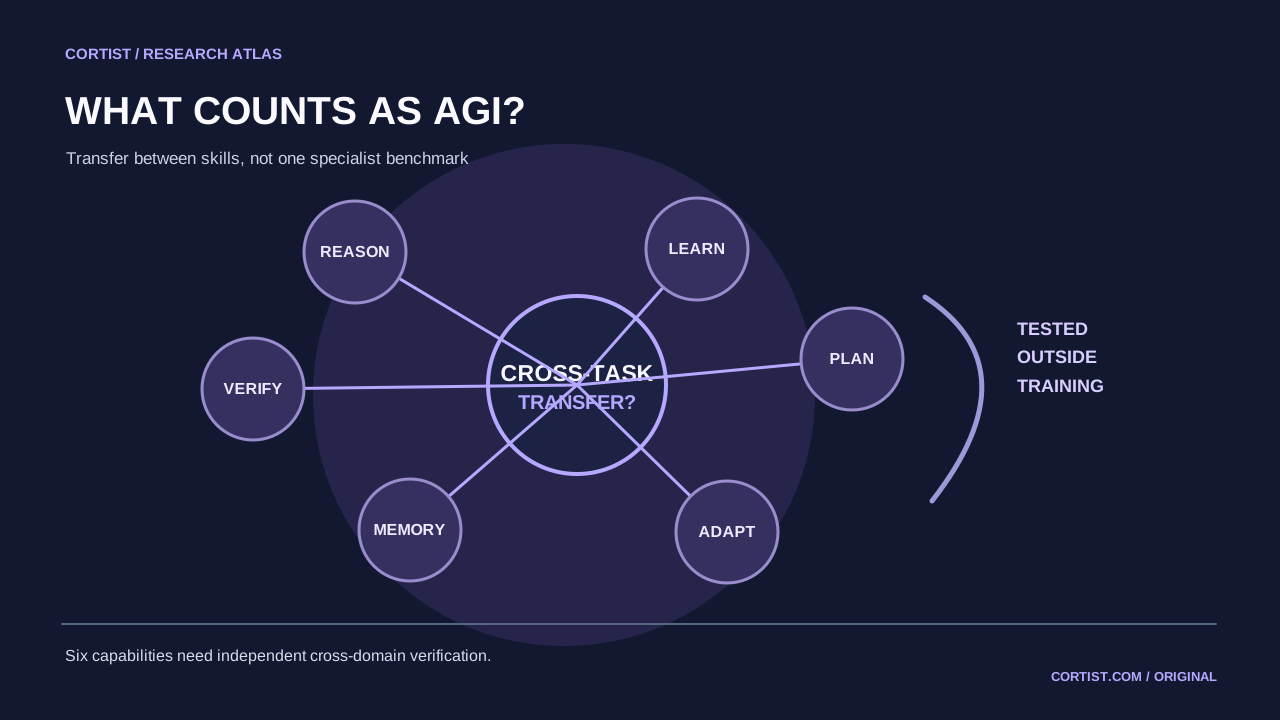
Original Cortist topic-specific research illustration. AGI evidence map: independent transfer across unfamiliar skills is the key challenge. This illustrates a research framework, not a measured AGI result.
What does “general intelligence” actually mean?
Artificial general intelligence (AGI) generally refers to AI that can perform well across a broad range of cognitive tasks, including unfamiliar ones, rather than excelling in a single benchmark. There is no universally accepted pass/fail test. Google DeepMind’s Levels of AGI framework separates breadth of capability from depth of performance and also considers autonomy. Under that approach, solving a difficult mathematics problem or producing convincing prose is evidence about a particular ability; neither alone establishes general intelligence.
A credible test would specify the task distribution, baseline human performance, allowed tools, training-data leakage checks, novelty of problems and the level of autonomy before evaluation. It should cover transfer learning, sustained reasoning, memory, planning and error correction. Public demonstrations deserve attention, but benchmarks selected by a developer cannot be treated as universal proof.
How much do current systems tell us?
Advances in reasoning, software engineering and multimodal perception show that frontier models are improving on many dimensions. But narrow success on tests does not automatically translate into reliable, independent performance across the range of situations people encounter. Google DeepMind’s March 2026 cognitive taxonomy identifies ten relevant abilities and explicitly calls for better evaluations. It is a measurement proposal, not an announcement that AGI has arrived.
METR’s time-horizon research offers a different lens: the length of software tasks an agent can complete with a specified success probability. It is valuable because extended tasks reveal compounded failures. However, the task suite is predominantly technical, the horizon is based on human expert completion time, and neither a rising horizon nor an extrapolated trend is a direct AGI arrival test.
When might AGI arrive?
The responsible answer is a range of competing possibilities, not a countdown. Researchers, companies and forecasting communities use different AGI definitions and provide different horizons. A statement about “human-level AI,” a predicted date for economically useful agents and a claim about general human cognitive competence cannot be placed on one timeline without the original criteria. Cortist preserves dated external claims separately from its own estimate.
F-001 is a cumulative subjective view: 38% by the end of 2030 means the assigned chance of the relevant event having occurred by that date, not a 38% chance in 2030 alone. The original v0.1 curve and year selector remain available on this page. Criteria are still under review; the estimate is not locked, independently verified or scored.
Four tests of generalityAn AGI label should rest on several independent dimensions.
01BreadthDifferent cognitive domains
02TransferNew and unfamiliar tasks
03ReliabilityRepeatable success and recovery
04ReplicationOutside evaluations
Cortist original concept diagram, 26 October 2026. These are evaluation dimensions, not an AGI certification or measured score.
What evidence would change the forecast?
The strongest positive signal would be a pre-registered and independently administered evaluation showing robust performance across unfamiliar domains, sustained autonomy, reliable tool use and clear human comparison groups. Repeated results across organizations and failure audits matter more than a single headline score. Public documentation should specify model version, allowable assistance and how tasks were selected.
Reasons for caution include benchmark contamination, excessive scaffolding, unnoticed human intervention, fragile multi-step execution and definitions that move after a result is observed. Clear negative replications or robust evidence of a capability plateau would also matter. The forecast should change only through a dated, explained new version, never by quietly rewriting its historical curve.
AGI is not the same thing as a convincing chatbot
Fluent conversation can demonstrate language competence, but it does not establish how reliably a system can solve unfamiliar problems or learn new rules in an unknown environment. An AI might perform extremely well on a coding test and still struggle with strategic planning, complex real-world constraints or transferring knowledge between subjects. Generality requires evidence across a distribution of tasks, not one impressive output.
Performance must be interpreted together with the amount of help provided. Tool access, human corrections, search and repeated attempts can make a system more useful while complicating comparisons. A trustworthy AGI claim identifies the exact model, allowed tools, task selection, evaluation rules and human baseline.
A useful distinction: narrow AI, frontier systems, AGI and ASI
Narrow AI excels in specific tasks. Today’s general-purpose frontier systems may handle many different tasks but show uneven reliability, especially when problems are novel or multi-step. AGI is a proposed broader adaptability threshold under explicit verification criteria. Artificial superintelligence describes the additional, hypothetical possibility of systems exceeding the best human capability across many intellectual fields.
These are different categories of evidence. Excellence at a single game is not AGI. A frontier model doing useful research is not automatically ASI. The Levels of AGI research framework helps distinguish depth of performance from breadth, autonomy and deployment considerations.
Category
What it shows
What remains unproven
Specialist AI
Performance in a defined task
Generality outside that task
Frontier general-purpose AI
Broad, sometimes uneven tested ability
Reliable transfer across all new settings
AGI (proposed)
Adaptable competence across diverse tasks
An agreed independently resolved event
ASI (hypothetical)
Broad performance far beyond leading humans
Inevitable arrival or a certain date
How should an independent AGI evaluation work?
A serious evaluation would include tasks developed or held out independently, multiple domains, new problems and repeated trials. The test should define success before running the model, document any human intervention and check whether information from the test might already be represented in training material. Evaluators should compare results with suitable humans and disclose uncertainty, cost and failure modes.
This is why a few spectacular benchmark records are insufficient. A benchmark may be valid within its intended scope but not answer whether a machine can work independently across many unfamiliar settings. Outside replication and fresh test construction strengthen claims. The 2026 Google DeepMind cognitive taxonomy is an effort to improve measurement, not a declaration of AGI.
Why task horizons matter without proving AGI
Long projects require an AI system to remember constraints, plan steps, choose tools, recover from errors and verify final outcomes. Even if it performs well on isolated questions, small errors may compound throughout a complex workflow. Reliable completion across longer tasks is therefore valuable evidence about practical capability.
METR’s task-completion time horizon is measured using the duration a human expert needs for tasks of a given difficulty, at a specified AI success probability. It does not indicate that an agent ran without assistance for that many hours, nor does it test every occupation or cognitive domain. It is one signal within a wider AGI assessment.
Which breakthroughs or barriers could change the timeline?
Progress in reasoning, memory, tool use, planning, multimodal learning, research automation and verification could move systems toward broader competence. Yet there is no established formula that translates more computing power or larger models into general intelligence. Other constraints include unreliable long-horizon execution, limited real-world feedback, evaluation weaknesses, cost and the difficulty of defining a stable milestone.
The pace could be faster or slower than recent benchmark trends suggest. Forecasts should spell out which scientific advances they assume and how they would be validated. Predictions with incompatible definitions cannot be directly averaged into a single objectively established AGI date.
What does the Cortist forecast mean?
Cortist’s F-001 v0.1 assigns a provisional 38% cumulative chance by 31 December 2030 to its intended AGI threshold. This is an editorial judgment, not a scientific frequency or a scored estimate. The year selector displays historical subjective model values rather than observations. The underlying event criteria are still under review.
An external scientist’s predicted arrival year or a forecasting-platform consensus is not the same as Cortist’s own F-001 record. We keep publication dates, event definitions and source attribution separate. A later revision must be visibly dated; it should not overwrite the earlier curve or retrospectively claim a verified outcome. Read the full F-001 record and forecast protocol.
What would change the evidence rather than the headlines?
The strongest positive signal would be reproducible, independently assessed general performance across unfamiliar domains, sustained task completion and credible comparisons with humans on predeclared tasks. Important counterevidence includes failures to generalize, evaluation contamination, dependence on extensive human scaffolding and results that outside evaluators cannot replicate.
A useful report should state not just the success rate but what failed, which tools were allowed and whether the system could detect and correct its own errors. The Cortist methodology is designed to keep claims, provisional forecasts and later real-world verification distinct.
Why AGI matters beyond the benchmark
Broad AI capability may have substantial implications for employment, science and governance, but those outcomes also depend on implementation, regulation, costs and human choices. A technically capable model is not proof that an occupation will disappear, an AI-discovered treatment will be approved, or a future system will escape oversight. Those questions require their own evidence.
The Levels of AGI framework is valuable because it distinguishes breadth and depth of capability. The framework does not appoint an official authority for deciding whether AGI has arrived. A claim based on benchmark success still requires evidence of transfer to unfamiliar work and an evaluation that outside researchers can reproduce.
METR task horizons describe performance on a defined set of technical tasks at a specified success rate. They cannot by themselves establish general intelligence across all domains. Cortist’s 38% cumulative F-001 view for the end of 2030 remains a provisional editorial forecast, not a scientific measurement.
Primary sources and research context
These publications address different aspects of intelligence and its measurement. None is a certification that AGI has already occurred.
For dated researcher statements and the original forecast record, continue to the expert chronology and forecast sections below. Original model versions and Ledger evidence remain separately preserved.
02 / TIMESTAMPED EXPERT STATEMENTS
What the experts actually said.
We separate an expert's publicly stated timeline from numerical probabilities. We never invent a percentage for someone who only gave a date range.
21 OCT 2026EXPERT TIMELINE
Demis Hassabis brings his AGI horizon closer
The Google DeepMind leader expects AGI within two to three years, compared with a three-to-five-year estimate earlier in 2026. He describes AGI as covering the full range of human cognitive capabilities.
Expected window: approximately 2028–2029No numerical probability stated
A long-running forecasting question records changing community expectations for the first general AI system to be devised, tested and publicly announced. The estimate is dynamic, not a fixed statement by one expert.
10 dated source records, 4 years. Direct original references; no new news articles.
A chronological research and public-statement archive, not a leaderboard. Every entry identifies the speaker, publication date, location, core claim and what the statement does not prove. Summaries are editorial paraphrases, not invented direct quotes.
2026
RESEARCH
Ryan Burnell and Oran Kelly, Google DeepMind
AGI needs a multi-ability test, not one benchmark
DeepMind proposed a taxonomy of ten cognitive abilities and a human-baseline evaluation protocol for measuring progress toward AGI.
Context: Measurement proposal, not an arrival prediction or proof of AGI.
LeCun discussed limitations of current LLMs, the need for world understanding, abstract reasoning and planning, and a longer research path toward human-level AI.
Context: Recorded interview and methodological position; not evidence that AGI has arrived.
Anca Dragan, Rohin Shah, Four Flynn and Shane Legg
AGI could emerge within the coming years
The authors described human-level capability on most cognitive tasks as potentially arriving in the coming years and called for proactive testing and safety planning.
Context: Broad qualitative time horizon, not a date-certain prediction or a numeric probability.
Thomas Kwa, Ben West, Joel Becker and METR colleagues
Agent task horizons doubled roughly every seven months
METR reported an approximately seven-month historical doubling time for the length of tasks generalist agents could complete at a specified reliability level, while noting extrapolation limits.
Context: Measures a particular autonomous-task capability, not AGI itself.
Published at: METR: Measuring AI Ability to Complete Long Software TasksRead original source ↗
EXECUTIVE CLAIM
Sam Altman
Altman said OpenAI knew how to build AGI as traditionally understood
Altman expressed confidence in a route to traditionally understood AGI and expected the first AI agents to begin materially affecting workplaces in 2025.
Context: A first-person capability outlook, not a publicly independently validated AGI milestone.
Amodei explored the potential upsides of powerful AI and repeatedly cautioned that predictions about its consequences involve considerable uncertainty.
Context: His defined powerful AI is not automatically equivalent to Cortist's proposed AGI threshold.
Meredith Ringel Morris, Shane Legg and Google DeepMind coauthors
AGI should be measured along breadth and performance
Researchers proposed levels that separate an AI system's generality from how proficiently it performs, rather than treating AGI as a single simple switch.
Context: Academic measurement framework; no claim that a specific model had reached full AGI.
OpenAI argued AGI needs gradual deployment and independent oversight
OpenAI described AGI as a possible transformative but risky capability and called for safety evaluations, public scrutiny and governance while acknowledging uncertain timelines.
Context: Institutional policy statement, not a probability forecast or achieved milestone.
Calling a system AGI is easy. Demonstrating general intelligence without moving the goalposts is harder.
01
Breadth
Performance across diverse cognitive domains—not just one benchmark or profession.
02
Novel tasks
Generalization and adaptation to genuinely unfamiliar challenges.
03
Independent tests
Replicable evaluations beyond a company's own announcement.
04
Pre-committed criteria
A fixed resolution standard, published before the estimate is officially scored.
Editorial transparency: these are principles, not yet a complete pass/fail threshold. Our 38% is provisional until a measurable resolution protocol is locked and time-stamped. See the Cortist methodology and forecast record.
05 / AGI EXPLAINED
Frequently asked questions.
What does AGI stand for?
Artificial general intelligence. The term usually refers to AI with broad, transferable intellectual capabilities across tasks and domains. There is no single universally agreed technical test.
Will AGI be achieved by 2030?
That remains unknown. Cortist's current working model v0.1 estimate is 38% by 31 December 2030, but our full resolution protocol is still being finalized. This is not a measured frequency or a guaranteed prediction.
Did Demis Hassabis predict a specific AGI probability?
No numerical probability is reported in his 21 October 2026 interview. He gave a two-to-three-year timeline; Cortist does not translate that statement into an invented percentage.
How often is the AGI tracker updated?
Cortist runs a daily editorial search for newly published or revised AGI predictions. Any new entry is subject to source checks. Page updates and the permanent forecast record are separate from the daily research check.
FOLLOW THE RECORD
Tomorrow's AI claims. Today's receipts.
All forecasts are timestamped, carefully sourced and revisited when the evidence changes.
Curated from all 32 published Cortist reports · 2 relevant to this topic. Cross-topic links are context, not evidence that a forecast has resolved. Explore the complete news archive.
Explore the other Cortist research topics:AI Agents · AI in Medicine · AI & Energy. Each has a separate forecast with explicit evidence and uncertainty.