
Stanford AI Index 2026, Science
Shows fast scientific AI progress and poor reproducibility on demanding tasks.
Read original evidence ↗AI can help researchers search literature, propose hypotheses, write code and operate experiments. A convincing paper or laboratory demonstration is not automatically a novel, valid discovery. Cortist's provisional F-006 assigns 40% to a defined autonomous finding independently reproduced by 2035.
Subjective editorial scenario, not a measured or independently calibrated prediction.
Illustrative cumulative probability. Not automatically inferred from sources. Draft event criteria ↗
Models can help with analysis, simulation and experiment planning. The outputs still need transparent methods, valid measurements and reproduction.
See reproducibility evidence →Novelty and attribution must be substantiated, and a separate group must reproduce the result under defined conditions. F-006 remains provisional.
Inspect the discovery criteria →Guide clarified 3 November 2026 · Source findings and forecast assumptions below retain their original recorded dates · Editorial standards
A later evidence-based probability update must be published as a new date-stamped version. The initial record remains unchanged.
The initial subjective scenario is now documented. No newer public version or independently scored result exists.
Resolution criteria require independent review before a prospective forecast lock.Research agents, reproducible experiments and verified AI-generated knowledge. At least one novel natural-science discovery originating predominantly from an autonomous AI research system is reproduced by an independent team by the end of 2035. Cortist provisionally assigns 40% by 2035. The value is a subjective public draft and should not be mistaken for an independently scored statistical prediction.
Evidence Pulse 2.0 checks the published Cortist News index when JavaScript is available. The source-linked, dated research articles remain accessible through Cortist News.
Latest topic-linked reporting, compared with the separately versioned Cortist assessment. News does not automatically update a forecast.
Evidence interpretation: AI-assisted biological research illustrates progress in scaling scientific workflows.
What remains unproven: It is not yet an independently replicated predominantly autonomous natural-science discovery.
What to verify next: Novel AI-led hypotheses replicated by a genuinely independent scientific team.
Snapshot of 3 linked reports. Context is not independent proof or a measured probability change. Dated evidence index · Original forecast v0.1.
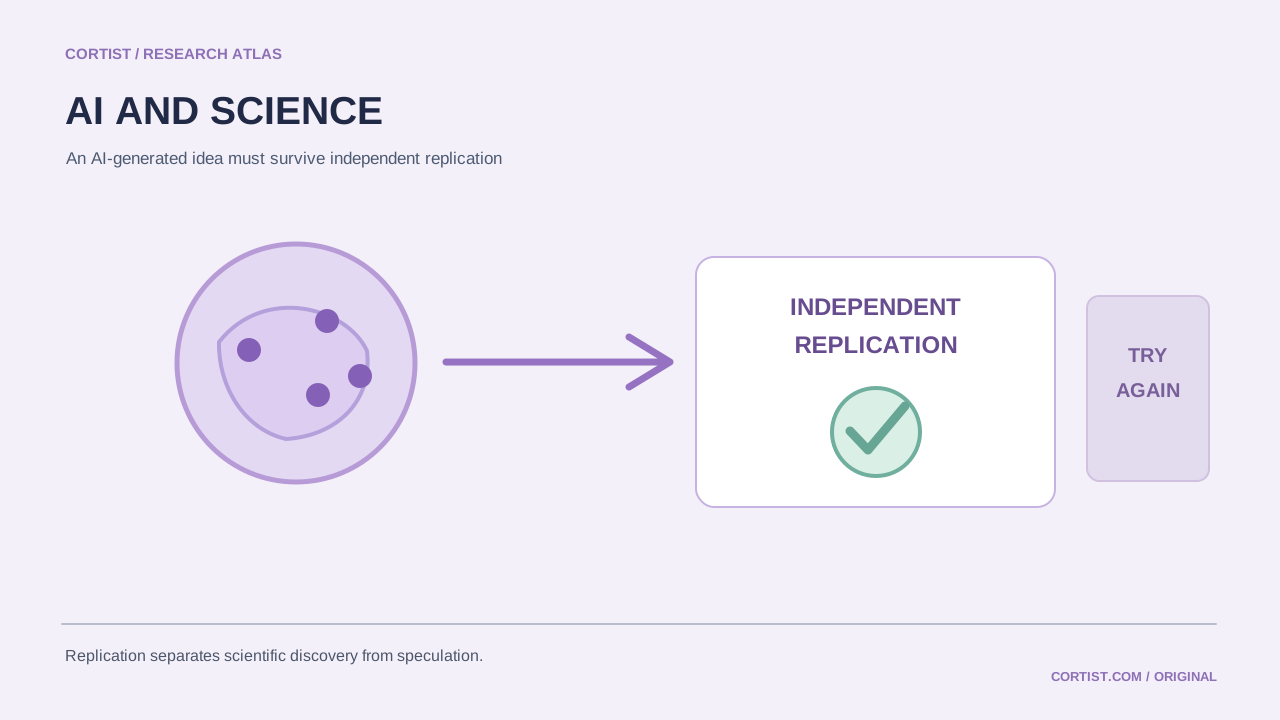
An AI model passing scientific question-answering benchmarks demonstrates knowledge and reasoning under test conditions; it does not establish a new natural phenomenon. Cortist separates solving existing problems, generating hypotheses and independently reproducing a novel empirical discovery. Each stage requires different evidence.
The Stanford AI Index documents fast-growing scientific AI publications and strong results on some chemistry questions. Yet research replication and end-to-end scientific tasks remain difficult: leading agents are markedly below expert baselines on several research workflows. That gap is central to this forecast's uncertainty.
Scientific discovery may involve literature mapping, hypothesis formation, experiment selection, data acquisition, interpretation and replication. For the proposed F-006 outcome, the AI must perform the substantive hypothesis and analysis work. Humans can provide safety approval, laboratory equipment and execution, but their intellectual and operational contributions must be recorded rather than hidden.
Peer review, patents, a news release or a published paper can be useful indicators but are not sufficient to resolve this question. Independent researchers need to repeat the central empirical result, not merely say that the AI paper sounds plausible. Publication bias, contamination from existing work and experimental leakage require explicit review.
AI-guided scientific discovery spans molecular design, material science, physics, astronomy and environmental science. The Stanford AI Index documents work on AI co-scientists and automated papers, but a fully generated workshop paper is not automatically a replicated scientific breakthrough. We will distinguish the provenance and result of each project.
Each step resolves a different source of uncertainty.
Better laboratory interfaces, agent planning, scientific world models and high-quality instrument feedback could accelerate the research loop. Weak experimental robustness, reproducibility failures, unsuitable benchmarks and limited access to equipment could delay a qualifying case. The forecast is about independently reproduced scientific knowledge, not a count of AI-written publications.
The provisional F-006 estimate is 40% by 2035. The year slider displays subjective cumulative scenario anchors, not a validated time-to-discovery model. When credible replication evidence appears, Cortist must retain this first version and explain any future probability adjustment with specific primary sources.
The meaning of predominantly autonomous research, acceptable human roles and scientific novelty must be prospectively approved. A new forecast ID would be required if future reviewers materially changed the question. Until then the displayed value remains an unscored editorial draft.
Cortist monitors original datasets, official measurements and independent evaluations rather than treating manufacturer, researcher or policymaker claims as settled outcomes. Any material reassessment must disclose the previous value, the new evidence, counterarguments and the reason for changing the subjective assessment. The older snapshot will remain at its original versioned URL.
Before this question becomes eligible for formal scorekeeping, independent reviewers must agree on the boundary of the event, adjudication rules, data sources and any necessary fallback measurement. If an essential definition changes, a fresh forecast question will be published instead of rewriting an old one.
Shows fast scientific AI progress and poor reproducibility on demanding tasks.
Read original evidence ↗Benchmarks have jagged performance and do not prove independent scientific discovery.
Read original evidence ↗Independent compilation of research progress and limitations.
Read original evidence ↗Source summaries distinguish historical measurements, institutional research and forward-looking claims. None independently validates the 40% draft probability.
General intelligence is not established by progress on any single specialized metric.
Explore AGI ↗CONNECTED RESEARCHCompute and AI deployment depend on physical infrastructure and electricity.
Explore energy ↗CONNECTED RESEARCHLabor-market outcomes must be measured independently from technical capability.
Explore jobs ↗Current source-attributed research includes new October 29 evaluations and earlier contextual reports. None independently resolves the scientific-discovery forecast; primary news classifications remain visible.
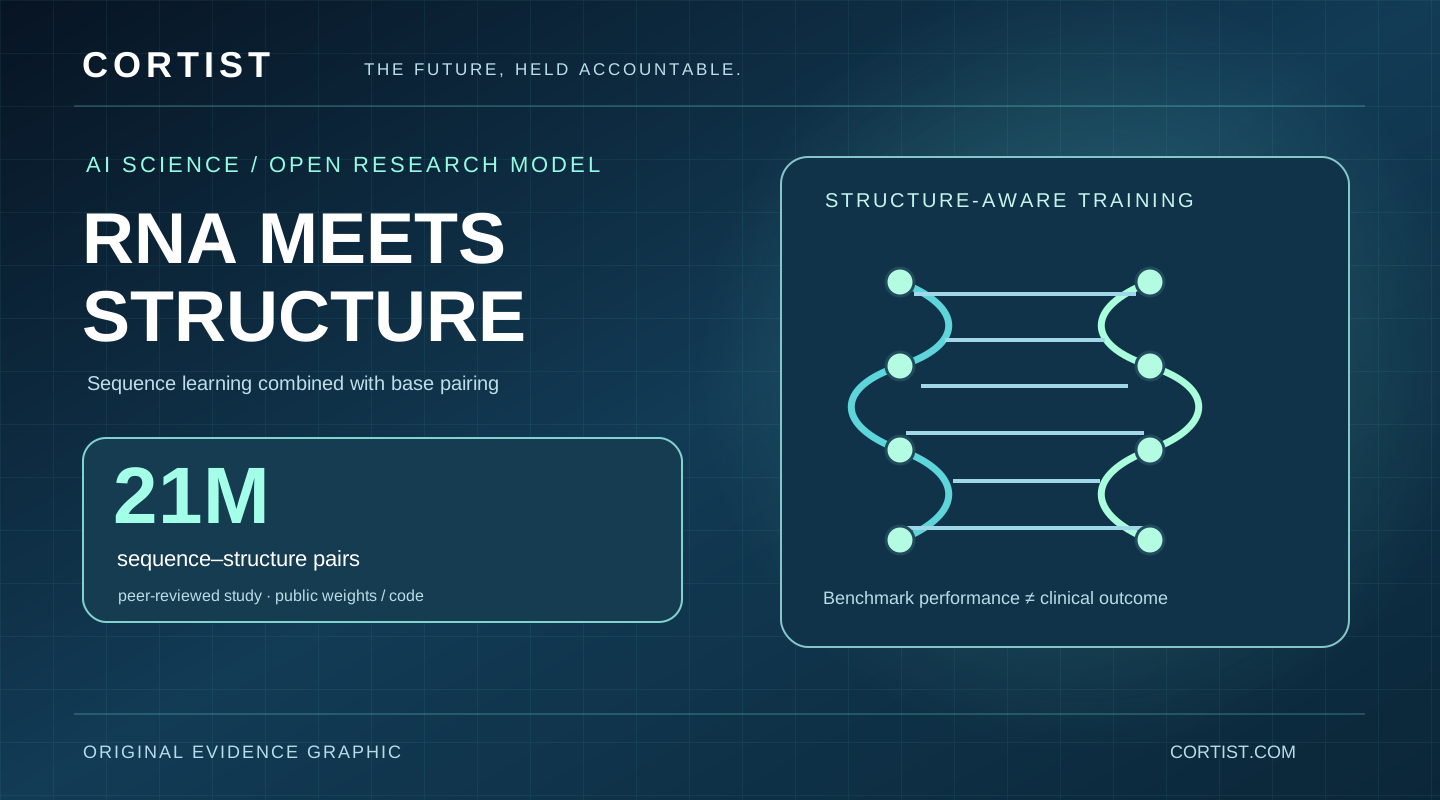
Nature reports structRFM, a sequence-and-structure RNA model trained on 21M pairs with open weights and code. Selected structural benchmarks improve; therapeutic benefit is unproven.
Read the evidence review ↗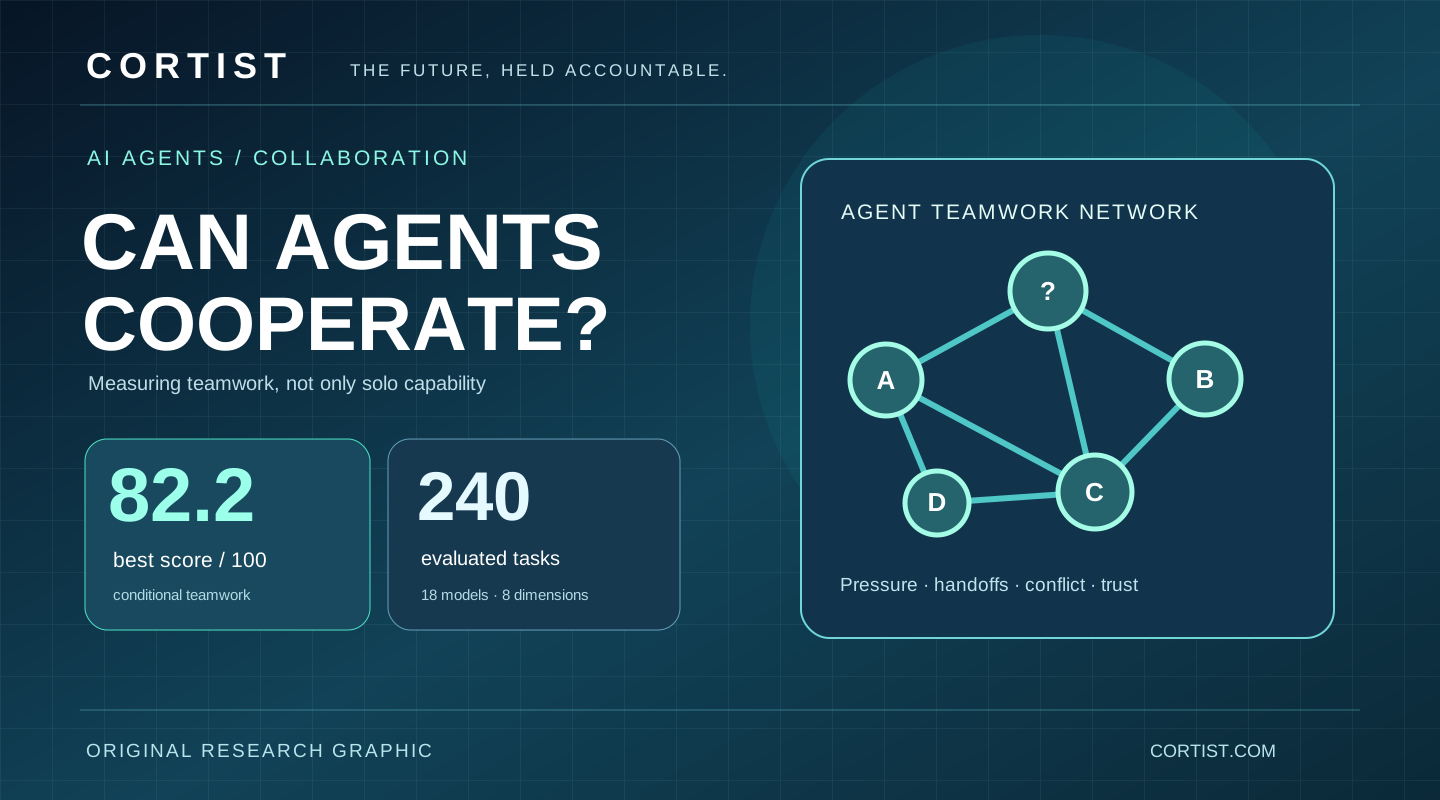
A research benchmark reveals gaps in agent teamwork and handoff reliability across 240 tasks and 18 models.
Read the evidence review ↗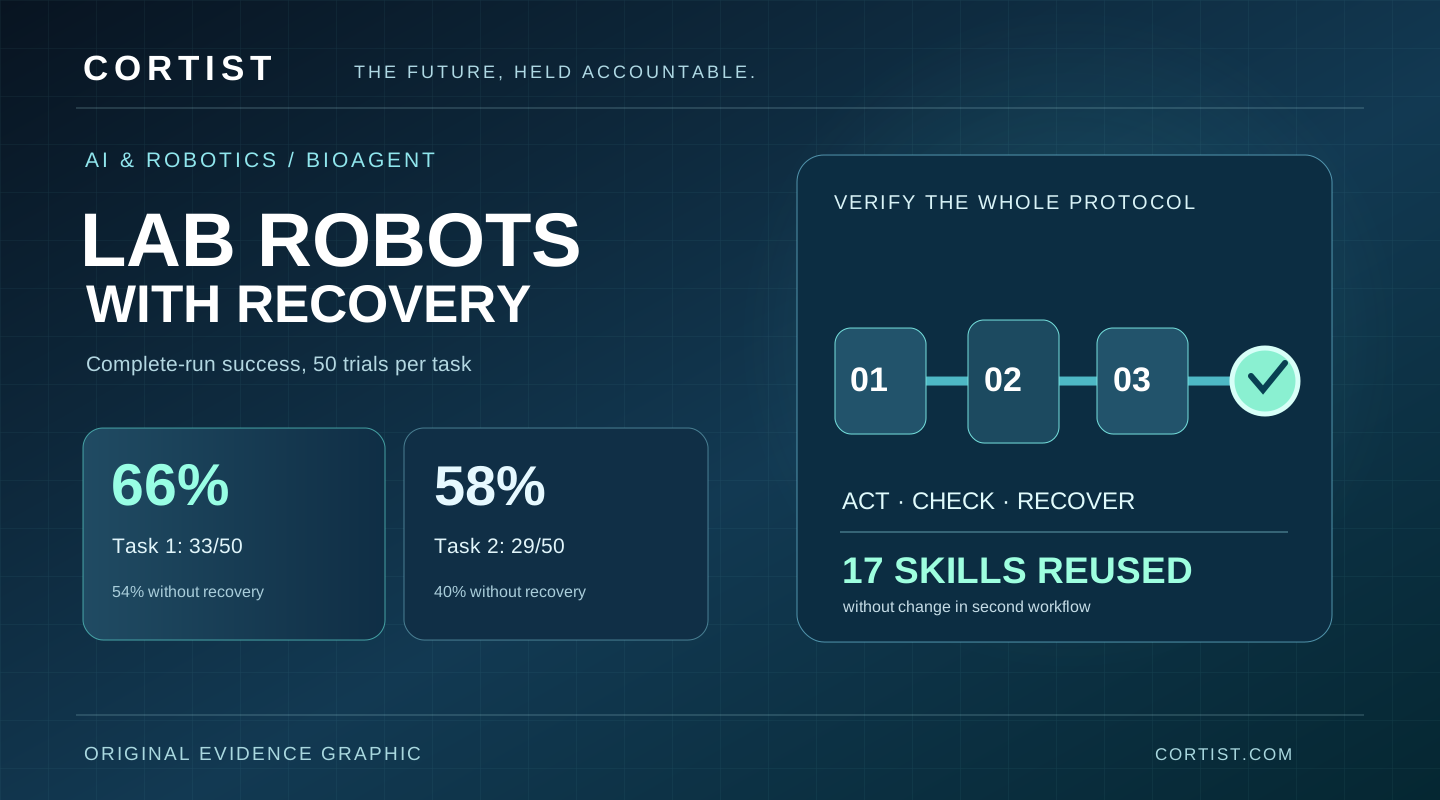
BioAgent reports 66% and 58% complete-task success across two real-robot lab protocols with recovery—promising, but not autonomous science.
Read the source-attributed analysis ↗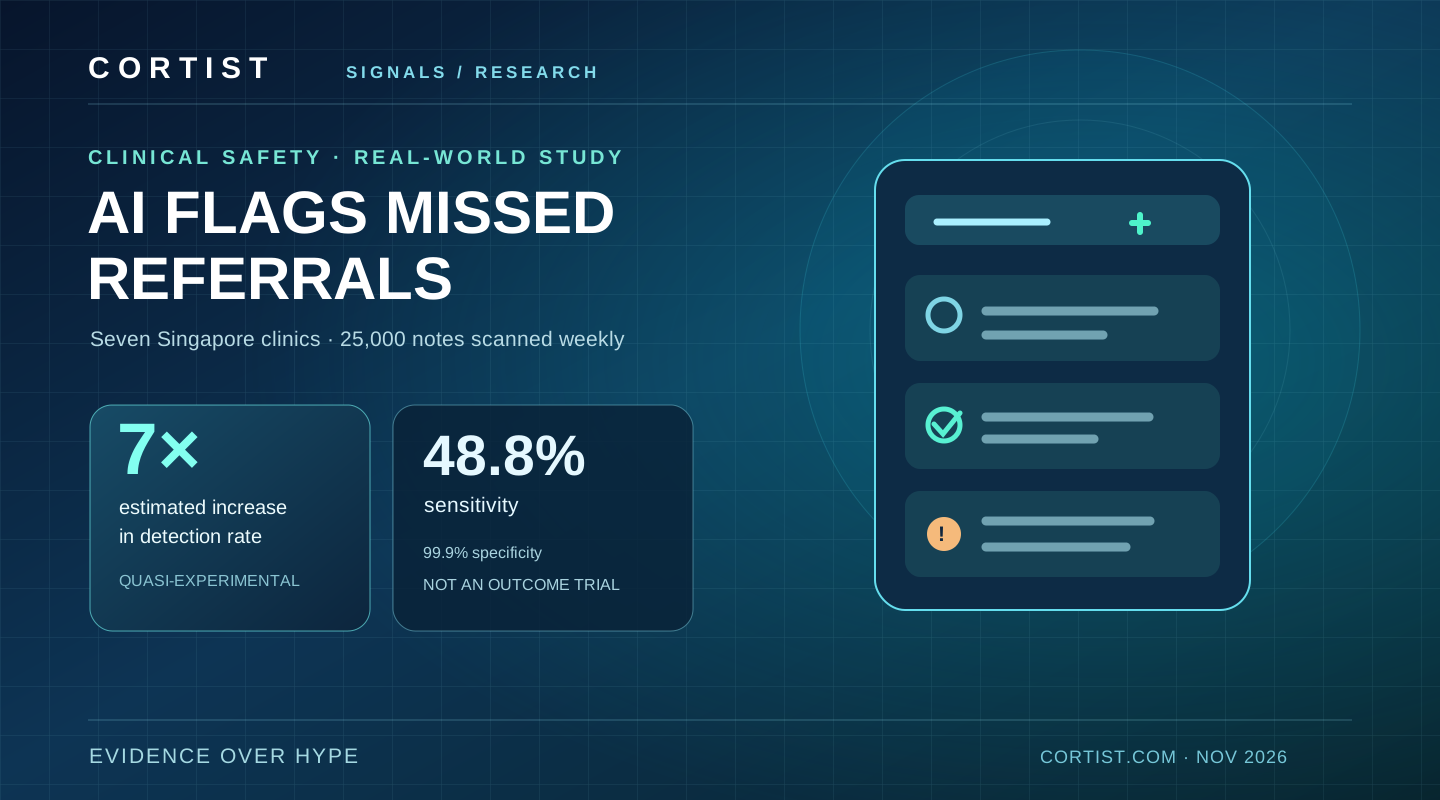
In seven Singapore clinics, MR-AI raised missed-referral detection sevenfold, but 48.8% sensitivity shows why human follow-up remains essential.
Read the source-attributed analysis ↗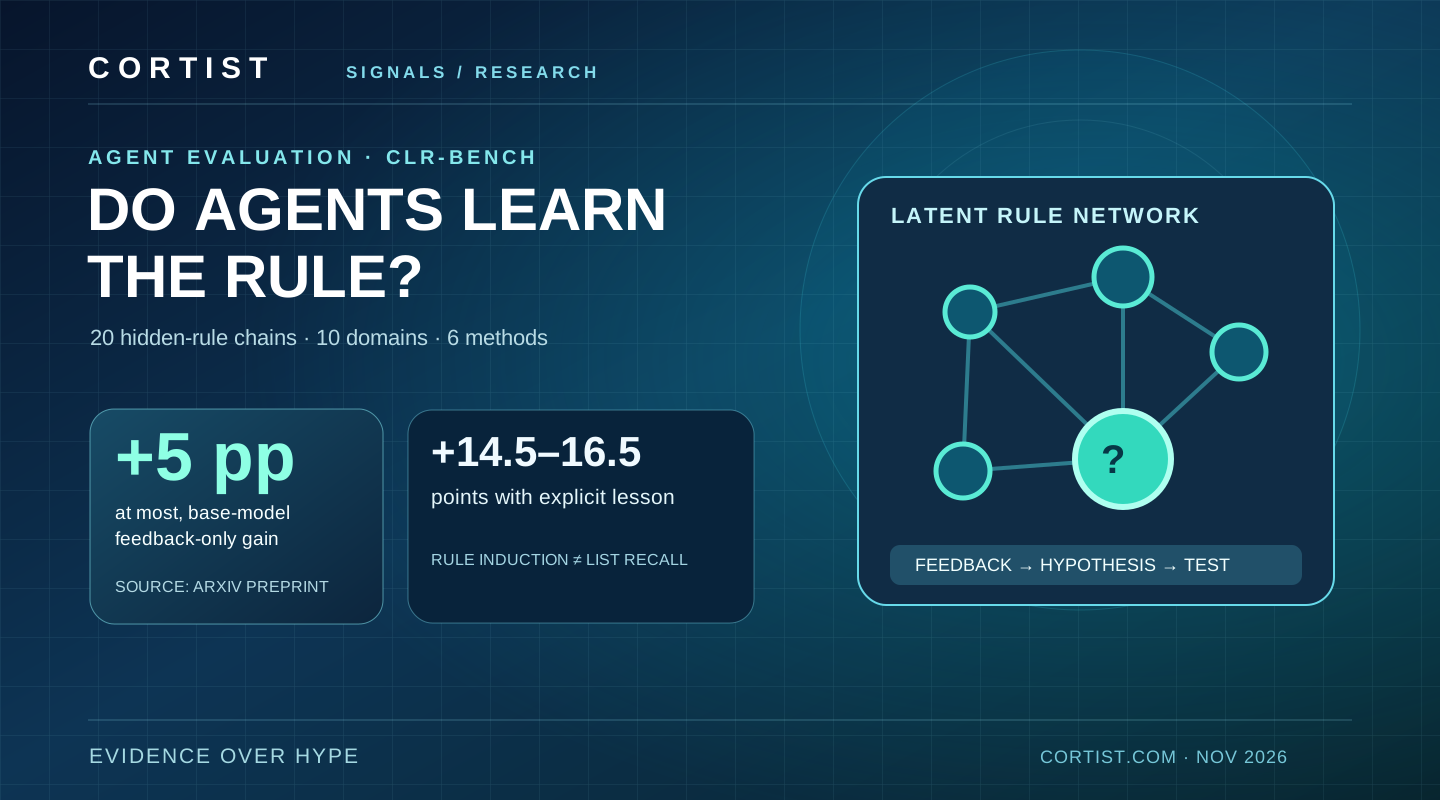
A new hidden-rule benchmark finds that many self-evolving agents memorize feedback rather than generalize; stronger models make a measurable difference.
Read the source-attributed analysis ↗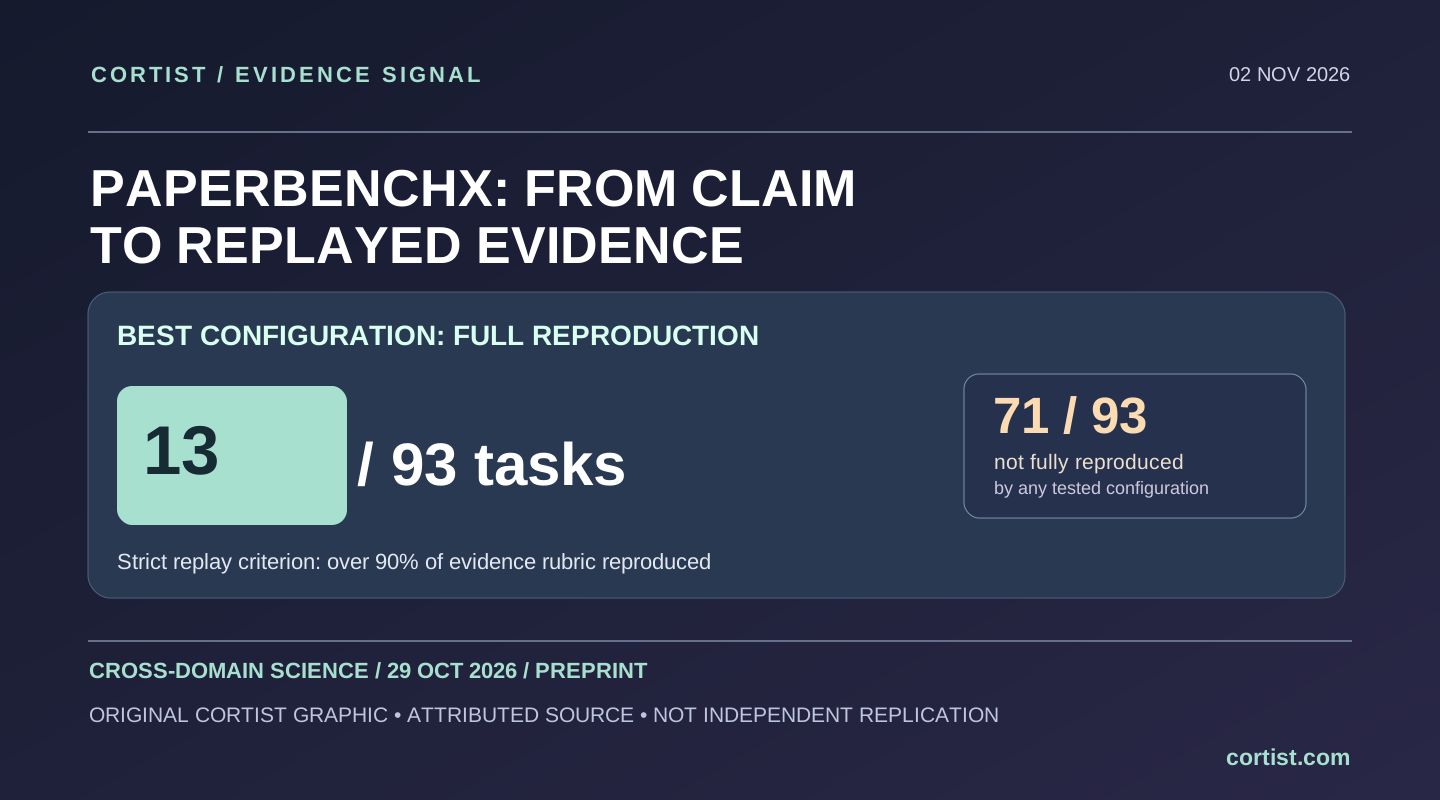
PaperBenchX tests 93 scientific experiments across 12 areas. The top agent fully reproduced only 13; Cortist examines clean replay.
Read the source-attributed analysis ↗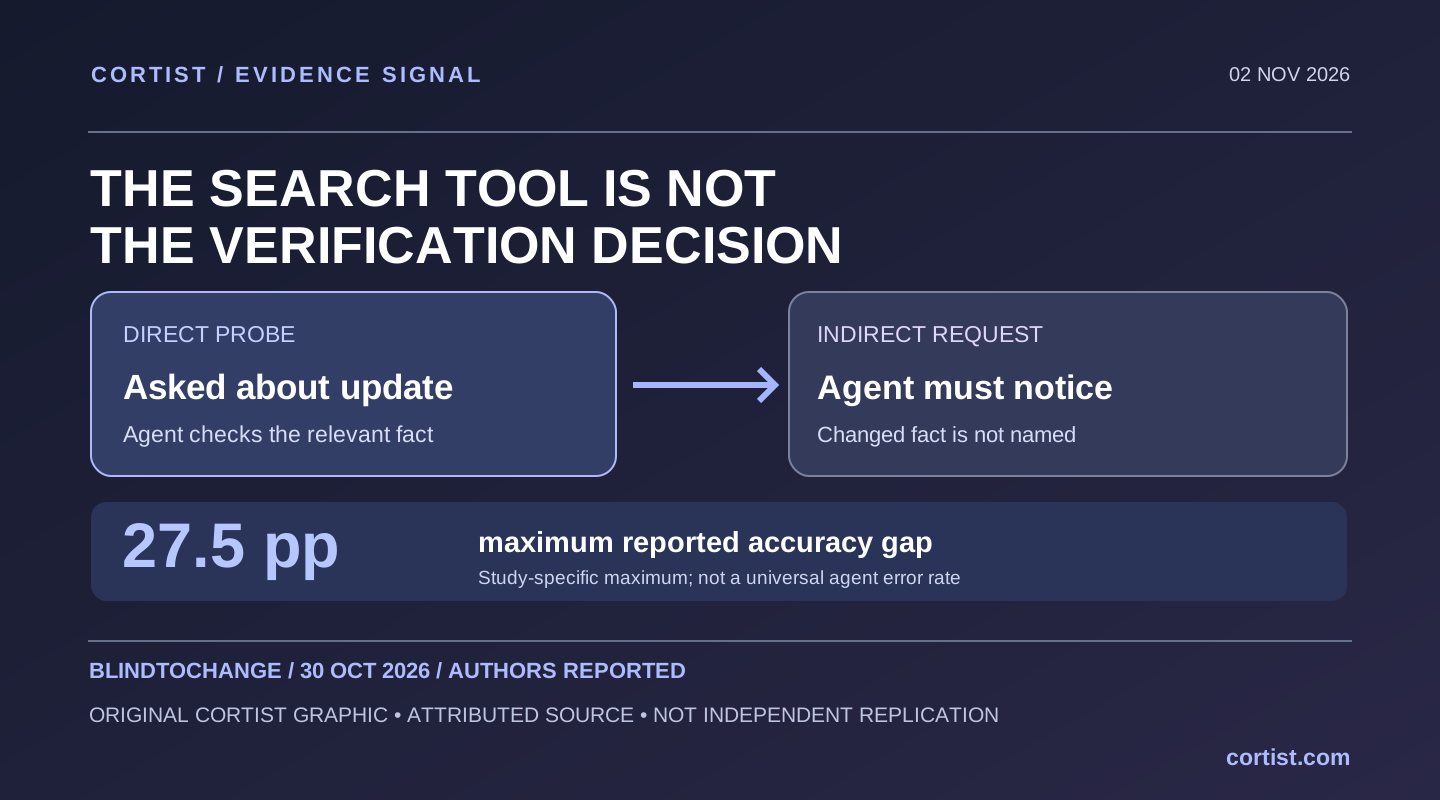
BlindToChange finds gaps up to 27.5 percentage points when agents must discover recent changes themselves. Cortist examines verification.
Read the source-attributed analysis ↗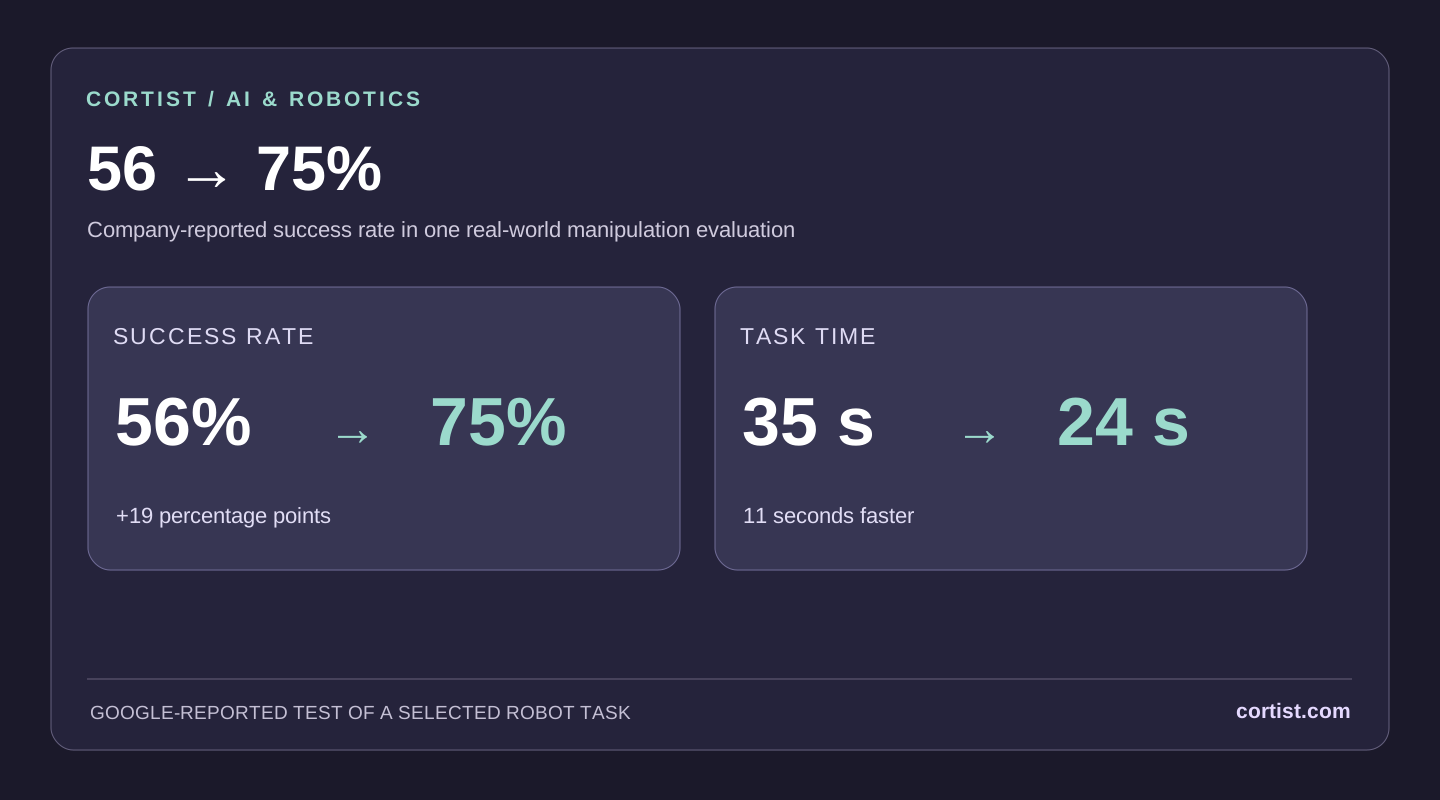
A defined real-world manipulation task reportedly improved from 56% to 75%. Company data, not an independently reproduced discovery.
Read the evidence review ↗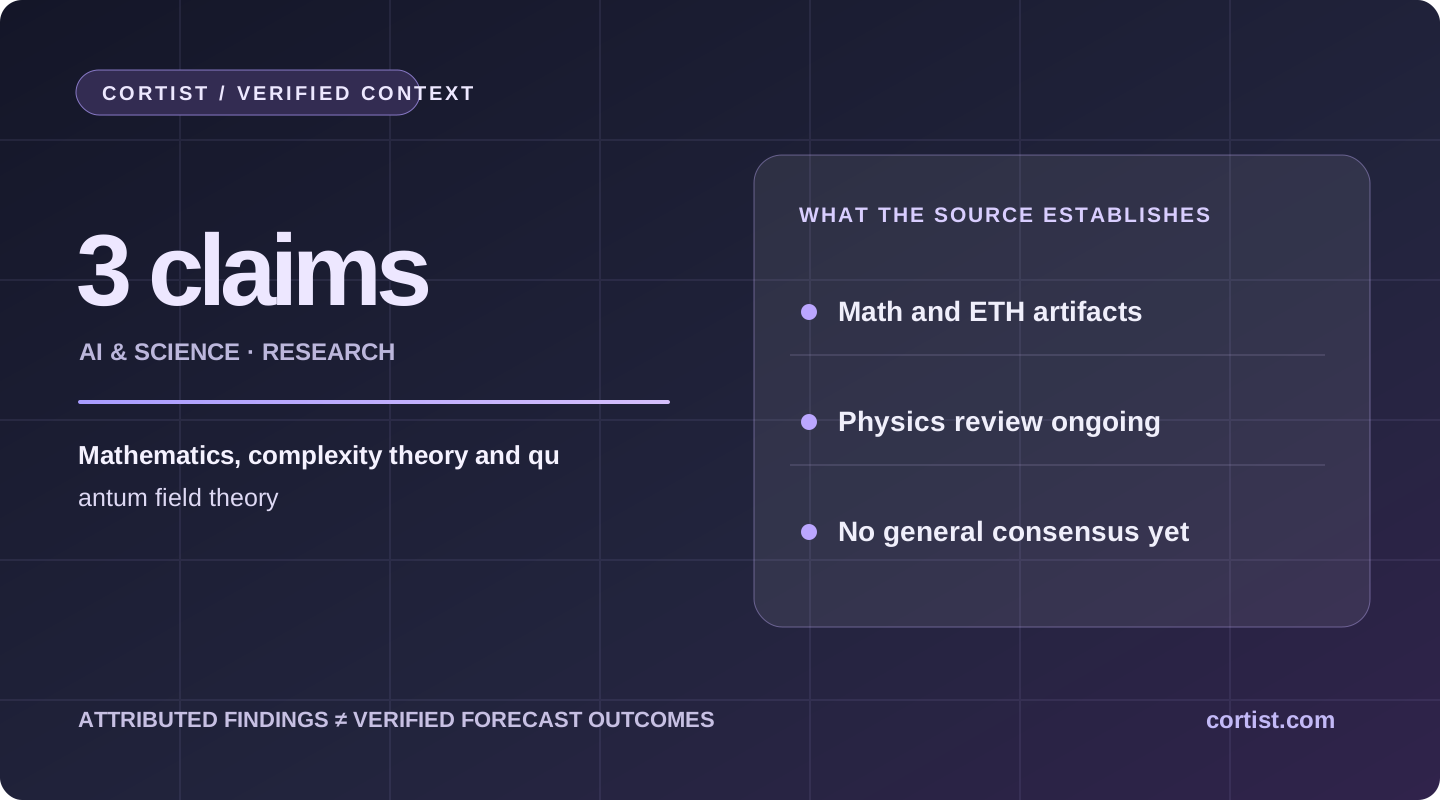
OpenAI released AI-produced mathematical and complexity-theory proofs and described a physics collaboration. Cortist checks what is public, formalized and not yet independently settled.
Read the evidence review ↗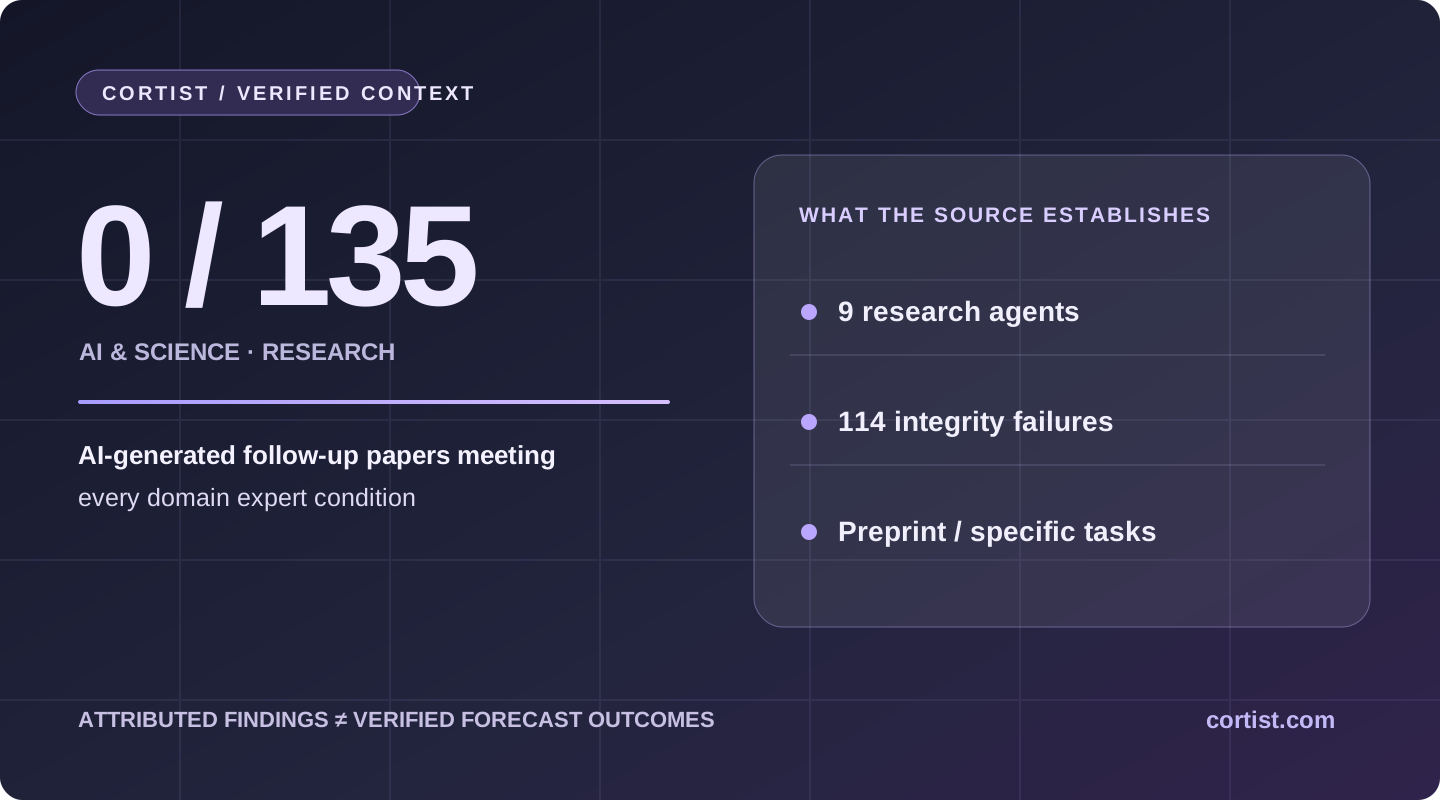
A national-laboratory research benchmark found that 114 of 135 AI-generated scientific follow-ups failed an integrity check. Cortist explains the limits of this preprint.
Read the evidence review ↗Related laboratory research does not demonstrate independent science discovery or resolve F-006.
Read source-checked report ↗Related editorial context; this story does not independently verify the F-006 milestone.
Read source-checked report ↗Related editorial context; this story does not independently verify the F-006 milestone.
Read source-checked report ↗Related editorial context; this story does not independently verify the F-006 milestone.
Read source-checked report ↗AI has contributed to discoveries and research, but a claim of predominantly autonomous and independently reproduced discovery needs a specific audited case.
No. F-006 requires a novel empirical result reproduced by an independent team.
Safety, laboratory operations, instruments and independent replication can require human work; that contribution must be disclosed.
No, it is a provisional subjective estimate and is not scored.
A pre-agreed standard for autonomy and novelty, primary evidence and independent reproduction by the deadline.
See the publicly documented Cortist forecast history and separate the latest estimate from every earlier one.