
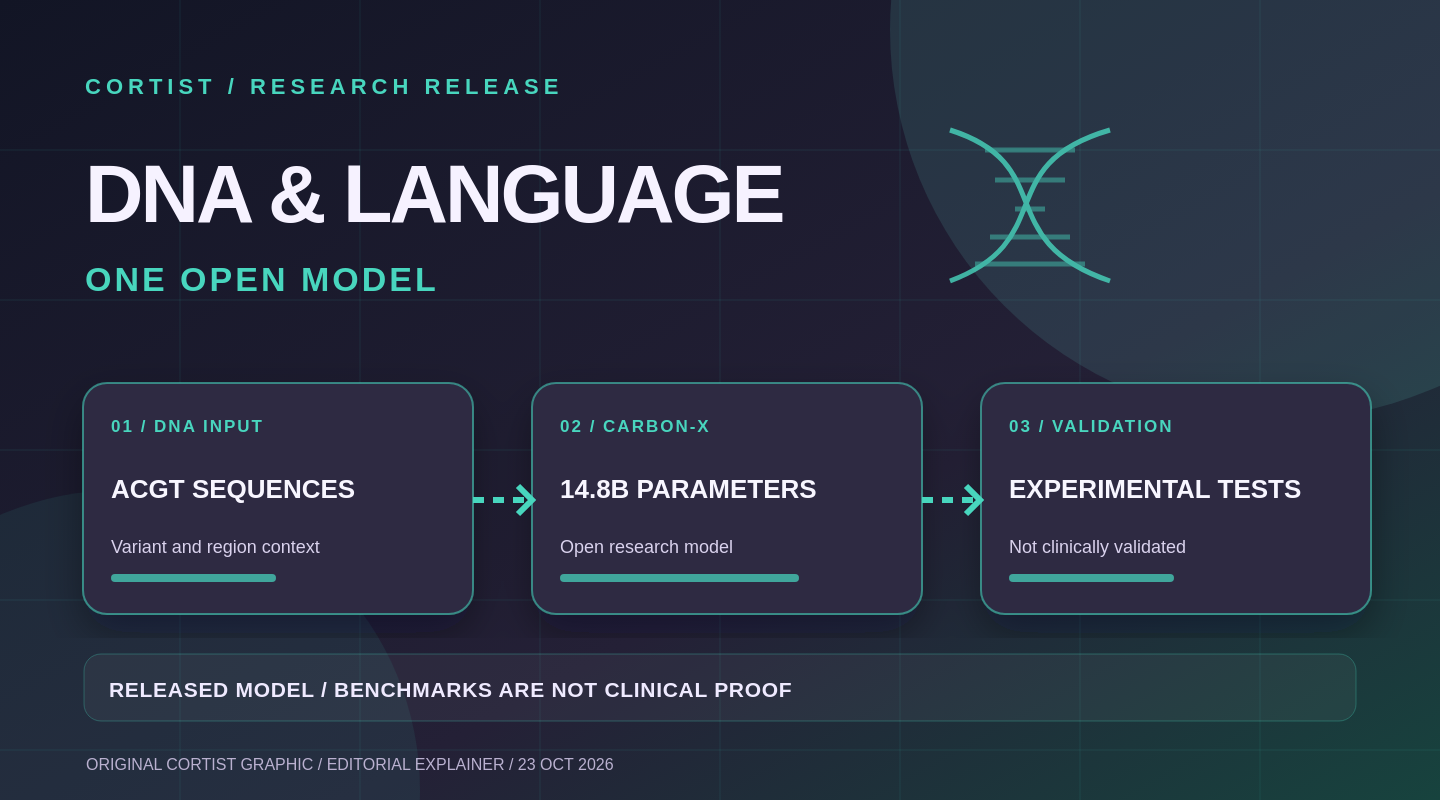
- Carbon-X is an open 14.8-billion-parameter DNA-and-language model released by Hugging Face and research partners, derived from Qwen3-14B.
- Researchers can submit a DNA sequence with a natural-language question to get variant, gene-regulation or sequence-level estimates.
- Its developers report a 66.7% average across five selected DNA benchmarks, compared with 67.5% for GPT-6.1 Sol under different inference conditions.
- Its creators explicitly say it is not clinically validated. Model outputs must not be used to make medical decisions.
The Signal
Hugging Face Biology Research and collaborators at Zhongguancun Academy and Italian research institutes have made Carbon-X openly available. The 14.8-billion-parameter model accepts genomic DNA sequences and ordinary language together, letting researchers ask about mutation effects, gene-regulatory regions and sequence properties inside a chat-style interface.
The model starts from Qwen3-14B and adds a DNA-aware tokenizer. Unlike a generic chatbot that sees strings of A, C, G and T as arbitrary text, Carbon-X can represent sequences as non-overlapping six-base units in a shared DNA-and-language context. The developers say this supports variant-effect predictions, next-base prediction and explanations of biological signals.
Carbon-X is offered under an Apache 2.0 license. Its standard bfloat16 weights can run on one 80 GB GPU, according to the model card, making private research setups conceivable for institutions with sufficient hardware. Local availability does not mean every personal laptop can run the full uncompressed model.
The Shift
Carbon-X's developers report a 66.7% average across five DNA benchmarks, with extended reasoning disabled. Their comparison lists GPT-6.1 Sol at 67.5% under different inference settings. The result suggests that targeted biology training can be competitive on selected genomic tasks without trying to replace the breadth of a general-purpose assistant.
The comparison requires care. Different benchmarks test different properties, and some benchmarks are produced by the Carbon-X team itself. The reported average is not a laboratory demonstration that predictions cause the expected biological effects, and it certainly is not a percentage of correct diagnoses in patients.
Because the weights are available, independent researchers can inspect software, run their own test sets and compare repeatability without routing their unpublished sequences through a closed hosted service. That matters in genomics, where confidentiality of sequence data is often important.
The Cortist Lens
The exciting development here is the growing specialization of open models. Natural-language interaction can lower the friction between bioinformatics code, sequence databases and experimental questions. But translating AI answers into scientific knowledge requires independent biological validation and carefully controlled experiments.
The developers explicitly warn that Carbon-X can miscount bases, confuse coordinates and invent a sequence's identity when prompts lack essential context. Exact sequence edits and position checks still belong in deterministic bioinformatics tools. They also caution that performance on long inputs and some biology tasks is uneven.
Nothing in this release establishes new AGI capabilities or validated clinical medical advice. The most credible next step for a research group is a narrow evaluation on its own annotated sequences, followed by independent experimental testing where appropriate. The software release is real; a medical breakthrough has not been demonstrated.
Researchers can test the download, license, model behavior and benchmark reproducibility immediately. Evidence of biological usefulness requires independent results. This ordinary release report is archived and is not enrolled in ongoing Cortist Evidence Watch.
Carbon-X makes DNA-language research tools more accessible and inspectable. Strong developer-reported benchmarks are a promising starting point, not a substitute for independent experiments or clinical validation.
Primary sources & editorial note
This source-linked standard news item was published on October 23, 2026. Claims concerning benchmarks, pricing, feature support and performance remain attributed to their developers or named customers unless otherwise noted. Editorial context is Cortist analysis. Archive class: Standard News. This report is not enrolled in a dedicated continuous Evidence Watch or monitored forecast register.
Hugging Face Carbon-X model cardPrimary model documentation and limitationsHugging Face release collectionOfficial release artefactsWIRED report, October 23Contemporary independent reportingCarbon-X source repositoryOfficial public source code