
EU AI Act official implementation timeline
European law implementation timing; not evidence of three G20 regimes.
Read original evidence ↗AI governance means the laws, institutions and accountability processes shaping AI development and use. Voluntary principles, binding rules and independent enforcement are distinct. Cortist's provisional F-008 assigns 60% to a defined frontier-AI regulatory milestone by 2032; it is not a scored forecast.
Subjective editorial scenario, not a measured or independently calibrated prediction.
Illustrative cumulative probability. Not automatically inferred from sources. Draft event criteria ↗
It includes legislation, standards, audits, reporting and responsibility for AI. A policy announcement does not itself demonstrate enforced safeguards.
Review Cortist's evidence standard →Evidence should show binding scope, requirements, enforcement and implementation. The proposed 2032 event concerns qualifying regimes, not press statements alone.
Check the F-008 event criteria →Guide clarified 3 November 2026 · Source findings and forecast assumptions below retain their original recorded dates · Editorial standards
A later evidence-based probability update must be published as a new date-stamped version. The initial record remains unchanged.
The initial subjective scenario is now documented. No newer public version or independently scored result exists.
Resolution criteria require independent review before a prospective forecast lock.AI regulation, compliance, incident reporting and accountable public oversight. By the end of 2032 at least three distinct G20 jurisdictions enforce binding predeployment safety evaluations and mandatory serious-incident reporting for frontier general-purpose AI models under public oversight. Cortist provisionally assigns 60% by 2032. The value is a subjective public draft and should not be mistaken for an independently scored statistical prediction.
Evidence Pulse 2.0 checks the published Cortist News index when JavaScript is available. The source-linked, dated research articles remain accessible through Cortist News.
Latest topic-linked reporting, compared with the separately versioned Cortist assessment. News does not automatically update a forecast.
Evidence interpretation: External evaluation initiatives and new governance structures show attention to oversight.
What remains unproven: Voluntary initiatives do not establish enforceable rules in three qualifying G20 jurisdictions.
What to verify next: Enforceable G20 frontier-AI evaluation, reporting and oversight rules in force.
Snapshot of 3 linked reports. Context is not independent proof or a measured probability change. Dated evidence index · Original forecast v0.1.
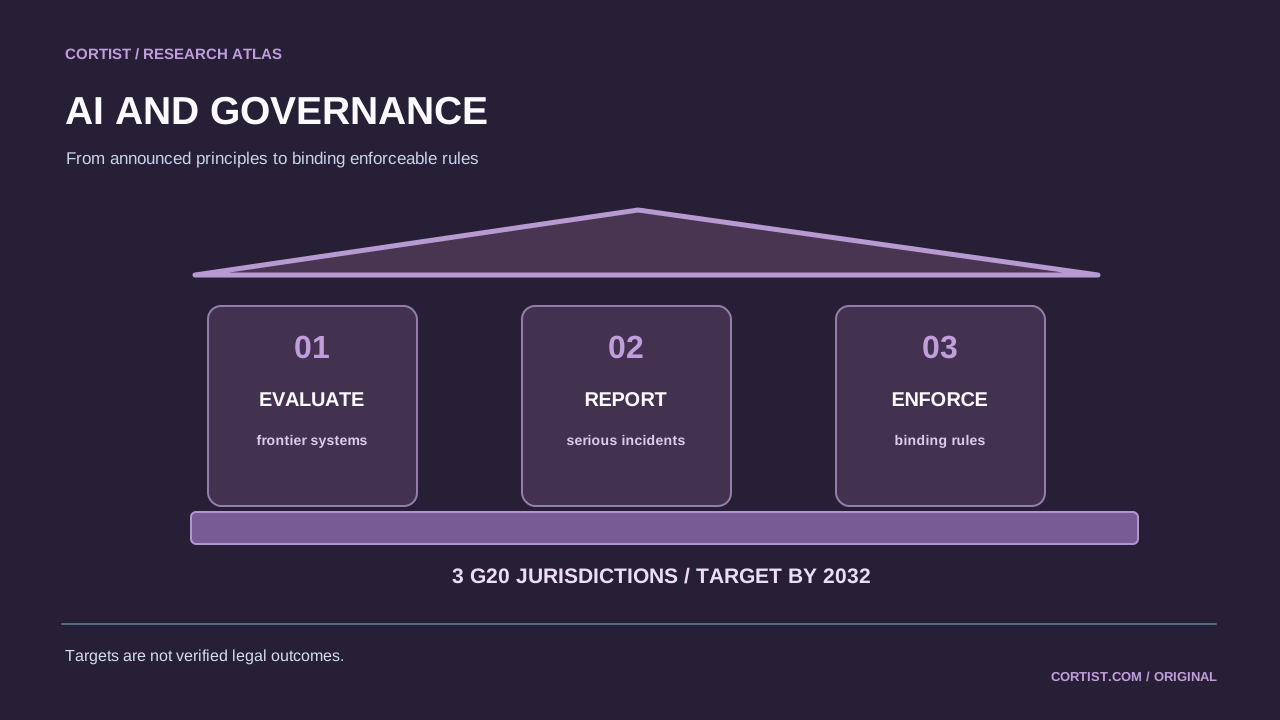
International declarations and voluntary company safety commitments can shape norms, but they do not require the same compliance as a law enforceable by a regulator. The OECD AI Principles are influential intergovernmental guidance; they do not themselves count as one of the binding regimes required by the proposed Cortist forecast.
The European Union has a statutory AI framework with implementation phases and oversight institutions. Its precise obligations, timelines and amendments need tracking through the official AI Act Service Desk rather than stale headlines. A European framework is evidence of regulatory ambition; it is not by itself proof that three distinct G20 jurisdictions satisfy F-008.
The US National Institute of Standards and Technology maintains an AI Risk Management Framework intended for voluntary use. It offers a structured language for evaluation and governance, but adopting that guidance without binding legal duties is not a qualifying outcome. Cortist distinguishes the existence of standards from regulator-enforceable requirements.
Each counted regime must cover a defined frontier model class, require safety evaluation before deployment, mandate reporting of serious incidents and empower an independent public body to inspect or penalize violations. Passing only one or two requirements does not resolve the event. Regulations that never enter force are excluded.
The G20 includes major AI economies with different legal traditions. Widespread convergence could improve comparability, clarify liability and reduce inconsistent safety expectations. Yet a count of laws cannot alone prove they are effective, scientifically grounded or fairly enforced; outcome quality requires separate research.
Four requirements that make public rules enforceable.
New binding statutes, regulator staffing, implementing rules and incident-reporting systems could increase confidence. Diluted legislation, long implementation delays, divergent definitions of frontier models and weak enforcement capacity could decrease it. Compliance announcements and model-provider self-assessments must be verified against actual legal authority.
Cortist's initial F-008 estimate is 60% by 2032. It is a subjective cumulative forecast about meeting a precisely counted legal threshold, not an endorsement of any particular regulatory approach. The slider uses disclosed assumptions; it does not update automatically when a government releases a press statement.
An independent legal review must define jurisdiction counting, effective dates, grandfathering, serious-incident categories and which public bodies qualify as independent oversight. Because the target depends on future legal changes, source documents should be archived with effective dates. The first v0.1 probability remains intact when later evidence motivates an update.
Cortist monitors original datasets, official measurements and independent evaluations rather than treating manufacturer, researcher or policymaker claims as settled outcomes. Any material reassessment must disclose the previous value, the new evidence, counterarguments and the reason for changing the subjective assessment. The older snapshot will remain at its original versioned URL.
Before this question becomes eligible for formal scorekeeping, independent reviewers must agree on the boundary of the event, adjudication rules, data sources and any necessary fallback measurement. If an essential definition changes, a fresh forecast question will be published instead of rewriting an old one.
European law implementation timing; not evidence of three G20 regimes.
Read original evidence ↗Voluntary risk-management standard, not an enforceable law.
Read original evidence ↗International principles are soft-law guidance, not binding requirements.
Read original evidence ↗Comparative governance and AI policy context.
Read original evidence ↗Source summaries distinguish historical measurements, institutional research and forward-looking claims. None independently validates the 60% draft probability.
General intelligence is not established by progress on any single specialized metric.
Explore AGI ↗CONNECTED RESEARCHCompute and AI deployment depend on physical infrastructure and electricity.
Explore energy ↗CONNECTED RESEARCHLabor-market outcomes must be measured independently from technical capability.
Explore jobs ↗Three existing Cortist articles with related research, economics or governance context. Original articles and their primary classifications remain unchanged.
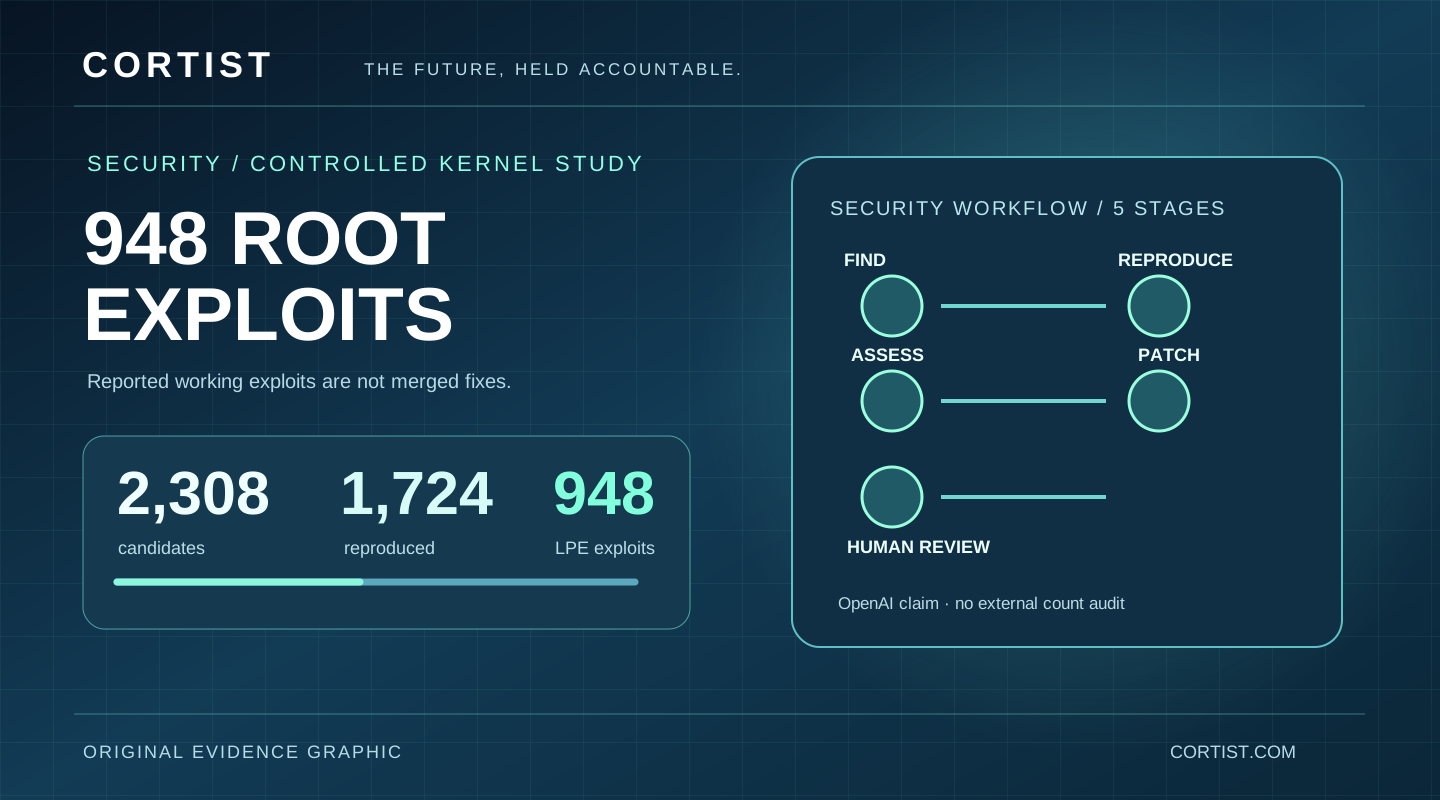
OpenAI says its cyber-agent pipeline reproduced 1,724 Linux flaws and demonstrated 948 local root exploits for $1.21M. Maintainer-verified fixes remain a separate question.
Read the evidence review ↗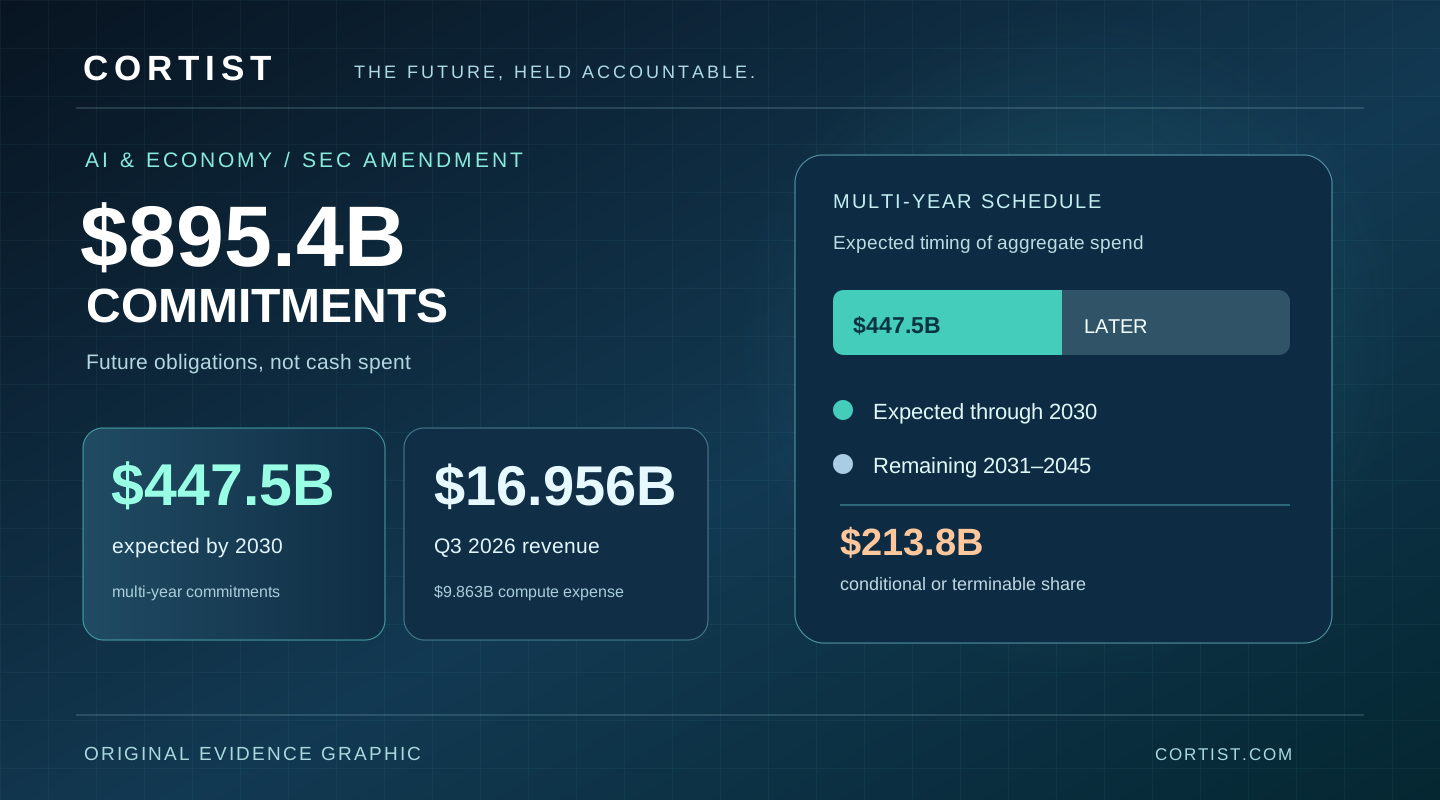
Anthropic’s November 2 S-1 amendment adds Q3 figures and $895.4B in compute-heavy commitments. Cortist separates obligations, costs and profit.
Read the source-attributed analysis ↗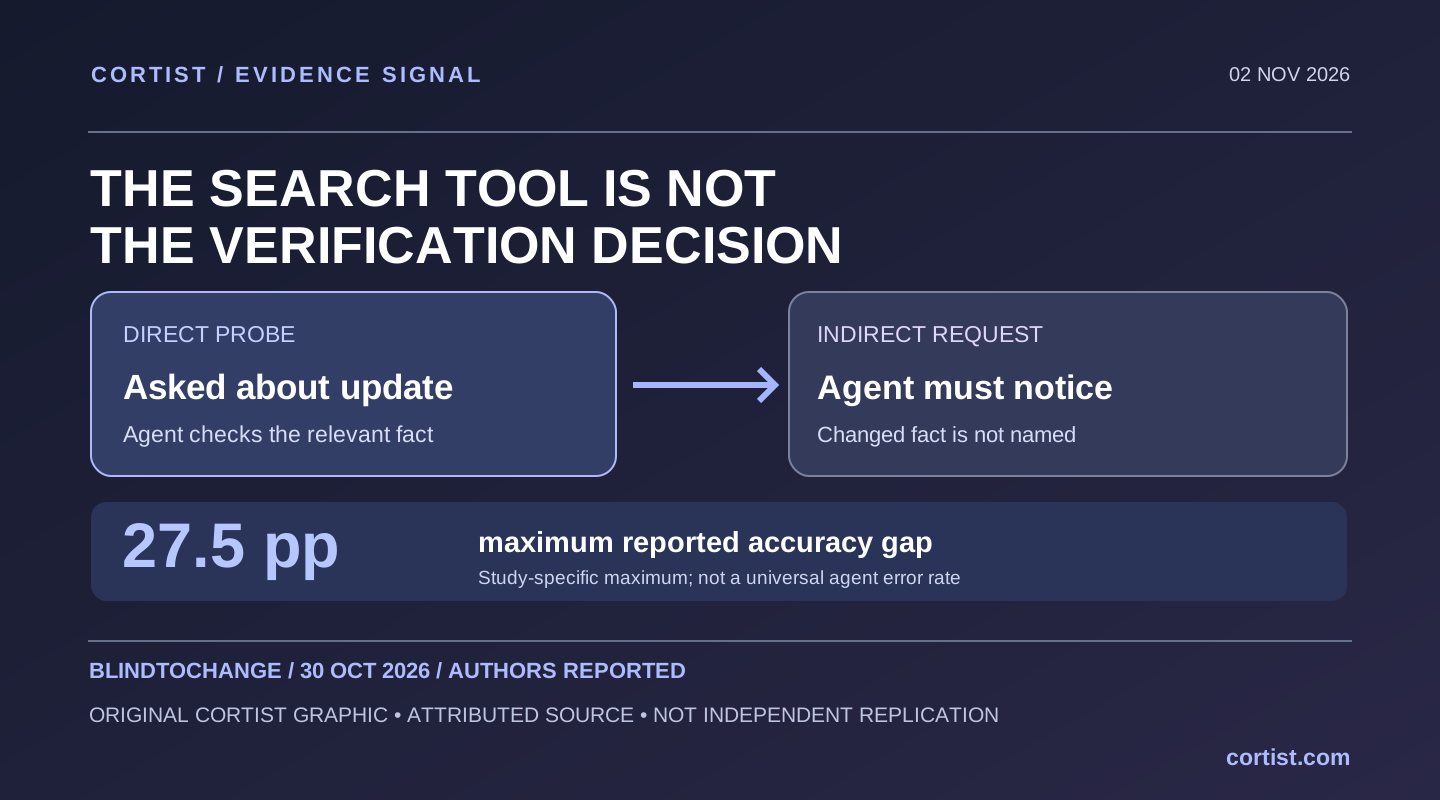
BlindToChange finds gaps up to 27.5 percentage points when agents must discover recent changes themselves. Cortist examines verification.
Read the source-attributed analysis ↗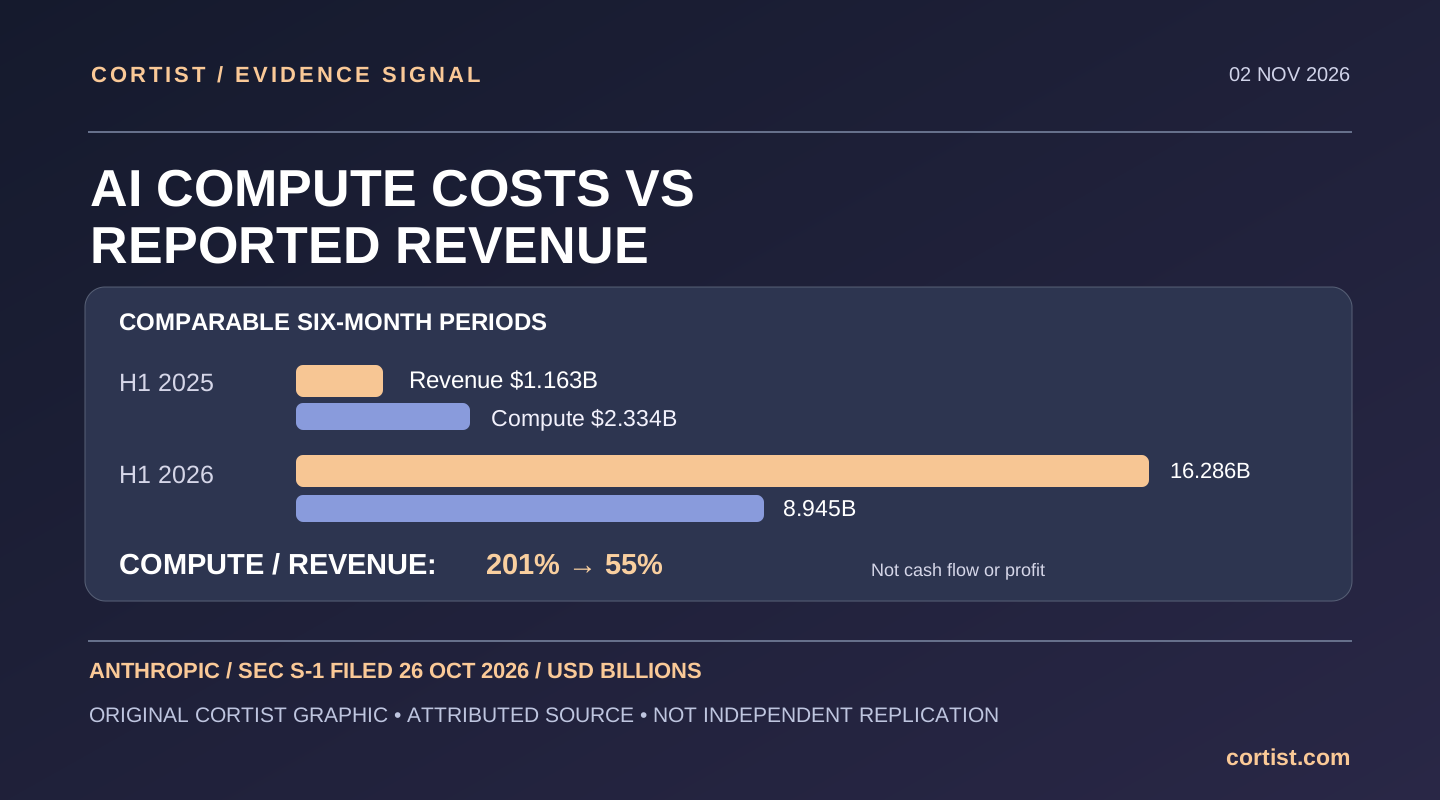
Anthropic's SEC S-1 reports $16.286B revenue and $8.945B compute expense over six months. Cortist separates growth from accounting losses.
Read the source-attributed analysis ↗Related editorial context; this story does not independently verify the F-008 milestone.
Read source-checked report ↗Related editorial context; this story does not independently verify the F-008 milestone.
Read source-checked report ↗Related editorial context; this story does not independently verify the F-008 milestone.
Read source-checked report ↗No. They guide policies but do not constitute an enforceable national frontier-AI regime.
No. F-008 requires three distinct qualifying G20 jurisdictions and specific legal obligations in force.
Binding predeployment safety evaluation, serious-incident reporting and oversight with legal enforcement authority.
No. It is a provisional subjective Cortist editorial estimate, not independently scored.
Enacted laws, implementing regulations and actual oversight can support a new versioned probability with documented sources.
See the publicly documented Cortist forecast history and separate the latest estimate from every earlier one.