
EU AI Act official implementation timeline
European law implementation timing; not evidence of three G20 regimes.
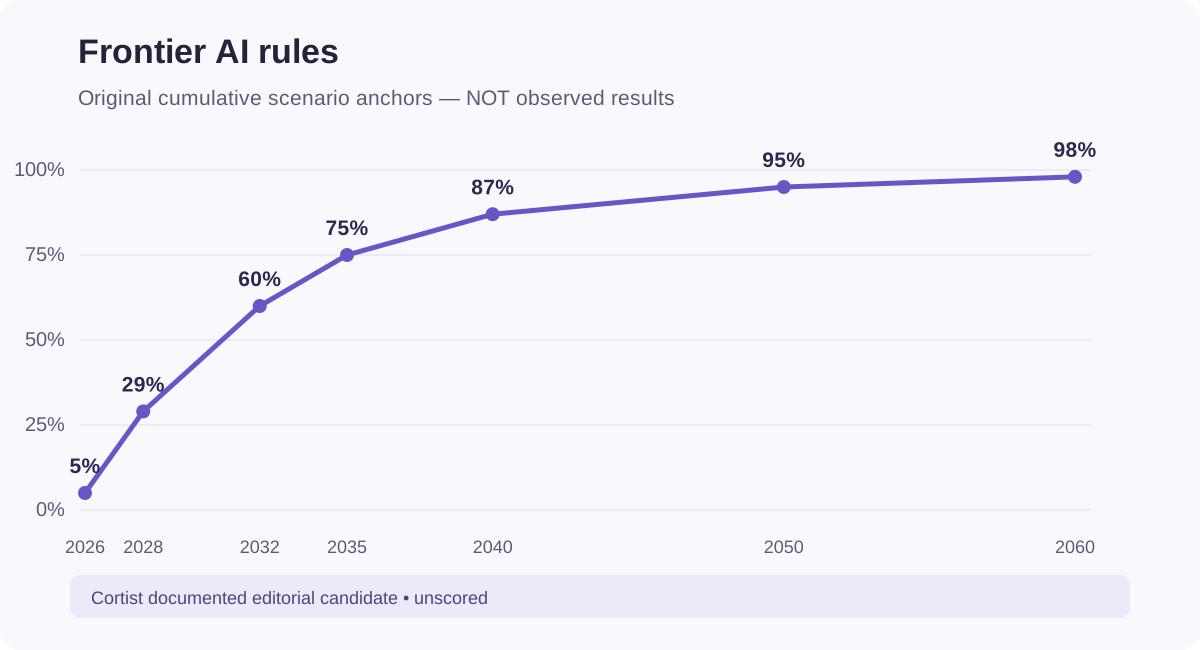
Read original evidence ↗By 31 December 2032, will at least three G20 jurisdictions enforce binding predeployment frontier-AI safety evaluations and serious-incident reporting through an independent public oversight authority? This forecast uses a provisional subjective 60% initial estimate and awaits independent review of its rules.
Recorded: 26 October 2026. Version: v0.1. Not independently locked, calibrated or scored.
This is an original provisional v0.1 subjective probability, not a measured or independently locked forecast. The stored draft and any historical numbers remain unchanged.
3 G20 jurisdictions with enforceable rules. A company announcement is not a substitute for independently verifiable evidence.
An international declaration can influence policy without creating legal duties for AI developers. F-008 distinguishes voluntary principles from enforceable rules: a qualifying jurisdiction needs both safety evaluation before deployment and serious-incident reporting backed by an authority capable of oversight and sanctions.
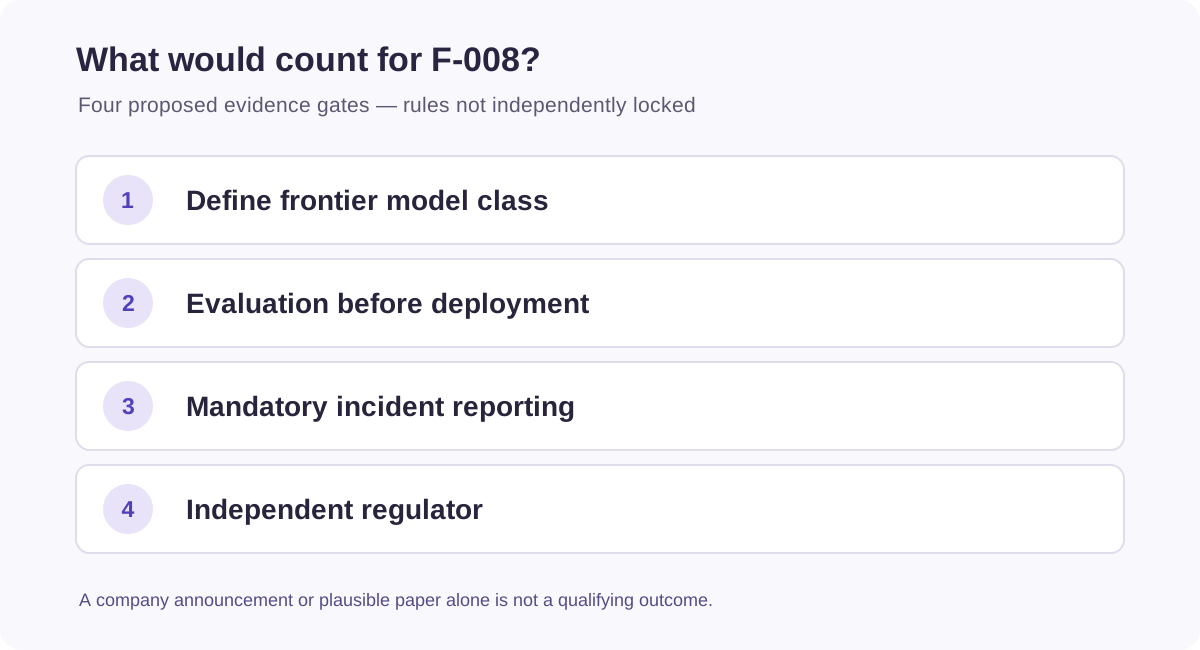
A press conference announcing legislation, a voluntary developer commitment or a general AI ethics policy cannot by itself count toward the required three jurisdictions. Future implementation delays, exceptions and definitional differences can all affect the count.
The proposal counts distinct G20 jurisdictions only after the relevant obligations are in force for a defined frontier AI model class. Legal texts, implementation dates and regulator enforcement powers must be checked independently. Partial requirements do not add up to one qualifying regime.
Required part of the proposed evidence path; one step alone cannot settle the question.
Required part of the proposed evidence path; one step alone cannot settle the question.
Required part of the proposed evidence path; one step alone cannot settle the question.
Required part of the proposed evidence path; one step alone cannot settle the question.
The historical forecast record above contains the complete original draft criteria. Those historical rules are not being retrospectively changed by this expanded explanation.
The most valuable evidence is actual legal text, entry-into-force notices, regulatory guidance and public enforcement or inspection authority. Cortist would need an agreed rule for contested jurisdiction scope before converting the current provisional 60% into a scoreable commitment.
An announcement, a source-attributed observation, an independent replication and a formally resolved forecast are separate types of evidence. Cortist should preserve the difference when judging later developments. Until the rules are independently frozen, this question cannot add a legitimate score to a forecasting track record.
No. Binding requirements enforced by a competent public authority are needed.
No. The relevant evaluation and incident-reporting requirements must be legally effective by the deadline.
No. It is a provisional subjective draft, with unresolved formal criteria.
These source documents were already cited in the original forecast. The links support contextual review; their presence is not an independent replication or confirmation of an outcome.
Inspect the original machine-readable F-008 v0.1 forecast record
Substantive explanatory update: 29 October 2026. Historical data, original publication dates, probabilities, sliders and scoring eligibility are unchanged.
By 31 December 2032, will at least three G20 jurisdictions enforce binding predeployment frontier-AI safety evaluations and serious-incident reporting through an independent public oversight authority?
An independent reviewer must approve precise datasets, sampling or evaluation thresholds and adjudication rules. No retrospective revision of the event is permitted for formally scored versions. The current draft remains unscored.
International declarations and voluntary company safety commitments can shape norms, but they do not require the same compliance as a law enforceable by a regulator. The OECD AI Principles are influential intergovernmental guidance; they do not themselves count as one of the binding regimes required by the proposed Cortist forecast.
Each counted regime must cover a defined frontier model class, require safety evaluation before deployment, mandate reporting of serious incidents and empower an independent public body to inspect or penalize violations. Passing only one or two requirements does not resolve the event. Regulations that never enter force are excluded.
Cumulative scenario anchors: 2026: 5% · 2028: 29% · 2032: 60% · 2035: 75% · 2040: 87% · 2050: 95% · 2060: 98%. These are subjective assumptions, not an empirically calibrated estimate. They should be challenged with independent evidence, not interpreted as precise forecasts.
European law implementation timing; not evidence of three G20 regimes.
Read original evidence ↗Voluntary risk-management standard, not an enforceable law.
Read original evidence ↗International principles are soft-law guidance, not binding requirements.
Read original evidence ↗Comparative governance and AI policy context.
Read original evidence ↗Initial 60% probability documented on 26 October 2026. A later adjustment would require a separate new snapshot, archived assumptions and sources.
Read research background, uncertainties and use the interactive year slider.