Artificial superintelligence (ASI) means hypothetical AI that substantially surpasses leading human experts across many intellectual domains—not simply human-level AGI. No arrival date is independently verified. Cortist’s provisional, unscored F-002 estimate is a 24% chance of independently verified ASI by 31 December 2040.
Provisional chance of independently verified ASI by 2040
Model v0.1 working judgment, October 22, 2026. Not a statistical measurement and not yet eligible for scoring: resolution criteria must be locked first.
Selected horizon31 DEC 2040
RecordF-002 · DRAFT
VerificationNOT LOCKED
20262070
Cumulative chance by year-end · Subjective model v0.1 · Method ↗
Start with the definition and evidence threshold. Explore the provisional forecast, original record and dated research below.
What is artificial superintelligence?
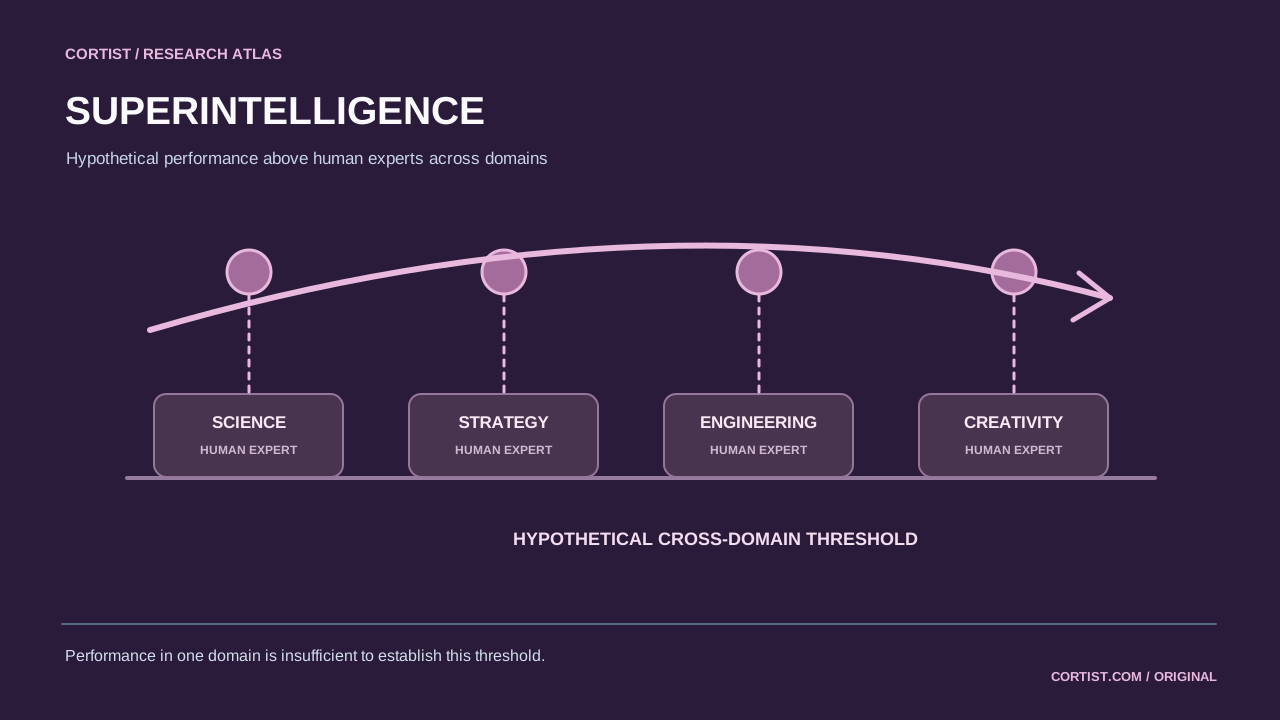
ASI refers to hypothetical AI capability far above leading human experts across many intellectual domains. It is not equivalent to a chatbot or a system that tops one benchmark.
There is no verified arrival date. Cortist’s F-002 v0.1 assigns a provisional, subjective 24% chance of independently verified ASI by 31 December 2040. The criteria are not locked and the forecast is not scored.
AGI concerns broad transferable competence across tasks. ASI goes substantially beyond the strongest human experts in many domains. Evidence for one would not automatically prove the other.
Independent evaluators would need transparent, repeatable evidence of sustained capability far above human expertise across diverse domains—not a single vendor demonstration. There is no universal resolution standard.
ASI ≠ AGIHUMAN-LEVEL VS BEYOND HUMAN-LEVELINDEPENDENT EVIDENCE REQUIREDUPDATED 22 OCT 2026
CORTIST REFERENCE GUIDE · 26 OCTOBER 2026 · SOURCE-FIRST
Artificial superintelligence explained: definitions, evidence and timing
In brief
Artificial superintelligence (ASI) is a hypothetical AI system whose broad intellectual abilities substantially surpass leading human experts. There is no independently accepted ASI milestone. Cortist’s F-002 is a preliminary, subjective 24% cumulative estimate by the end of 2040, not a measured or scored probability.
Evidence Pulse 2.0 checks the published Cortist News index when JavaScript is available. The source-linked, dated research articles remain accessible through Cortist News.
CORTIST / EVIDENCE PULSEIndex checked 27 Oct 2026
Evidence archive · 27 October 2026
Latest topic-linked reporting, compared with the separately versioned Cortist assessment. News does not automatically update a forecast.
Forecast / latest public versionUnchanged: 24% (v0.1)Original record: Oct 22, 2026
Coverage since first draft1 report published after first draftLatest linked news: Oct 24, 2026
Original Cortist topic-specific research illustration. Superintelligence evidence map: capability across distinct domains matters more than one exceptional benchmark. Hypothetical, not observed.
AGI and ASI are not the same milestone
AGI concerns broad, adaptable capability across many tasks, with the exact threshold dependent on a stated definition. ASI adds a much more demanding question: can a system substantially outperform leading humans across strategically important domains and sustain that performance outside curated demonstrations? Superhuman play in a game or superior performance on selected exams is not proof of superintelligence.
A defensible classification would distinguish breadth, peak performance, autonomy and reliability. Google DeepMind’s Levels of AGI helps illustrate why generality and performance should be measured separately. This distinction matters because a forecast about AGI cannot simply be relabeled as a forecast about ASI.
Possible paths from current systems to ASI
One possibility is incremental progress through larger models, better training, stronger tools and more reliable agent workflows. Another involves AI-assisted research accelerating parts of model development. Other paths could face bottlenecks in energy, data, hardware, evaluation, coordination or real-world deployment. These are conditional scenarios, not a known sequence of events.
Self-improvement is a research question rather than an automatic consequence of achieving AGI. A system that writes code or recommends experiments does not necessarily have the resources, authorization, independent validation or operational continuity needed to rapidly redesign itself. The speed of a transition, if any, therefore remains deeply uncertain.
What would credible evidence look like?
Evidence would need independent assessment across multiple hard and unfamiliar domains, credible comparisons against expert teams and sustained reproducibility. Evaluate performance on new research problems, not only historical exams. Inspect failures, dependencies on human reviewers, costs, tool access, adversarial resilience and whether results survive replication at a different institution.
The 2026 International AI Safety Report distinguishes observed advances from uncertain future capabilities and describes major disagreement about high-end scenarios. This is a reason to document both acceleration and counterevidence. Governance claims also need their own evidence: passing a benchmark is not proof that a system is controllable, safely deployed or economically transformative.
How to evaluate an ASI claimSuperhuman results on one test do not establish broad superintelligence.
01BreadthMany important fields
02DepthBeyond top human experts
03NoveltyUnseen, hard problems
04ReplicationIndependent confirmation
Cortist original conceptual evaluation diagram. No superintelligent system or timeline is implied.
How to read the Cortist ASI forecast
F-002’s 24% by 2040 refers to the cumulative probability assigned by Cortist’s provisional model v0.1 to its intended ASI event by year-end 2040. The curve is an editorial forecast, not data points collected from reality. Its criteria are not independently locked, and there are no resolved or scored ASI outcomes. The existing year slider remains available for exploring this preliminary view.
New independent evaluations, reproducible scientific breakthroughs, robust capability plateaus or meaningful limitations in deployment could change the assessment. Changes would require a dated, transparent forecast revision while preserving the originally published values and evidence trail. Statements by individual researchers should retain their original definitions, dates and uncertainty.
How AGI and ASI differ
AGI is about adaptable competence over many types of work. ASI adds a far more demanding threshold: strong and repeatable performance beyond expert human ability across multiple important domains. Excellence in chess, mathematics or programming alone would not establish either broad milestone. A credible comparison must disclose model, tasks, tools and expert baselines.
Google DeepMind’s Levels of AGI separates breadth from depth and treats autonomy as an additional consideration. The framework is a research proposal, not an organization that officially certifies AGI or ASI.
Could AI research automation accelerate progress?
Systems that help write code, design experiments or evaluate models might shorten some development cycles. But recommendations are not automatically valid breakthroughs. Compute budgets, high-quality data, verification, human judgment, physical infrastructure and deployment constraints may remain limiting factors.
Recursive self-improvement is therefore a scenario requiring evidence at every stage, not a known consequence of reaching AGI. Analysts should distinguish measured automation of individual research tasks from confirmed accelerated end-to-end research progress.
What would independent proof look like?
Outside evaluations should include genuinely new challenges across science, planning, abstraction and unfamiliar work. Results should be reproducible under transparent rules, with failure cases and assistance reported. A company’s strongest selected demonstration is not enough to establish general superhuman ability.
A claim about ASI also requires a prior event definition. Independent researchers need to know which domains count, how “better than humans” is measured and how sustained reliability is tested. It remains possible to improve selected benchmarks without satisfying those requirements.
How to read F-002 without false precision
F-002 model v0.1 assigns a 24% cumulative subjective chance by 2040. It is not the result of repeated observed ASI events or an independently scored forecast; its criteria are still provisional. The values on the historic year slider are preserved as originally published editorial assumptions.
Predictions from outside experts can use inconsistent definitions of “human-level” or “superintelligent” AI. Cortist records their dates and original wording rather than merging them into a single inevitable timeline. See the forecast record.
Does superintelligence automatically create existential risk?
No. A capability milestone describes what a system might be able to do, whereas actual harm would depend on behavior, permissions, oversight and deployment. A result showing strong technical ability does not by itself prove loss of control or predict a catastrophe.
The International AI Safety Report 2026 describes uncertainty and disagreement over extreme scenarios. Those questions belong in a separate risk assessment with explicit mechanisms and evidence boundaries.
Cortist evidence analysis · 26 October 2026
Expert assessment: what the research supports
The Levels of AGI taxonomy illustrates why generality, performance and autonomy need separate definitions. A researcher claiming broad superhuman intelligence would need to show repeatable results across unfamiliar domains and comparisons with suitable experts, rather than highlight a single impressive benchmark.
The International AI Safety Report 2026 documents uncertainty and disagreement about the trajectory of advanced systems. Cortist’s F-002 24% by 2040 is a provisional cumulative judgment. A capability claim also does not independently prove a loss-of-control pathway.
Research sources and limitations
Use each original source within its stated scope. An expert forecast is not evidence of a resolved event.
We distinguish academic definitions and scenario analyses from precise probability forecasts. Dates and definitions matter.
12 JUN 2026GOOGLE DEEPMIND · RESEARCH
From AGI to ASI
DeepMind discusses artificial general superintelligence as cognitively more capable than large organizations of humans, exploring scaling, AI paradigm shifts, recursive improvement and multi-agent collectives. The paper does not establish a fixed arrival date.
A foundational definition emphasizes performance far beyond the best human brains across virtually all significant cognitive domains. This is much stronger than beating humans at chess, coding or one benchmark.
Research discussion continues to distinguish superintelligence as a hypothetical capability level from broader uses of the phrase in politics and marketing. The lack of a universal test is a central obstacle to a scored forecast.
11 dated source records, 4 years. Direct original references; no new news articles.
A chronological research and public-statement archive, not a leaderboard. Every entry identifies the speaker, publication date, location, core claim and what the statement does not prove. Summaries are editorial paraphrases, not invented direct quotes.
2026
SAFETY / POLICY
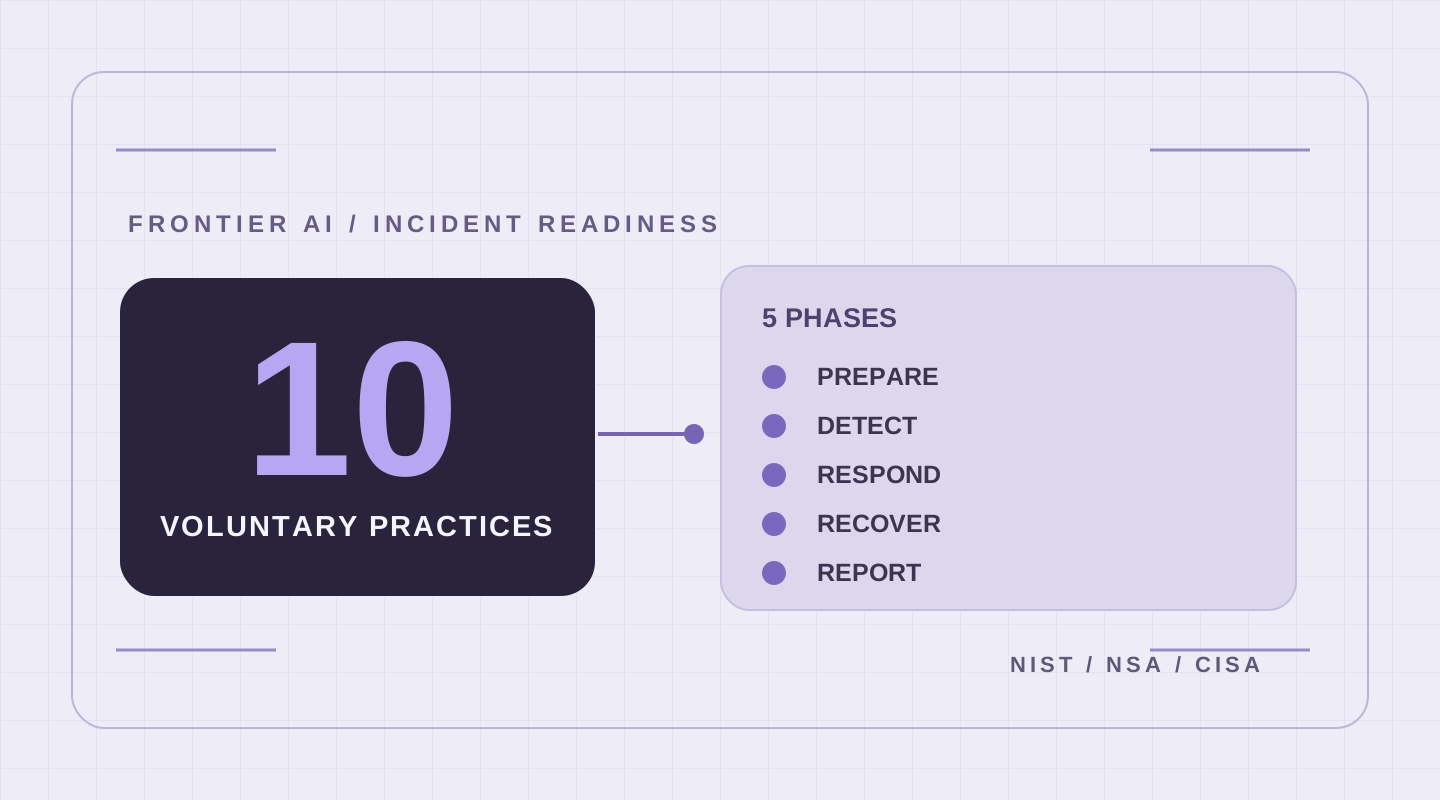
NIST, NSA and CISA
Ten practices for advanced-agent incident readiness
US agencies published voluntary practices covering preparation, detection, response, recovery and reporting during advanced-agent training and evaluation.
Context: US government policy calls this super intelligence; it is NOT proof of research-level ASI.
Pachocki reflected on reasoning-model progress and wrote that researchers should take seriously the prospect of machines meaningfully smarter than ourselves within their lifetimes.
Context: Personal long-horizon assessment; no ASI arrival date or independently demonstrated ASI.
Tim Genewein, Shane Legg and Google DeepMind coauthors
Four possible pathways from AGI to ASI
Researchers surveyed scaling, paradigm shifts, recursive improvement and large-scale multi-agent collectives as possible routes beyond AGI, stressing major uncertainty and bottlenecks.
Context: Conceptual research; the report supplies no single agreed arrival year.
Superintelligence needs new social and economic institutions
OpenAI presented exploratory policy proposals intended for a transition toward superintelligence, emphasizing public participation and institutions rather than only capability milestones.
Context: A policy agenda, not a statement that ASI already exists.
Meta publicly set out a personal-superintelligence vision
Zuckerberg argued that personal superintelligence should amplify individual agency and said Meta would direct its research and product efforts toward that future.
Context: Strategic vision and company ambition, not a verified ASI system.
Altman shifted public emphasis beyond AGI toward superintelligence
Altman wrote that OpenAI was beginning to aim beyond its traditional AGI framing toward superintelligence and the prospect of much faster scientific discovery.
Context: Executive ambition; no verifiable timeline or proof of superintelligence.
OpenAI said superintelligence could arrive within the 2020s
In launching its superalignment effort, OpenAI stated its belief that superintelligence could arrive during that decade and described the need for new methods to control systems much smarter than humans.
Context: Historical organizational outlook, conditional and unscored; not evidence of arrival.
A ten-year scenario for systems beyond expert-level capability
The authors argued that systems surpassing expert skill in most domains within ten years were conceivable and proposed special international coordination and audits.
Context: Scenario analysis rather than a numerical probability or independently resolved ASI forecast.
Only a publicly reproducible capability demonstration can support the eventual outcome. Lab press releases and benchmark records alone are not sufficient.
01
Breadth
Superior results across scientific, reasoning, planning and other broadly relevant domains.
02
Depth
Performance compared with expert human teams, not merely an average person.
03
Reliability
Repeatable results on unfamiliar and long-horizon tasks, with limitations exposed.
04
Verification
Public independent assessment under criteria fixed before scoring begins.
No. AGI refers to general human-level capabilities; ASI is a much higher, broadly superhuman threshold. The exact boundaries are debated.
Does 24% mean ASI is 24% complete?
No. It is a subjective model v0.1 estimate of whether an independently verifiable system could exist by the end of 2040. It is neither measured progress nor a locked forecast.
Can a new announcement prove ASI exists?
Not by itself. We require clearly defined capabilities, independent evidence and documented resolution rules. Our news coverage provides context, not automatic verdicts.
ONE PUBLIC RECORD
Two questions. Two different thresholds.
Compare our AGI watch with superintelligence and see why definition, evidence and time horizon matter.
Curated from all 32 published Cortist reports · 3 relevant to this topic. Cross-topic links are context, not evidence that a forecast has resolved. Explore the complete news archive.
Explore the other Cortist research topics:AI Agents · AI in Medicine · AI & Energy. Each has a separate forecast with explicit evidence and uncertainty.