
Will artificial superintelligence
be verified by 2040?
An explicitly preliminary forecast with a fixed proposed deadline. It is not yet a scored commitment.
Understanding the Superintelligence forecast
This is an original provisional v0.1 subjective probability, not a measured or independently locked forecast. The stored draft and any historical numbers remain unchanged.
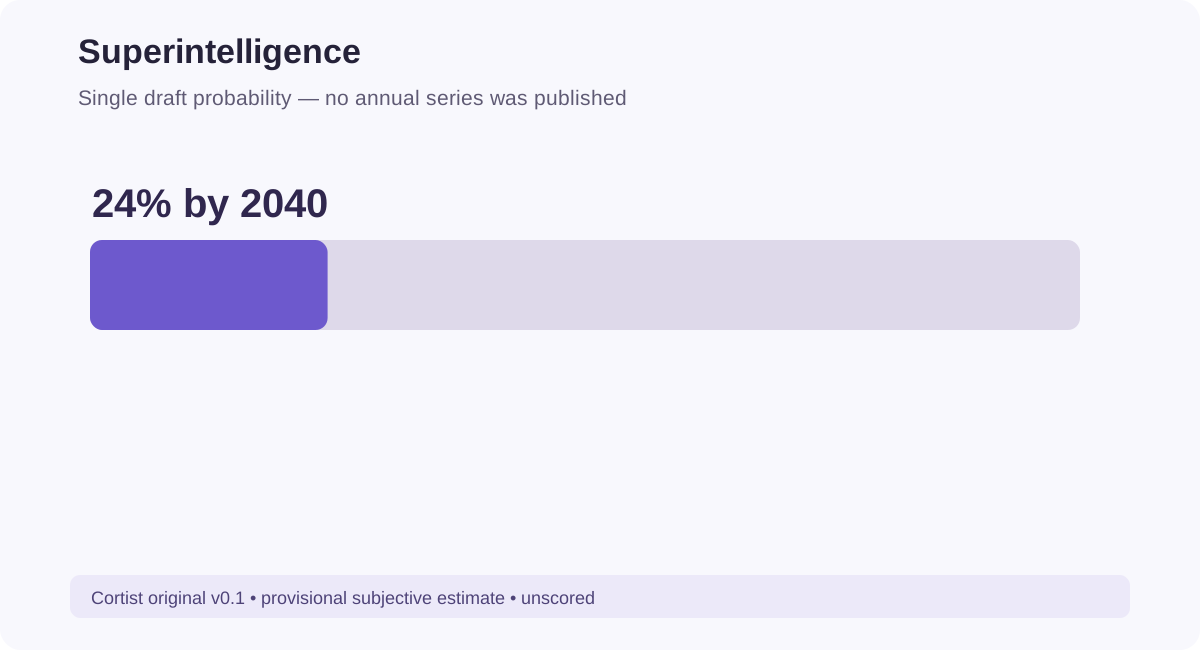
24% by 2040. A company announcement is not a substitute for independently verifiable evidence.
What the original data does and does not say
Superintelligence is a substantially more demanding claim than human-level generality. A system might match skilled people on diverse tests and still not substantially outperform the best coordinated expert teams. Cortist therefore separates AGI from ASI and does not infer the stronger event from progress toward the weaker one.
A frontier model surpassing humans on one mathematical contest, scientific benchmark or game would be relevant context but would not establish broad superintelligence. Comparisons can be skewed by how human teams are selected, how much time and tool use are permitted and whether the AI has seen similar tasks.
What would make this claim checkable?
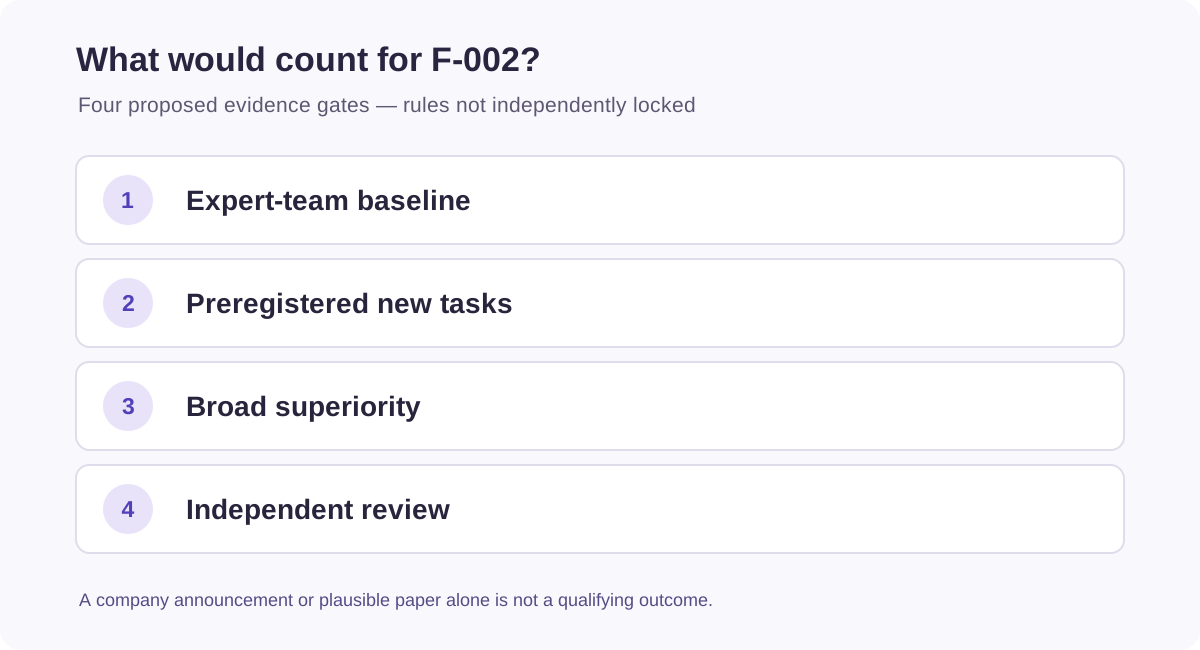
A credible evaluation needs to specify which expert teams form the baseline, which domains qualify, how far beyond human performance the AI must perform and how often that advantage must repeat. Preregistered novel tasks and transparent access are essential to avoid selecting only the most favorable demonstrations.
Required part of the proposed evidence path; one step alone cannot settle the question.
Required part of the proposed evidence path; one step alone cannot settle the question.
Required part of the proposed evidence path; one step alone cannot settle the question.
Required part of the proposed evidence path; one step alone cannot settle the question.
The historical forecast record above contains the complete original draft criteria. Those historical rules are not being retrospectively changed by this expanded explanation.
What evidence could change the assessment?
The strongest future evidence would combine broad, reproducible performance margins with independent tests and an agreed dispute process. If an apparent breakthrough depends on inaccessible systems or undisclosed evaluation conditions, Cortist should leave the event unresolved rather than infer success.
An announcement, a source-attributed observation, an independent replication and a formally resolved forecast are separate types of evidence. Cortist should preserve the difference when judging later developments. Until the rules are independently frozen, this question cannot add a legitimate score to a forecasting track record.
Frequently asked questions
Is the 24% figure a measured probability?
No. It is an unscored, subjective v0.1 estimate and is not independently locked.
Does ASI mean being good at one difficult task?
No. The proposed threshold requires substantial superiority across a preregistered and diverse mix of demanding cognitive domains.
How does this differ from the AGI forecast?
F-001 considers broadly human-level generality; F-002 considers superiority over top expert teams and uses a later deadline.
Published supporting sources
These source documents were already cited in the original forecast. The links support contextual review; their presence is not an independent replication or confirmation of an outcome.
- Originally cited research source 1
- Originally cited research source 2
- Originally cited research source 3
Inspect the original machine-readable F-002 v0.1 forecast record
Explore original context
Substantive explanatory update: 29 October 2026. Historical data, original publication dates, probabilities, sliders and scoring eligibility are unchanged.
Estimated probability of independently verified artificial superintelligence by 31 December 2040. A subjective assessment, not a statistical model result.
This published snapshot is a provisional forecast, not a prospectively locked commitment. Browse the machine-readable JSON record, the Forecast Protocol v1.0, and the Public Scorecard. SHA-256: cb742c65cfd5c6b51a28cdfa9e655e096c77b2d6d2658f8aaac91d57ffd061b7. The same-site checksum is not an independent timestamp or immutable archive.
The public review dossier contains proposed measurement thresholds and open questions for F-002. These are not validated standards. No reviewer has signed off or issued an external timestamp, so this v0.1 estimate is not locked or scored.
The current probability follows our subjective, documented year-by-year scenario checkpoints; it is not a scientific measurement or a probability supplied by third-party researchers. The earlier 45% (AGI by 2030) and 30% (ASI by 2040) were unscored launch drafts, now superseded by v0.1. View assumptions and version history ↗.
This model v0.1 working estimate cannot be counted in Cortist's forecasting record until the objective ASI threshold, eligible evidence, resolution adjudication and immutable record procedure are set in advance. Future revisions will be separately dated.
What is being predicted?
By 31 December 2040, at least one publicly documented AI system or coordinated AI system will demonstrate broad artificial superintelligence: capabilities substantially surpassing the best human expert teams across a preregistered, diverse set of demanding cognitive tasks, not only one narrow benchmark.
Why 24% in model v0.1?
This is Cortist's provisional editorial judgment, not a probability stated by a cited scientist. Rapid advances in reasoning, autonomous research, and multi-agent systems motivate assigning a meaningful chance. But fundamental uncertainty remains around generality, reliability, real-world transfer, independent tests, computing constraints and whether AGI is achieved first. The number must not be mistaken for precision or a promise.
Proposed independent verification
- Define general domains and expert reference teams before the forecast is locked.
- Specify performance margins, reliability and novel-task evaluation without allowing cherry-picked benchmark results.
- Require sufficient public technical evidence and independent assessors.
- Document a decision process for contradictory evidence, withdrawn claims and unresolved results.
Current limitation: these tests are a methodological proposal, not complete operational resolution rules. Until they exist, F-002 is a public candidate only.
Relevant research
- Google DeepMind, From AGI to ASI (June 2026) — discusses pathways and definitions.
- Nick Bostrom, How Long Before Superintelligence? — historical definition and forecasting discussion.
- Nature, The science of superintelligence (October 2026) — explores definitional ambiguity.
Compare with AGI forecast candidate F-001 and read our methodology.
Latest published draft: 24%
The 24% editorial estimate is the latest recorded v0.1 snapshot dated 22 October 2026. There is no newer published Cortist version, no independently locked definition and no scoring eligibility. Later updates must be new dated versions with explicit evidence, never a replacement of this file.