
Will AGI be independently
verified by 2030?
Our updated model v0.1 working estimate, with transparent assumptions and the criteria still needed before scoring.
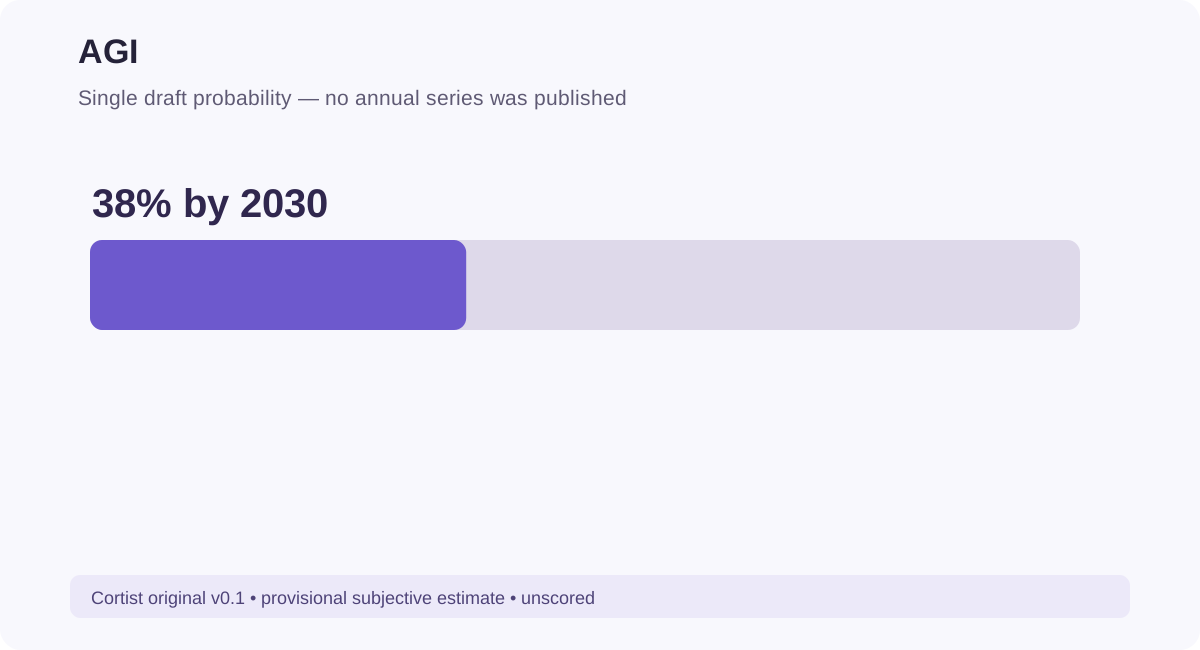
Estimated chance of qualifying AGI by 31 December 2030. This figure is a judgment, not an empirical measurement.
This published snapshot is a provisional forecast, not a prospectively locked commitment. Browse the machine-readable JSON record, the Forecast Protocol v1.0, and the Public Scorecard. SHA-256: 5e4416bf7b6c6b3caf63c4926998cf1f5ceb3c5f81ea6d07f6859373238c618b. The same-site checksum is not an independent timestamp or immutable archive.
The public review dossier contains proposed measurement thresholds and open questions for F-001. These are not validated standards. No reviewer has signed off or issued an external timestamp, so this v0.1 estimate is not locked or scored.
The current probability follows our subjective, documented year-by-year scenario checkpoints; it is not a scientific measurement or a probability supplied by third-party researchers. The earlier 45% (AGI by 2030) and 30% (ASI by 2040) were unscored launch drafts, now superseded by v0.1. View assumptions and version history ↗.
Why 38% in model v0.1?
Demis Hassabis's 21 October 2026 interview moved his expected timeframe to two to three years, a meaningful signal from a frontier-lab leader. At the same time, AGI still lacks a single accepted operational definition. Improvements on individual benchmarks do not, by themselves, demonstrate general intelligence. Our current illustrative curve gives weight to rapid capabilities progress without assuming the evaluation problem is solved.
We do not attribute Cortist's percentage to Hassabis or Metaculus. Their timelines are separate records with different definitions and forecasting methods.
Proposed resolution framework
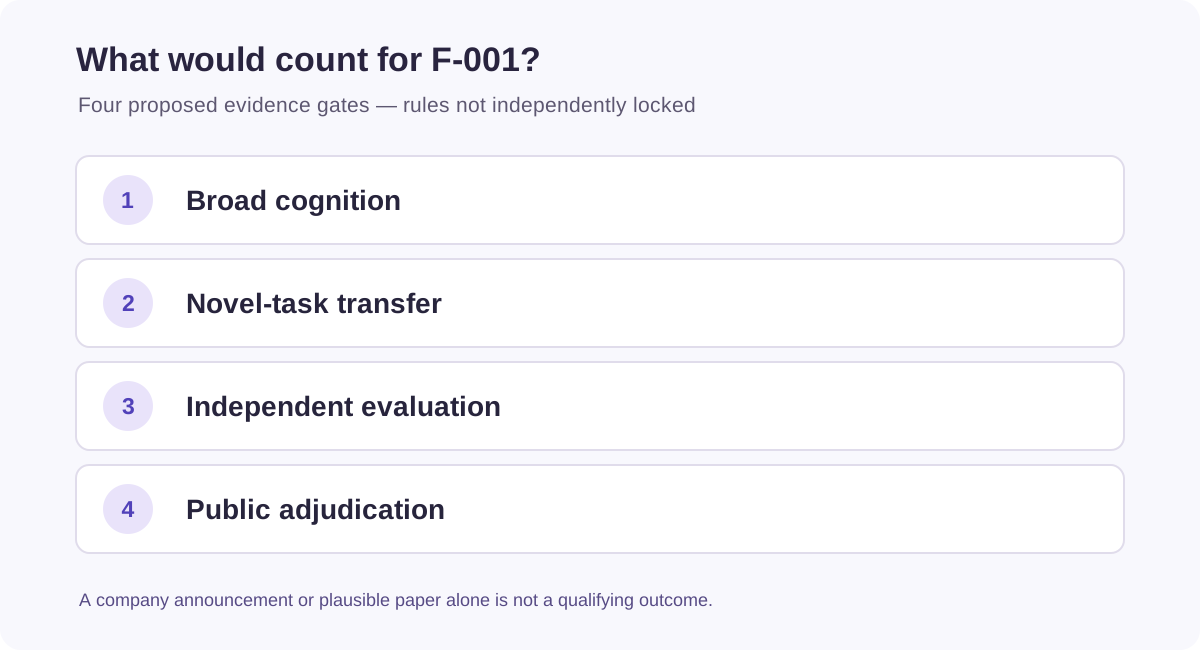
A qualifying system would need to demonstrate broad human-level cognitive capabilities across different tasks, adapt to genuinely novel challenges, and pass independently replicable tests. A company's own AGI announcement alone would not qualify. The exact domain set, test thresholds, auditing process and treatment of unavailable systems still need to be fixed before the estimate can be scored.
Cortist is publishing its updated, provisional 38% model v0.1 estimate for transparency, but we will not retrospectively treat it as a scored prediction once new rules are written. A future locked forecast must have a new explicit issue date, archived criteria and a publicly traceable change history.
Primary sources and comparators
- Wall Street Journal · Demis Hassabis profile, 21 October 2026 — two-to-three-year AGI expectation.
- Google DeepMind · Measuring progress toward AGI, 17 March 2026 — a cognitive evaluation framework.
- Metaculus · When will the first general AI be announced? — independently maintained, changing community forecast; not a Cortist probability.
What changes this estimate?
Strong, independently reproduced tests of learning and transfer across unfamiliar tasks would be positive evidence. Repeatable failures on broad cognitive evaluations, escalating reliability limitations or a narrower-than-promised capability profile would count against early arrival. Cortist will annotate material developments on the AGI hub while preserving the earlier unscored launch draft and the version history.
Understanding the AGI forecast
This is an original provisional v0.1 subjective probability, not a measured or independently locked forecast. The stored draft and any historical numbers remain unchanged.
38% by 2030. A company announcement is not a substitute for independently verifiable evidence.
What the original data does and does not say
The central uncertainty is not whether frontier models improve on familiar exams, but whether the same system demonstrates broadly human-level capabilities when evaluators introduce genuinely new tasks. Cortist’s proposed threshold is broader than a benchmark leaderboard: it requires generalization, reliability and tests that other research groups can repeat.
A single striking demonstration, fast product adoption or high score on a narrow exam could occur without meeting the proposed generality standard. Conversely, poor performance on one unsuitable task would not automatically disprove broad capability. The question is deliberately more demanding than an announcement date.
What would make this claim checkable?
For a defensible positive outcome, qualified independent assessors would need to freeze a diverse task portfolio, human comparison groups, reliability thresholds and an access protocol before testing. They should preserve failed trials and disclose when the system is unavailable. A company's designation of its model as AGI cannot substitute for these measurements.
Required part of the proposed evidence path; one step alone cannot settle the question.
Required part of the proposed evidence path; one step alone cannot settle the question.
Required part of the proposed evidence path; one step alone cannot settle the question.
Required part of the proposed evidence path; one step alone cannot settle the question.
The historical forecast record above contains the complete original draft criteria. Those historical rules are not being retrospectively changed by this expanded explanation.
What evidence could change the assessment?
A prospectively designed independent multi-domain evaluation would be stronger evidence than another timeline prediction. Evidence against an early outcome would include persistent failures to transfer skills to unfamiliar tasks, large reliability gaps or the inability of outside teams to reproduce claimed capabilities.
An announcement, a source-attributed observation, an independent replication and a formally resolved forecast are separate types of evidence. Cortist should preserve the difference when judging later developments. Until the rules are independently frozen, this question cannot add a legitimate score to a forecasting track record.
Frequently asked questions
Is Cortist claiming a 38% scientifically measured AGI probability?
No. This is a dated subjective editorial draft, not an empirical frequency, independently calibrated probability or scored forecasting record.
Would a laboratory announcement settle F-001?
No. The proposed event requires externally reproducible evidence against rules agreed before a future lock.
Is AGI already a universally defined scientific milestone?
No. The eligible domains, human baselines and reliability thresholds remain unresolved methodological choices.
Published supporting sources
These source documents were already cited in the original forecast. The links support contextual review; their presence is not an independent replication or confirmation of an outcome.
- Originally cited research source 1
- Originally cited research source 2
- Originally cited research source 3
Inspect the original machine-readable F-001 v0.1 forecast record
Explore original context
Substantive explanatory update: 29 October 2026. Historical data, original publication dates, probabilities, sliders and scoring eligibility are unchanged.
Latest published draft: 38%
The 38% editorial estimate is the latest recorded v0.1 snapshot dated 22 October 2026. There is no newer published Cortist version, no independently locked definition and no scoring eligibility. Later updates must be new dated versions with explicit evidence, never a replacement of this file.