
Google DeepMind — Gemini Robotics 2, July 2026
Company-reported model capabilities; does not prove eight-hour verified industrial autonomy.
Read original source ↗Physical AI combines perception, planning and control so robots can act in real environments. Completing one demonstration is not equivalent to a reliable full shift without remote intervention. Cortist's provisional F-003 estimates a 35% chance of a defined independently verified autonomy milestone by 2035.
Subjective editorial scenario. Not an independently calibrated, locked or scored forecast.
Cumulative subjective scenario by year-end; v0.1 anchors are not measured probabilities. How the curve works ↗
It connects models to sensors, actuators and real-world actions. Safety, recovery and physical conditions matter in addition to planning.
See measured robot recovery →A defined full-duration industrial task would need independent testing and explicit limits on human assistance. A short video cannot resolve the forecast.
Inspect forecast F-003 →Guide clarified 3 November 2026 · Source findings and forecast assumptions below retain their original recorded dates · Editorial standards
All new probabilities require an explicit new version. This is the first, provisional subjective assessment.
One new v0.1 draft. No revisions or observed qualifying robot outcomes have been scored.
Publisher demos cannot satisfy independent verification criteria alone.Physical AI connects perception and reasoning to machines acting in the real world. Humanoid robots have demonstrated increasingly sophisticated actions, but a reproducible, independently tested eight-hour autonomous industrial shift is a different and stricter milestone. Cortist F-003 starts with an explicitly provisional 35% editorial estimate by 2035; it is not a measured probability.
Evidence Pulse 2.0 checks the published Cortist News index when JavaScript is available. The source-linked, dated research articles remain accessible through Cortist News.
Three new source-attributed robotics reports are now linked. These are research and company-reported demonstrations, not a resolved or recalibrated forecast.
Related cross-disciplinary reproducibility study: PaperBenchX: only 13 of 93 experiments reproduced by the strongest agent configuration. Its robotics simulations are not an independently verified eight-hour industrial shift.
Evidence interpretation: The 4 linked reports provide specific research or manufacturer measurements, but none independently verifies a mixed-task eight-hour industrial shift.
What remains unproven: A reproducible, autonomous full-shift milestone remains unverified in this index.
What to verify next: Autonomous full-shift trials without remote steering in unfamiliar physical settings.
4 linked source-attributed reports; original historical 27 October evidence index preserved separately. Context is not independent proof or a measured probability change. Dated evidence index · Original forecast v0.1.
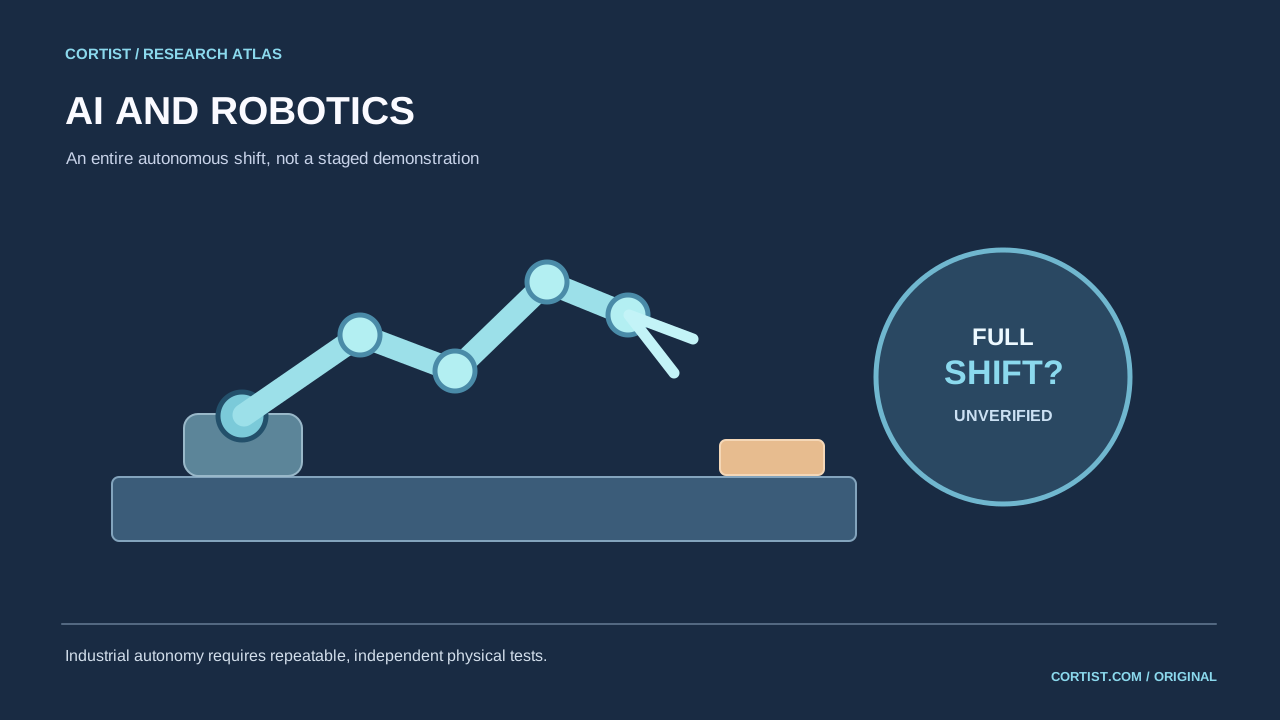
Physical AI describes systems that perceive their surroundings and act through a machine in the physical world. A language model can draft a work instruction without lifting anything. A robot must interpret that instruction, localize objects, plan safe movements, operate real actuators and respond to changing conditions. Vision-language-action (VLA) models aim to link instructions and perception directly to movement. The key distinction is not whether the robot resembles a human; it is whether the system performs useful tasks reliably in a real environment.
Humanoid robots are one embodiment of physical AI, alongside mobile manipulators, robotic arms, drones and autonomous vehicles. They add a practical challenge: coordinating locomotion, balance, hands and object manipulation. The 2035 forecast here concerns a humanoid body in an industrial workplace, not all forms of automation and not household adoption.
Cortist F-003 asks whether an independent evaluator can verify a humanoid robot working through an eight-hour industrial shift without teleoperation under an agreed multi-shift test. Merely operating on a factory floor, completing one four-minute demonstration, or remaining powered on for eight hours is not enough. The proposed test demands a mix of genuinely useful tasks, disclosure of interventions and repeated trials.
The draft evidence protocol calls for at least ten separate shifts across at least three dates, at least 80% success on assigned tasks under a preregistered rubric, independent observation and transparent intervention logs. Whether scheduled charging and consumable changes qualify, and how varied the task mix must be, remain open decisions. These rules must be reviewed and frozen before any result could be scored.
A robot successfully unloading a dishwasher or tying a knot is a technical achievement, not evidence that it can sustain reliable operation through a workday. Repeated handling magnifies failure risk: a small per-action error becomes consequential across hundreds or thousands of actions. A laboratory can also simplify clutter, lighting, object placement and recovery options. Production sites cannot always do so.
Figure reported a four-minute whole-body Helix 02 dishwasher task in January 2026, and described Helix 2.5 experiments on generalization to unfamiliar homes in September. These reports provide testable research claims and possible directions for future evaluation. They are not equivalent to independently replicated eight-hour industrial shifts with a preregistered, mixed-task success threshold.
Google DeepMind's Gemini Robotics work links visual perception, language instructions and physical movement. Its July 2026 Gemini Robotics 2 announcement focuses on whole-body coordination, dexterity, adapting to unfamiliar situations and multi-robot collaboration. The associated embodied-reasoning work addresses spatial planning and task orchestration. Those are precisely the components a more general industrial robot would need.
However, capability demonstrations and provider-authored benchmark reports cannot be converted directly into a probability of full-shift autonomy. Cortist distinguishes what the developer reported from what an external evaluator independently reproduced. A new model release may increase the number of plausible robotics workflows without satisfying F-003.
Cortist starts with a provisional 35% cumulative chance by 31 December 2035. This is a transparent editorial judgment, not a measured frequency or a claim of calibrated forecasting accuracy. The year slider interpolates between disclosed subjective scenario anchors. It shows what this one working curve would imply at different deadlines; it does not derive a separate validated estimate each time the slider moves.
The v0.1 anchors are 0% by 2026, 8% by 2030, 35% by 2035, 60% by 2040, 78% by 2050, 88% by 2060 and 93% by 2070. These are illustrative cumulative scenario assumptions. Their uncertainty is wider than the displayed integer precision suggests. The original 2035 estimate is archived as F-003 v0.1; a genuine later change requires a dated new version rather than editing this one.
Four practical checks beyond a promotional video.
The International Federation of Robotics reported 542,000 new industrial robot installations in 2024 in its World Robotics 2025 overview. That is evidence of substantial factory automation, but most of these installations are conventional industrial robots, not humanoids qualifying for Cortist's F-003 test. Treating installation totals as counts of autonomous humanoid workers would confuse two different categories.
Economic adoption also depends on integration cost, useful duty cycle, maintenance, safety, energy, return on investment and regulation. Widespread deployment could follow after a capability threshold is reached—or an excellent lab capability could remain commercially narrow. Adoption rates are useful context but should not be used as a proxy for independent technical verification.
A strong upward update would need more than a promotional launch. Evidence could include independently observed multi-hour mixed-task trials, broad generalization to new layouts and objects, reproducible intervention logs, safe recovery from faults and reliability maintained over many shifts. Independent comparisons against pre-registered benchmarks would matter more than selectively edited demonstration videos.
Separate progress in tactile sensing, vision-language-action policies, batteries, serviceability and data collection could reduce barriers, but the impact on the forecast depends on whether that progress transfers into end-to-end industrial performance. Cortist will attribute every material model update to the exact primary sources and reasoning in a new version.
Robotics faces constraints that are different from purely digital agents. Real hardware experiences wear, calibration drift, collisions, sensor occlusion and uncertain human movement around the machine. Manipulating a variety of objects safely is harder than repeating a fixed factory motion. Teleoperation can mask these weaknesses; therefore transparent disclosure of remote human assistance matters.
The definition itself is still under review. If the evaluation protocol is not locked in advance, a seemingly successful outcome might be impossible to judge fairly. A new question ID, rather than rewriting history, would be appropriate if the eventual threshold differs materially from the current F-003 draft.
Humanoid autonomy sits at the intersection of two other Cortist questions. The AI Agents topic studies whether software can plan and execute complex tasks reliably. The AI & Jobs topic studies how employers reorganize work, training and hiring. Moving an agent from software to hardware adds physical safety, navigation and equipment constraints; passing the technical robotics test would still not establish an economy-wide employment impact.
Physical AI also connects to AI & Energy, because model training, robot charging and factory infrastructure carry costs. Cortist will keep these causal questions separate: one capable humanoid does not prove household adoption, mass layoffs, broad AGI or artificial superintelligence.
The evidence supports rapidly improving dexterity, spatial reasoning and longer coordinated motions on particular robotic platforms. It does not independently establish the complete shift threshold. We treat robot-company reports as attributed demonstrations, not verified multi-shift outcomes, and industrial installation statistics as a separate adoption measure.
The meaningful future comparison is whether independent evaluators can reproduce robust whole-body behavior across different layouts and task sequences without concealed human assistance. We will track safety, charging, failure recovery, task selection and the economic context separately.
Company-reported model capabilities; does not prove eight-hour verified industrial autonomy.
Read original source ↗Company-reported four-minute whole-body autonomy demonstration; not an independent shift evaluation.
Read original source ↗Company-reported generalization to unfamiliar homes; not a direct industrial-shift result.
Read original source ↗Industry statistics for industrial robots, not humanoid shift autonomy.
Read original source ↗The robot manufacturers’ descriptions are attributed claims. The IFR publication counts conventional industrial robot deployments, not successful autonomous humanoid shifts.
Digital planning and long-horizon task reliability are related but do not solve the physical-world constraints of robotics.
Explore research ↗RELATED TOPICA robot capability milestone is not a measured employment or wage effect. Compare causal evidence separately.
Explore research ↗RELATED TOPICBroad software intelligence and independent physical task execution are different questions and thresholds.
Compare forecasts ↗There is no independently verified general answer. Cortist F-003 assigns a provisional subjective 35% chance of a qualifying, independently evaluated eight-hour industrial shift by 31 December 2035. This is not a locked or calibrated forecast.
Some developers report autonomous individual tasks and multi-step demonstrations. Cortist has not established that these reports satisfy the independent, repeated eight-hour mixed-task criteria proposed here.
No. It interpolates an openly disclosed subjective scenario curve. The selected probability is not a laboratory measurement, adoption rate or independent forecast validation.
A physical capability demonstration does not establish employment displacement. Wages, hiring, training, regulation, integration costs and substitution between tasks need separate evidence.
A third party must assess preregistered mixed tasks over repeated shifts with access to relevant telemetry, video and intervention records. Final details are still proposed, not locked.
Explore the 13 topic research questions in the Cortist version register. The original F-003 v0.1 remains separate from any future forecast update.