
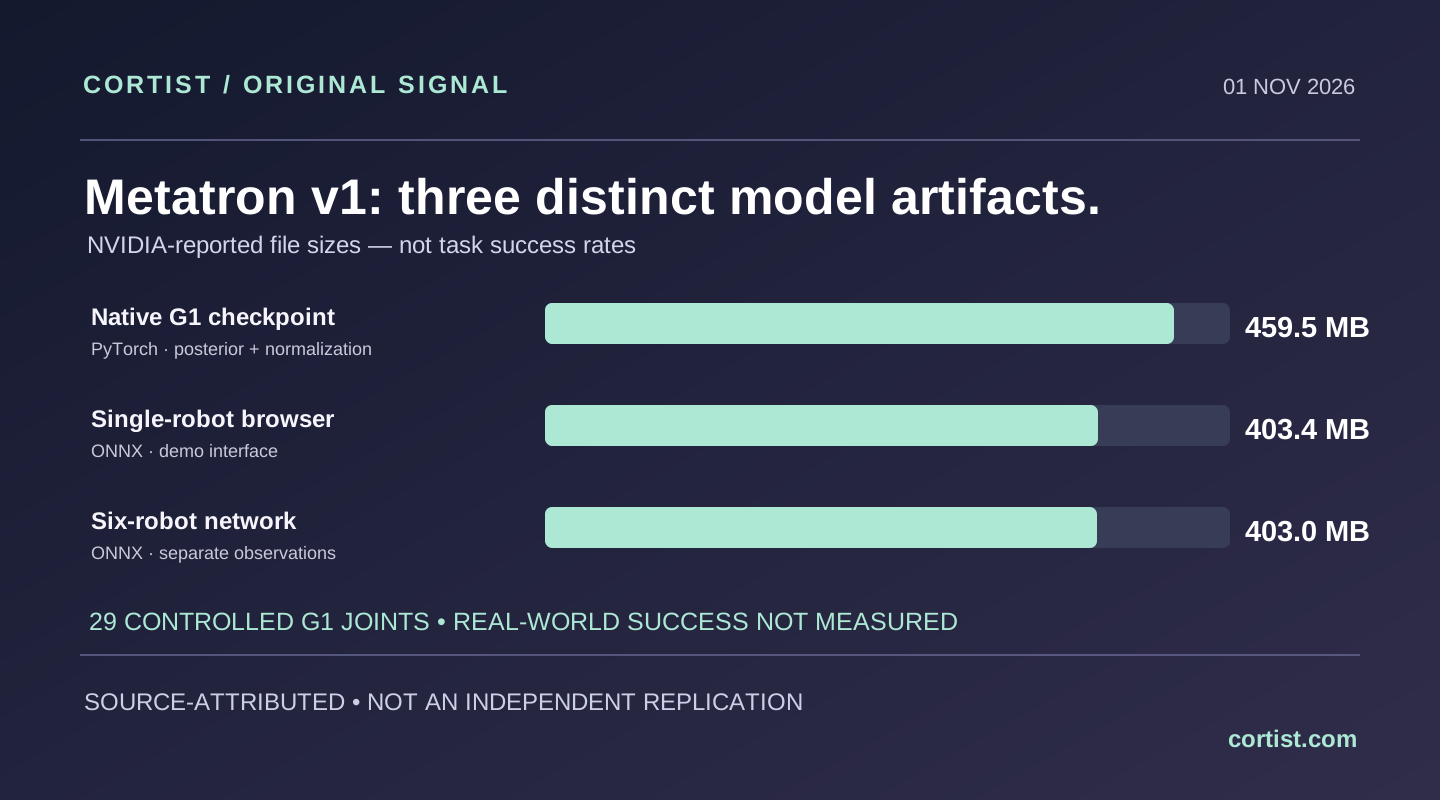
- NVlabs ProtoMotions announced Metatron v1 on 28 October: a unified Unitree G1 control policy for movement, scene interaction and recovery.
- The public Hugging Face card lists a 459,455,983-byte native checkpoint plus separate ONNX browser files of 403,375,789 and 403,036,698 bytes; the model drives 29 controlled joints.
- The card reports numerical export parity across 60 simulated states, not independent real-world industrial task performance. Weights and code use different licenses and training motions are not redistributed.
The Signal
Open weights are particularly meaningful for robotics because they let outside engineers inspect model inputs, outputs and program interfaces rather than judging capabilities from video. NVIDIA's NVlabs ProtoMotions project announced Metatron v1 on 28 October, describing a learned Unitree G1 policy spanning locomotion, steering, scene interaction and recovery after a fall.
The Hugging Face model card distinguishes three downloadable artifacts: a roughly 459 MB native PyTorch checkpoint, a roughly 403 MB ONNX browser export for one robot, and a similarly sized ONNX network for a batched six-robot simulator. They share learned weights but not interchangeable input contracts. Native checkpoint information and browser deterministic inference paths serve different use cases.
This is stronger transparency than promising weights in a future release. The repository publishes byte counts, SHA-256 hashes and interface documentation, which allow reproducible download and version pinning. Yet a matching file checksum proves the artifact's identity, not independent evidence of how well a robot performs in an unfamiliar factory.
The Shift
Motion control is difficult because humanoids must balance, steer, respond to changing goals and recover from perturbations. A unified policy could reduce hand-offs between specialized controllers. Metatron's model card documents 29 G1 controlled joints, observation histories, task goals and control outputs that real applications must integrate correctly.
The maintainers describe action-parity testing between browser exports on 60 distinct and perturbed simulator states, with a reported maximum action difference of 5.55e-6. This is a useful software consistency measurement. It is not a success rate of 60 robot tasks, a hardware safety certification or evidence of eight hours of independent work.
Licensing requires equally careful wording. ProtoMotions source code is Apache-2.0; the model files follow NVIDIA's Open Model License. Robot assets, motion clips and third-party datasets keep separate rights. Researchers can download the weights, but a fully reproducible training corpus is not included in this model repository.
The Cortist Lens
Cortist's F-003 forecast requires repeated, independently checked eight-hour industrial shifts across mixed tasks without hidden teleoperation by 2035. Metatron's release does not attempt that test. It supplies potentially useful control infrastructure, not a resolved outcome or reason to adjust the provisional forecast probability.
The decisive experiment would use a physical G1 under external supervision, reporting completed tasks, resets, interventions, falls, collision risks, unexpected environments, uptime and recovery behavior. Simulation demos and numeric output parity are informative engineering prerequisites; they remain separate from real industrial shift evidence.
Version-pinned artifact replication, independent real-G1 evaluation, recovery in unseen conditions and continuous multi-task operation with intervention and failure logs.
Verifiable model weights and interfaces increase auditability; they are not proof of unattended industrial autonomy.
Primary sources and evidence limits
Company, developer and model-card statements are attributed. Cortist has not independently reproduced the hardware experiments, benchmark trials or real-robot tasks. This report does not score or alter a provisional forecast. Review our editorial standards.
NVIDIA Metatron v1 model repository and cardNVIDIA on Hugging Face; checkpoint sizes, export validation, use limitsProtoMotions pretrained model documentationNVIDIA's technical model documentation and deployment caveatsNVlabs ProtoMotions source repositoryMaintainer source and release notice, 28 October 2026