
Sustained useful work
At least ten separate eight-hour shifts on three dates with varied meaningful industrial tasks; at least 80% task success according to preregistered rules.
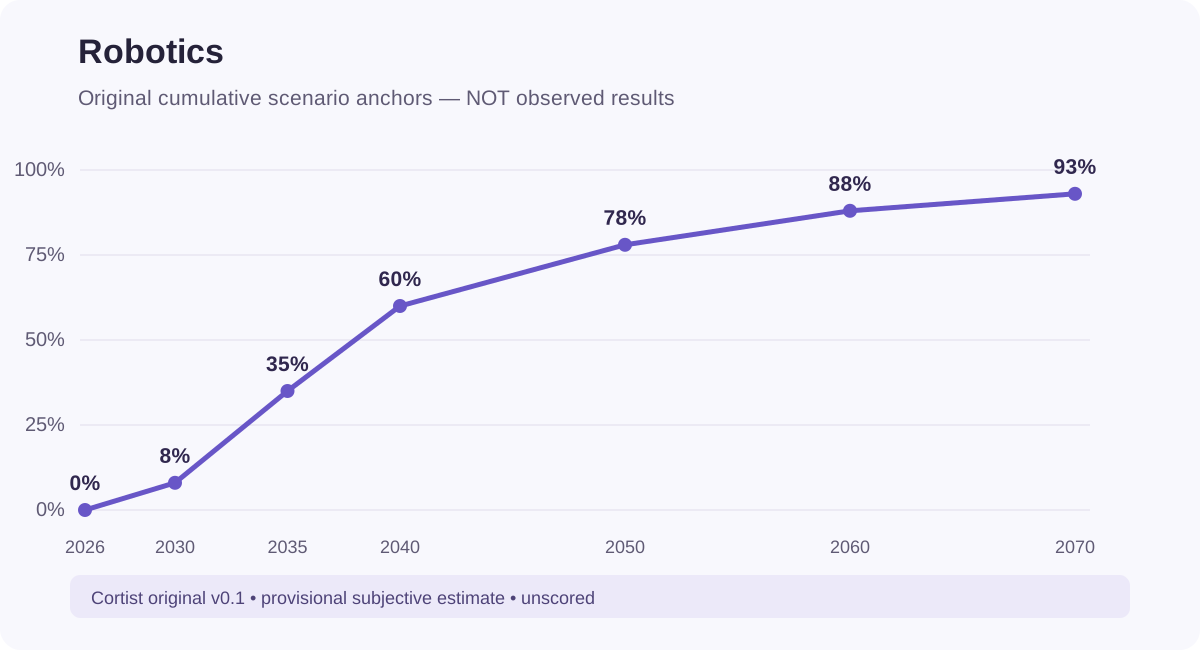
Cortist’s initial 35% probability by 2035 is a provisional editorial judgment. The eight-hour industrial task, independent assessor and intervention criteria are still proposed, not preregistered or independently approved.
Original publication: 26 October 2026 · draft v0.1 · no outside timestamp, independent lock or scoring.
This is an original provisional v0.1 subjective probability, not a measured or independently locked forecast. The stored draft and any historical numbers remain unchanged.
Eight-hour industrial shift. A company announcement is not a substitute for independently verifiable evidence.
Robot demonstration footage is not the same outcome as a productive work shift. A few minutes of controlled manipulation can show dexterity, while an eight-hour mixed-task shift tests navigation, recovery, safety, energy management and whether the machine can handle changes without an operator steering each action.
Factory robot installation statistics largely describe conventional industrial automation. They cannot be converted directly into autonomous humanoid work hours. Likewise, a manufacturer video or a single cherry-picked trial is not enough to resolve repeated industrial autonomy.
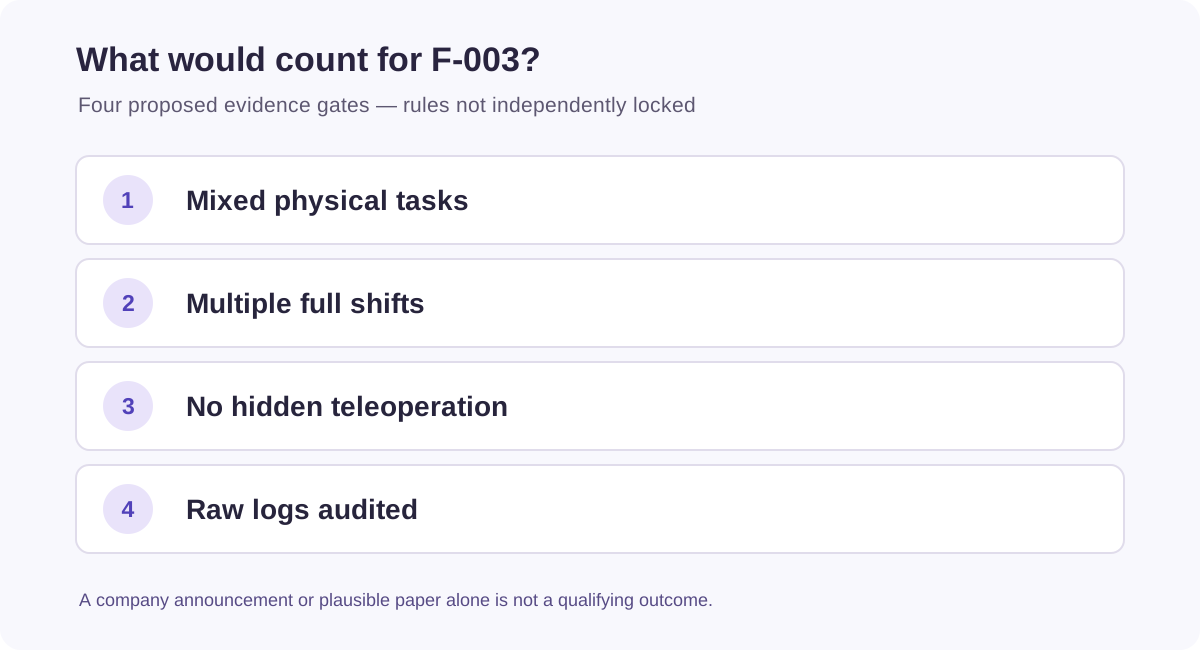
The original F-003 proposal requires multiple documented shifts on separate dates, a frozen task rubric and independent access to raw intervention logs. Human safety observers may be present, but concealed remote operation, manual task choices and undocumented resets would change what is being measured. Both physical success and the absence of hidden assistance are part of the claim.
Required part of the proposed evidence path; one step alone cannot settle the question.
Required part of the proposed evidence path; one step alone cannot settle the question.
Required part of the proposed evidence path; one step alone cannot settle the question.
Required part of the proposed evidence path; one step alone cannot settle the question.
The historical forecast record above contains the complete original draft criteria. Those historical rules are not being retrospectively changed by this expanded explanation.
The most useful next evidence would be independent reporting across different workplace layouts, clear failure rates, recovery behavior and logged interventions. A future rule review must decide how charging breaks and consumable changes affect the eight-hour requirement without rewriting the historical v0.1 estimate.
An announcement, a source-attributed observation, an independent replication and a formally resolved forecast are separate types of evidence. Cortist should preserve the difference when judging later developments. Until the rules are independently frozen, this question cannot add a legitimate score to a forecasting track record.
The precise allowance for charging, docking and scheduled breaks remains under review. This uncertainty must be settled prospectively.
No. The proposal excludes human task steering and hidden remote command guidance in counted shifts.
No. It is Cortist’s provisional probability for the specified 2035 future event.
These source documents were already cited in the original forecast. The links support contextual review; their presence is not an independent replication or confirmation of an outcome.
Inspect the original machine-readable F-003 v0.1 forecast record
Substantive explanatory update: 29 October 2026. Historical data, original publication dates, probabilities, sliders and scoring eligibility are unchanged.
Question: By 31 December 2035, will an independent evaluator verify a humanoid robot performing a mixed eight-hour industrial shift without teleoperation according to preregistered, repeated multi-shift criteria?
At least ten separate eight-hour shifts on three dates with varied meaningful industrial tasks; at least 80% task success according to preregistered rules.
Exclude hidden teleoperation, human task steering and manual resets. Emergency stops, setup and intervention logs must be disclosed.
External evaluators need access to sufficient raw observations, task definitions and intervention logs. Publisher demonstrations alone cannot resolve the forecast.
Cortist v0.1 is a subjective editorial scenario. Its interpolated cumulative curve uses explicit illustrative anchors: 0% by 2026, 8% by 2030, 35% by 2035, 60% by 2040, 78% by 2050, 88% by 2060 and 93% by 2070. These values are not a sample frequency, measured robot progress or a mathematically calibrated forecast. They are meant to expose assumptions for criticism and eventual comparison.
A threshold as demanding as repeated full shifts is still under methodological review. If the definition changes materially, Cortist will publish a new question rather than retroactively reshaping the original. The current draft is not eligible for scoring until independently reviewed and locked under a fair protocol.
Possible upside evidence includes independently witnessed long-horizon mixed-task trials, improved recovery and tactile manipulation, verified absence of teleoperation and generalization across changed layouts. Downside evidence includes failure rates, safety incidents, poor maintainability and tasks that require repeated remote help. Each future change must identify precise evidence and publish a dated new version.
Google DeepMind reported Gemini Robotics 2 improvements in whole-body control, dexterity and cross-robot coordination on 30 July 2026. Figure reported a four-minute Helix 02 dishwasher task on 27 January 2026 and unfamiliar-home generalization with Helix 2.5 in September. The IFR industrial installation totals provide adoption context, but none of these publications independently verifies Cortist’s full-shift milestone.
The 35% estimate was recorded on 26 October 2026 as draft v0.1. A subsequent change must use a new versioned file and expose the earlier probability, rationale and supporting sources. No independent retrospective score is claimed.
The AI & Robotics pillar explains the technology, evidence, relevant changes and interactive horizon slider.