
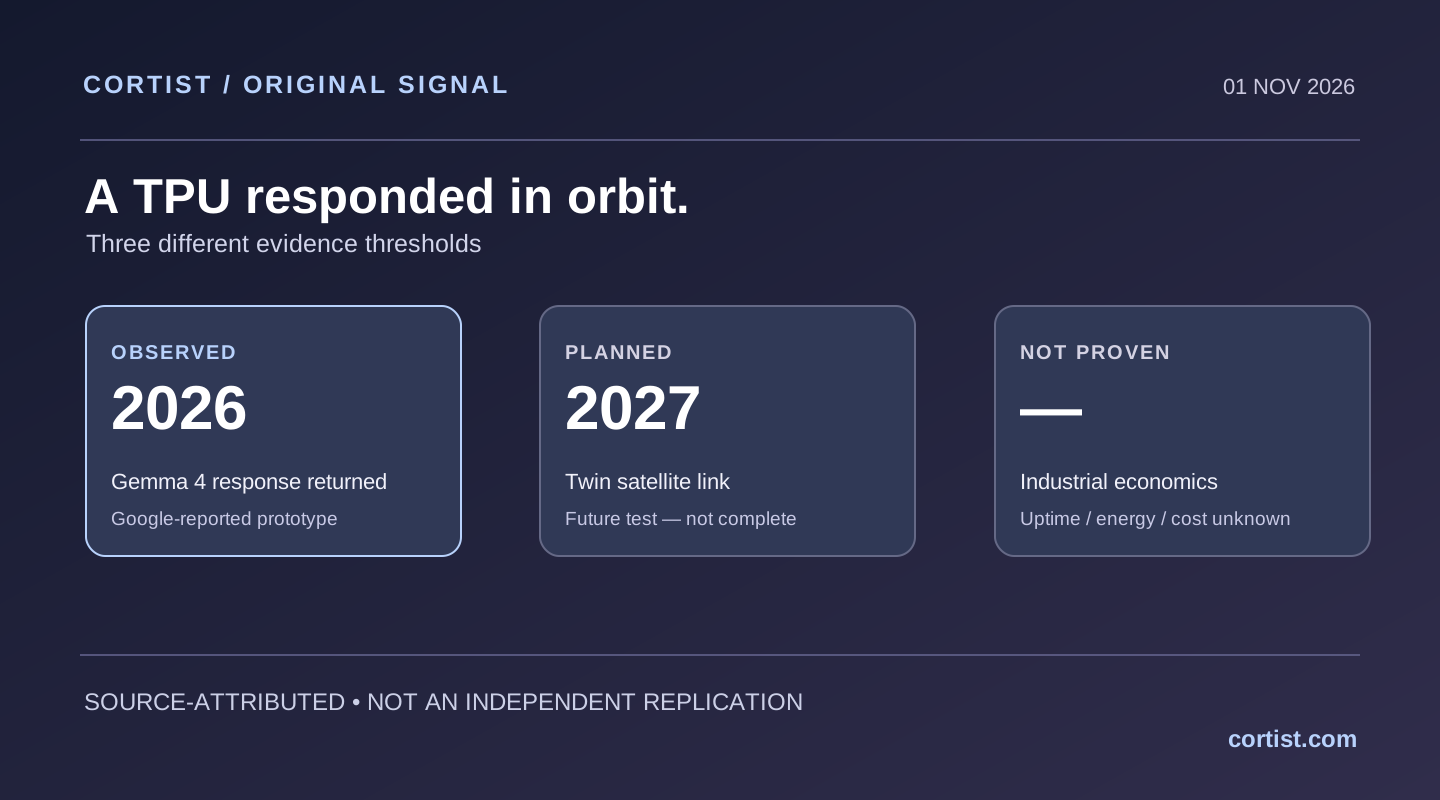
- Google says Project Suncatcher returned an inference response from a data-center-class TPU in orbit on 30 October 2026.
- Gemma 4 produced a short poem after a prompt was uplinked during a ground-station pass near Svalbard. The satellite launched on 1 October.
- Google plans testing for radiation and thermal resilience and a twin interconnected-satellite milestone in 2027. Long-term economics and reliability are not established.
The Signal
A satellite computing experiment has crossed an early functional threshold. On 30 October, Google said its Project Suncatcher prototype had completed an inference request aboard a data-center-class TPU in orbit. The company described activating the host and TPU trays following the satellite's 1 October launch, then sending a short prompt to the onboard Gemma 4 model during a ground-station pass near Svalbard.
The response, a short poem, proves something narrower than the headlines might imply: Google reports that a model executed, produced text, and returned that text over the communications link. It does not report a comprehensive throughput benchmark, an independently validated fault rate or a commercial data-center workload. Google's description of a first-ever data-center-class TPU response is a company claim about a particular class of hardware, rather than independent proof no orbital AI system ran previously.
The reported commissioning tests are still relevant. A spacecraft must reliably power a processor, execute a model, manage thermal conditions and communicate with Earth before higher-level experiments become possible. But an initial successful request does not quantify useful work over many days or months.
The Shift
The economics of ground data centers depend on more than the chip. Terrestrial systems have predictable physical access, power delivery, cooling infrastructure, high-bandwidth networking, maintenance and established supply chains. Orbital infrastructure faces different constraints including radiation, thermal rejection, communications, launch mass and replacement costs.
Google proposes further tests of its onboard TPUs under thermal and radiation stress. It also identifies twin interconnected satellites in 2027 as a next milestone. Inter-satellite connectivity would test an important component of a distributed architecture, but even that demonstration would not establish the latency, capacity, power use, economic competitiveness or training-scale networking of an operational orbital data center.
Space-based solar exposure should not be confused with proven cheaper AI power. A responsible comparison also needs manufacturing and launch burdens, network backhaul and the reliability of large fleets. Those assumptions are currently outside the published 'Hello World' demonstration.
The Cortist Lens
Cortist's AI Chips & Compute and AI & Energy topics track measured hardware and electricity trends. Project Suncatcher is interesting research evidence, but it does not satisfy the F-005 threshold concerning accelerator performance per dollar or the E-001 definition concerning U.S. data-center electricity consumption in 2030.
A decision-useful follow-up would disclose hardware power, tokens per second, error rates, radiation exposure, thermal operating ranges, uptime and a fair terrestrial cost baseline. Until such results exist, Cortist treats this as a functioning prototype—not a resolved forecast or a reason to change any provisional probability.
Long-duration telemetry, radiation-related failures, energy per inference, communication constraints and the planned 2027 two-satellite trial.
Google reports a real orbital inference milestone. No public result yet demonstrates economical, reliable space data centers.
Primary sources and evidence limits
Company, developer and model-card statements are attributed. Cortist has not independently reproduced the hardware experiments, benchmark trials or real-robot tasks. This report does not score or alter a provisional forecast. Review our editorial standards.
Google's original Project Suncatcher announcementTravis Beals, 30 October 2026