
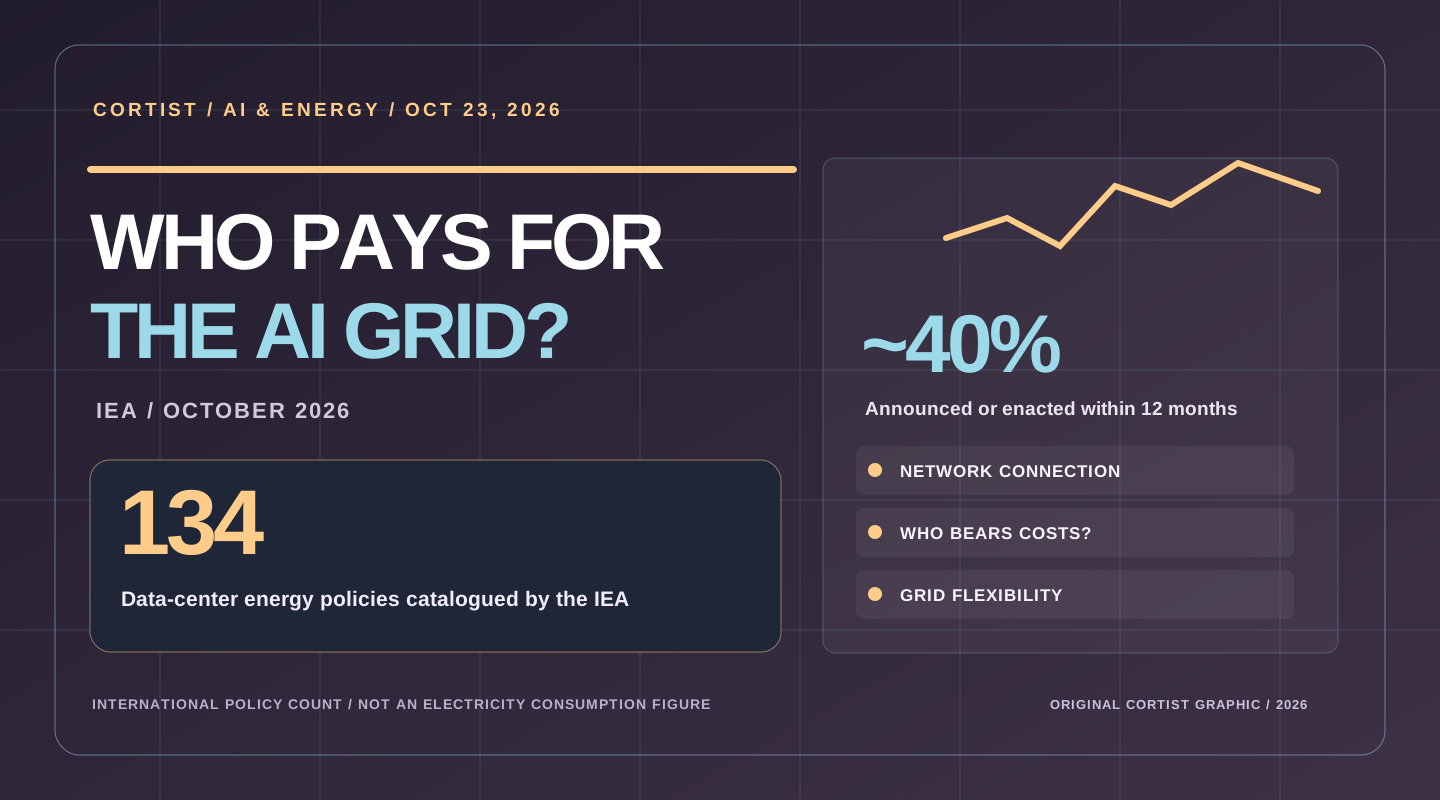
- The IEA's Powering Artificial Intelligence report was issued October 14, 2026 following a request from France's G7 Presidency.
- It records 134 measures concerning data-center power-system integration; nearly 40% were announced or implemented during the previous 12 months.
- More than 34 jurisdictions were surveyed, covering approximately 90% of global data-center capacity. This is policy coverage, not a measurement of AI-only electricity.
- Connection queues can contain speculative or duplicate data-center projects. Proposed capacity must not be reported as delivered electricity demand.
The Signal
Artificial intelligence has become an electricity planning problem, not simply a question about the wattage of new chips. The International Energy Agency's October 14 policy review, Powering Artificial Intelligence, surveys how regulators and utilities are responding to expanding data centers and the investments they require.
The agency documents 134 policies and regulations guiding the integration of data centers with electricity systems. Almost 40% had been announced or implemented during the previous year. More than 34 policy jurisdictions were analyzed, representing around 90% of the world's data-center capacity. This is a material regulatory shift, although a count of rules does not show that any given rule has worked.
The IEA highlights grid connection queues in which proposals can collectively request capacity exceeding today's system peak demand. Such queues mix projects at different stages, including speculative and repeated applications. Treating every application as an inevitable future load risks expensive, underused infrastructure; dismissing serious projects can leave grids unprepared.
The Shift
Several jurisdictions are tightening connection requirements so developers demonstrate project readiness and financial commitment. Other approaches allow phased or conditional access to the grid, or ask large data-center customers to help provide dispatchable power or flexibility. These policies differ geographically; no single approach applies to every data center.
The financial issue is central. When a power network is expanded for a new customer and the cost is recovered from all users, existing households or businesses may face larger bills. In other circumstances, a customer using otherwise idle capacity while paying its fair share can help spread fixed costs. Which result occurs depends on the tariff and actual network constraints, not on a general claim that all data centers make power expensive.
The IEA also reports that operators signed 45 TWh of renewable electricity purchase agreements in the first half of 2026, up nearly 20% on the same period of 2025. Contracting clean energy does not necessarily eliminate grid congestion or solve the location and timing of power demand. Proposals to curtail computing during grid stress similarly require credible technical and commercial arrangements.
The Cortist Lens
The accountability question is who assumes the risk if new demand arrives late, uses less electricity than reserved or never arrives. Minimum payments, collateral, phased connections and exit fees are tools regulators can use to guard against stranded assets. Their costs and benefits need transparent regional evaluation.
This story is distinct from Cortist's 2030 energy forecast. The forecast asks whether all US data centers will consume at least 12% of the nation's electricity in 2030. A count of policies across many countries neither resolves that event nor supplies a calibrated probability. Our 54% working-model scenario remains unreviewed, unsigned and unscored.
The useful metrics ahead are real grid hookups, power sold to operational sites, the amounts that customers commit to pay, what happens to unused network investments and published data on cost allocation. These are more informative than the sheer volume of announcements.
Monitor real implementation of large-load tariffs, transparent connection-queue reforms, independent annual consumption statistics and which party pays for delayed or abandoned data-center projects. This is archived standard news, not a dedicated ongoing Evidence Watch.
The IEA's 134-rule inventory is evidence of a fast regulatory response. It is not evidence that grid costs have been allocated fairly, or that future demand is already real.
Questions readers ask
Clear answers based on the currently available evidence, without overstating its scope.
How many new energy rules did the IEA find?
It counted 134 policies and regulations in total. Nearly 40% of those were announced or implemented in the preceding year; 134 is not the number introduced in 2026.
Do data centers automatically make household electricity more expensive?
No. Local effects depend on infrastructure, energy supply, tariff rules and who bears the risk of reserved but unused capacity.
How many jurisdictions were surveyed?
The IEA examined more than 34 jurisdictions together covering around 90% of global data-center capacity.
Does the report prove AI will use 12% of US electricity in 2030?
No. The 12% threshold concerns future observed national electricity use by all US data centers; a global policy inventory is a different measure.
Primary sources and editorial note
Published October 23, 2026. Original reporting with direct attribution, clearly separated company claims, research findings and independent clinical or regulatory evidence. Archive class: Standard News. No dedicated ongoing watch is created, and no Cortist forecast is locked or resolved by this article.
IEA: Powering Artificial Intelligence (October 14 2026)Primary international policy reportIEA: Executive summary of the 134-rule inventoryOriginal numeric findings, grid connections and cost allocationLawrence Berkeley National Laboratory: US data-center demand scenariosSeparate US energy-demand model