
Will data centers use 12% of US electricity?
Will observed annual electricity consumption from all US data centers reach at least 12% of total US electricity consumption in calendar year 2030?
Understanding the Data-center electricity forecast
This is an editorial milestone candidate, not an approved official probability forecast. The proposed threshold and preliminary working model are not scored.
≥12% of US annual consumption. A company announcement is not a substitute for independently verifiable evidence.
What the original data does and does not say
A projection about 2030 is not the observed consumption in 2030. Focusing on data centers also differs from focusing on AI: commercial data centers serve cloud computing, storage and other non-AI workloads, so the forecast's numerator must include both kinds of electricity use.
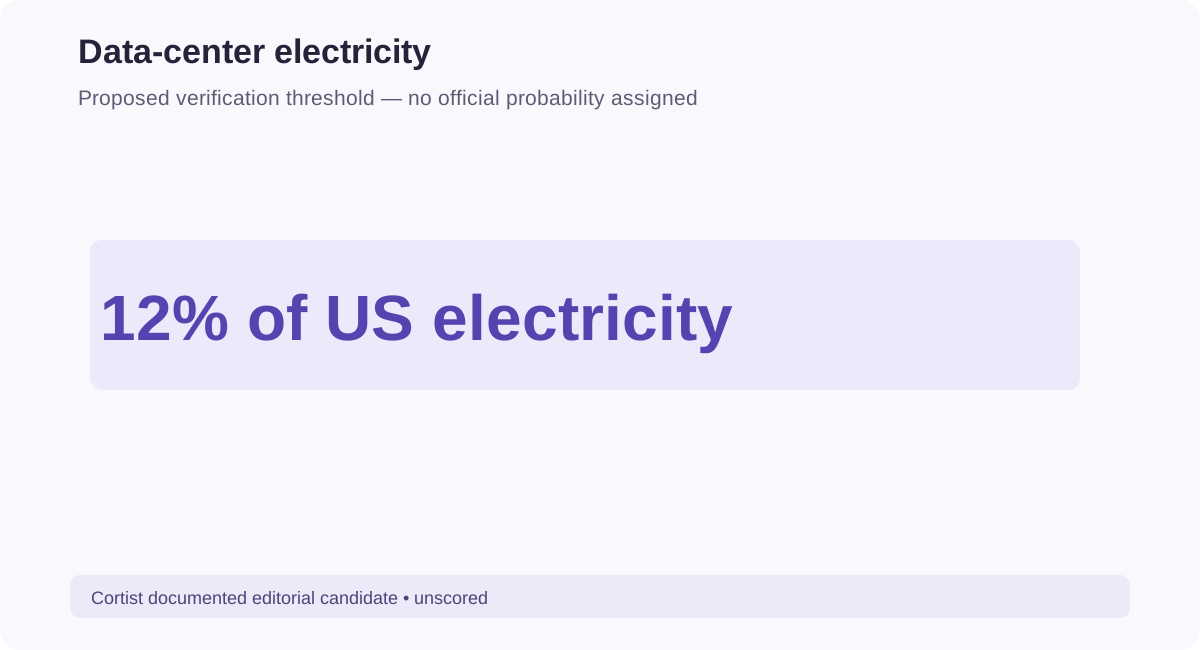
Lawrence Berkeley National Laboratory's 11.8% 2030 reference scenario and its modeled range are contextual scenarios, not an outcome already observed. A higher installed power capacity or a utility connection announcement would likewise not establish the final measured national share.
What would make this claim checkable?
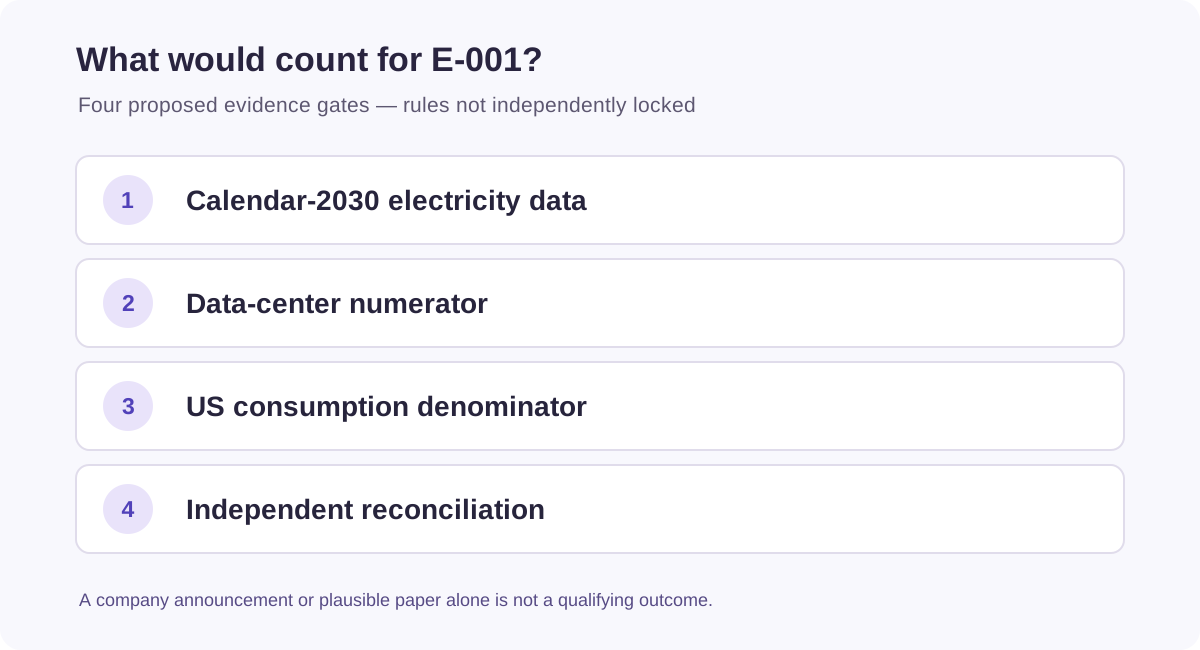
The threshold is a ratio of measured full-year domestic US data-center electricity consumption to total US electricity consumption in the same calendar year. Reviewers need consistent treatment of behind-the-meter generation, on-site power, data center classification and post-publication statistical revisions.
Required part of the proposed evidence path; one step alone cannot settle the question.
Required part of the proposed evidence path; one step alone cannot settle the question.
Required part of the proposed evidence path; one step alone cannot settle the question.
Required part of the proposed evidence path; one step alone cannot settle the question.
The historical forecast record above contains the complete original draft criteria. Those historical rules are not being retrospectively changed by this expanded explanation.
What evidence could change the assessment?
The eventual evidence should include observed post-2030 national accounting, source versions, a transparent numerator and denominator and an independent audit of the calculation. If the datasets remain inadequate or irreconcilable, the candidate's proposed rules favor unresolved rather than quietly marking NO.
An announcement, a source-attributed observation, an independent replication and a formally resolved forecast are separate types of evidence. Cortist should preserve the difference when judging later developments. Until the rules are independently frozen, this question cannot add a legitimate score to a forecasting track record.
Frequently asked questions
Does the 12% threshold measure AI electricity alone?
No. It refers to all US data centers, including non-AI workloads.
Is the 11.8% reference projection an observed result?
No. It is a modeled scenario published before 2030.
Has Cortist published an official probability?
No. E-001 has an editorial working model, but the candidate has not been formally locked or scored.
Published supporting sources
These source documents were already cited in the original forecast. The links support contextual review; their presence is not an independent replication or confirmation of an outcome.
- Originally cited research source 1
- Originally cited research source 2
- Originally cited research source 3
- Originally cited research source 4
Explore original context
Substantive explanatory update: 29 October 2026. Historical data, original publication dates, probabilities, sliders and scoring eligibility are unchanged.
What is really
being measured?
A measurable future event needs clearer evidence than a technology headline.
In June 2026 Lawrence Berkeley National Laboratory published a 2030 reference scenario of 11.8%, with a 9.5%-15.3% modeled range. Those values are projections, not an observed 2030 outcome. US data centers include cloud services and non-AI computing. The question therefore concerns their total electricity use, not AI alone. A measured 2030 numerator and denominator using consistent accounting will be needed after the target year.
Rules before
results.
Deadline: 2030-12-31 (end of day UTC). Proposed outcome and source rules remain subject to independent review.
Will data centers use at least 12% of US electricity in 2030?
Measurement: Annual US data-center electricity consumption >= 12.0% of annual total US electricity consumption in calendar year 2030
US data-center electricity consumption during calendar year 2030 divided by total US electricity consumption during the same year reaches or exceeds 12.0%, using a preregistered, consistent national accounting framework. The numerator includes AI and non-AI data-center activity; it is never labeled AI-only power demand.
What would count as yes?
- A post-2030 national accounting report based on observed 2030 consumption supports a share at or above 12.0%.
- The numerator and denominator are comparable annual domestic electricity consumption measures with transparent treatment of on-site generation and behind-the-meter supply.
- Independent energy-data reviewers verify the calculations and source versions.
What would count as no?
- A sufficiently complete observed 2030 dataset shows a 2030 data-center consumption share below 12.0% under the locked accounting rules.
What must be resolved before locking?
- Choose the primary post-2030 measurement authority and freeze accounting definitions before any forecast lock.
- The 2026 LBNL figure of 11.8% is a scenario reference estimate, not an observed 2030 result; it cannot be used to resolve the forecast.
- If measured 2030 coverage is not available by June 30, 2033, or published estimates are irreconcilably inconsistent, keep the question unresolved pending the protocol decision.
Important limitation: 2030 outcome must be independently measured after 2030. Today's 11.8% is a modeled reference projection, not an observed result; data centers include non-AI uses.
From energy scenarios to a testable question.
A transparent starting estimate. The figures are open to challenge and have not passed independent review.
A preliminary calculation, not an approved or locked Cortist forecast.
How the estimate was built
The 12% threshold lies just above the published reference projection. We use a simple illustrative probability model to see what that might imply, while acknowledging that published scenarios do not specify event probabilities.
The probability model is our assumption, not LBNL's. It counts all data centers, including non-AI computing, and must eventually be checked against observed 2030 electricity use.
The sensitivity figures illustrate alternative modeling choices, not a confidence interval. View the full calibration comparison and the independent-review requirements before interpreting them as predictions.
Evidence before
the percentage.
Original sources and explicit caveats, not made-up probabilities or unverifiable extrapolations.
View the versioned machine-readable research candidate (JSON). Created October 23, 2026. These are not locked or scored predictions.
What readers
should know.
Is this a locked Cortist prediction?
No. It is an editorial research candidate. Cortist has not assigned a probability, independently locked the criteria, or made it eligible for scoring.
What evidence could still be missing?
Choose the primary post-2030 measurement authority and freeze accounting definitions before any forecast lock.
Why might a claimed milestone not qualify?
The 2026 LBNL figure of 11.8% is a scenario reference estimate, not an observed 2030 result; it cannot be used to resolve the forecast.
What needs independent review?
If measured 2030 coverage is not available by June 30, 2033, or published estimates are irreconcilably inconsistent, keep the question unresolved pending the protocol decision.