
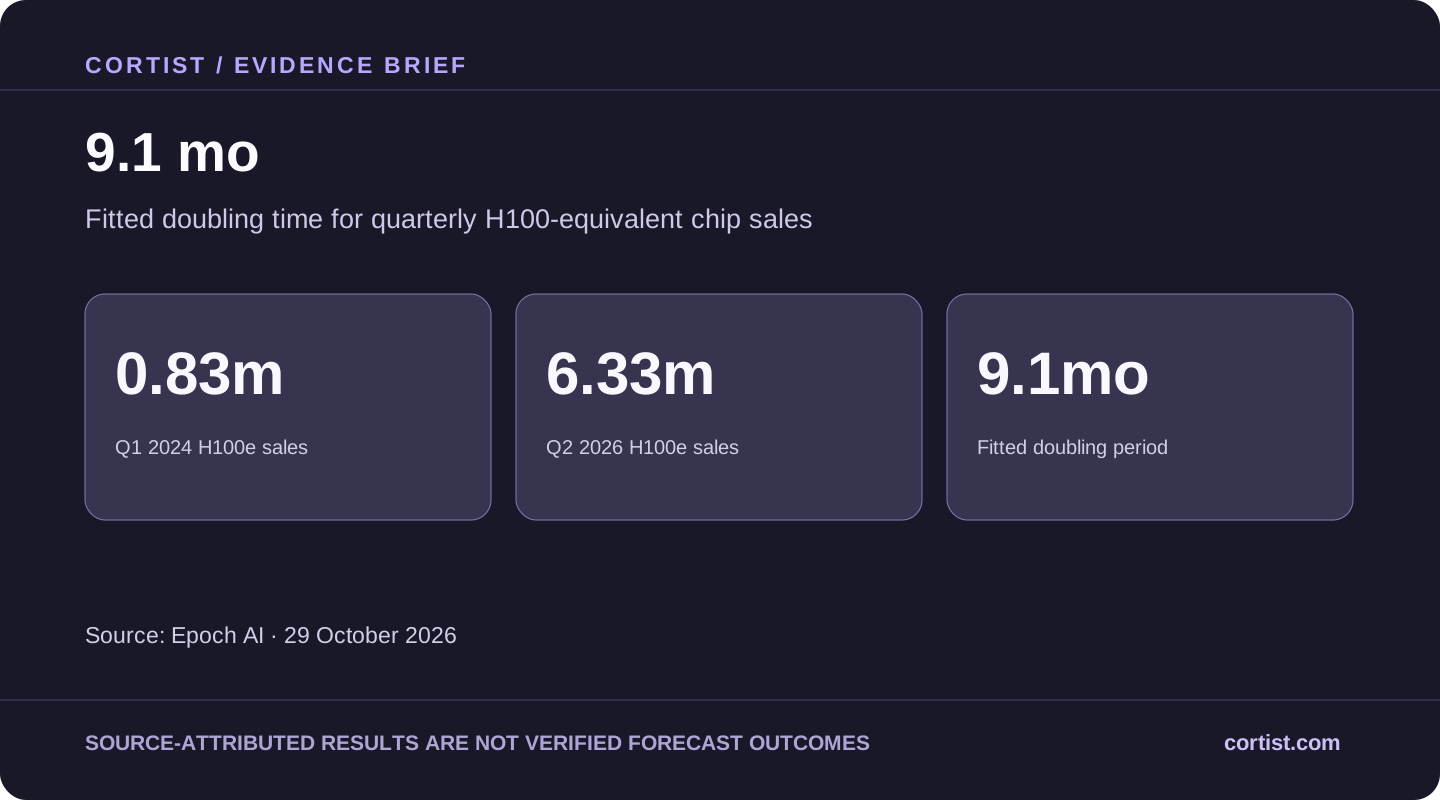
- Epoch AI fitted a 2.5× annual growth rate over ten quarters from Q1 2024 through Q2 2026, corresponding to 9.1 months per doubling (90% fit interval: 8.4–10.0 months).
- Its estimated quarterly compute additions rose from 827,914 H100-equivalents in Q1 2024 to 6,327,416 in Q2 2026, a roughly 7.6× change between those endpoints.
- The estimates measure AI-chip compute capacity sold by six designers, not installed operational capacity, utilization, model training runs or cost-adjusted capability.
The Signal
Epoch AI’s October 29 update puts a measured-looking number on one of the fastest-moving parts of the AI economy: the estimated computing capacity of chips sold each quarter. The research group fits a trend of roughly 2.5-fold growth per year since early 2024. On that definition, additions double about every 9.1 months. This is an estimate of additions to the hardware pipeline, not the total live computing capacity operating inside data centers.
The underlying quarter-level series rises from approximately 0.83 million Nvidia H100-equivalent units in the first quarter of 2024 to approximately 6.33 million by the second quarter of 2026. The metric pools chip sales from Nvidia, Google, AMD, Amazon, Huawei and Cambricon, expressed in comparable H100-equivalent compute units. Epoch fits a log-linear trend across ten quarterly estimates rather than treating one pair of endpoints as the definitive growth rate.
The Shift
This distinction matters for every forecast based on AI infrastructure. A chip delivered to a server builder may take months to become productive. Hardware may also be underused, face power constraints or carry different memory and networking costs. The dataset therefore does not prove that available model-training compute, tokens per dollar or AI intelligence is rising by precisely the same factor.
Epoch’s 90% confidence interval describes uncertainty from the trend fit to its median sales estimates—not the full error in the underlying financial and market estimates. The authors also flag an apparent slowdown in quarter-on-quarter growth that was not statistically significant. A headline about relentless acceleration would go further than the underlying evidence warrants.
The Cortist Lens
For Cortist’s AI Chips & Compute research, this is useful dated infrastructure evidence but not a result for the separate F-005 forecast. F-005 asks about real spending-weighted AI performance per inflation-adjusted dollar by Q4 2030. The sales-based H100-equivalent series cannot by itself resolve a price-performance threshold.
The stronger tracking approach is to preserve the original sales dataset, note the metric definition and revisit it when independent deployment, utilization, electricity and price data become available. Future revisions to sales estimates should be documented rather than silently replacing the historic figure.
Revised chip-sales estimates, commissioning lag from shipments to operating clusters, power constraints and independent spending-weighted performance-per-dollar measurements.
A strong estimate of the pace of chip capacity entering the market—but not a direct observation of deployed AI compute or a scored forecast.
Sources and evidence limits
Cortist attributes these observations to their original authors. The tests have not been independently reproduced by Cortist, and no forecast is changed or scored by this report. Editorial rules and corrections.
Epoch AI primary data insightPublished 29 October 2026; data and methods, CC BY attribution