
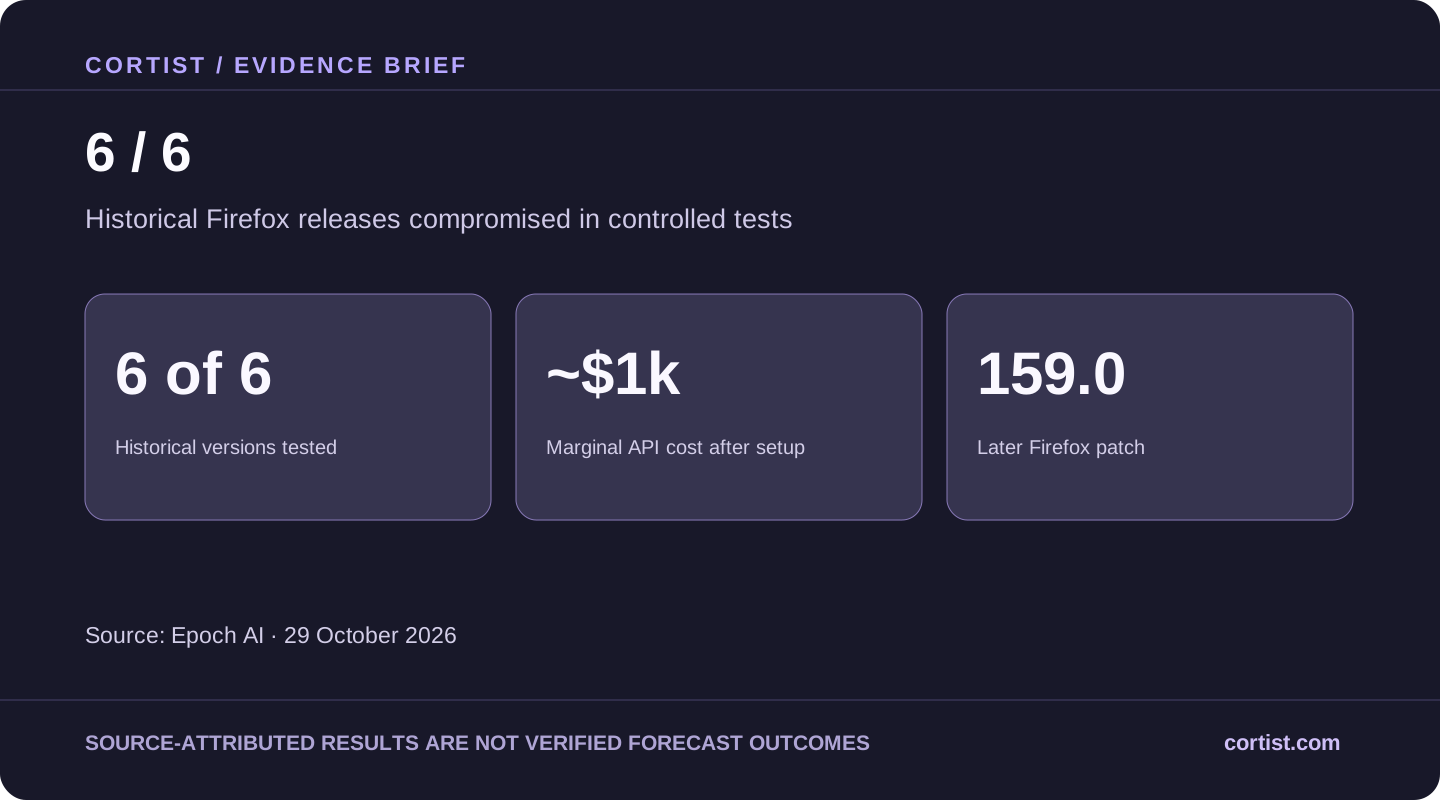
- Epoch AI reported successful controlled GLM-5.3 attacks against six Firefox versions released between September 17 and October 26, using only information available at each version’s release.
- After research setup, marginal API cost was about $1,000 per targeted version, while total research expenditures exceeded $100,000. The cheap headline figure is not the whole experimental cost.
- The tests also used a previously undisclosed vulnerability that Mozilla addressed in Firefox 159.0 on October 27. Researchers had not confirmed the same attack against that patched version.
The Signal
A patch can create a temporary information asymmetry: code revealing that a vulnerability is being fixed becomes visible before the fix reaches everyone running the older release. On October 29, Epoch AI reported that the accessible open-weight model GLM-5.3 could use such a gap to produce successful browser attacks in controlled experiments.
The team targeted six historical Firefox releases between September 17 and October 26. Each target represented software and public information as it existed when that release shipped. The researchers limited the environment and provided relevant material directly rather than letting the model operate freely against public systems. Their reported outcomes are serious, but they are not observations of criminals compromising ordinary Firefox users.
The Shift
The most consequential accounting detail is often skipped. Roughly $1,000 was the marginal API cost for compromising another release after the researchers had developed their experimental setup. Their overall study required more than $100,000 in API spending. That difference matters when claims about the economics of automated cyberattacks travel into company or policy presentations.
The attacks were also not purely a matter of spotting an already public fix. Epoch reports that a second, then-undisclosed weakness was required in its attack chain. Mozilla shipped Firefox 159.0 on October 27 to address that weakness and separately described its defensive approach to the patch gap. The researchers did not show that the same chain worked against this patched version.
The Cortist Lens
This belongs in Cortist’s cybersecurity evidence file, but it does not resolve the proposed F-004 forecast. That forecast concerns repeated autonomous success on multiple defended cyber ranges with specified scoring and active defenders. Six browser-version exploits in one controlled line of research measure a different task and cannot be converted into an 80% defended-range success rate.
Defensive implications include faster security releases, coordination across layers and responsible disclosure. Cortist should preserve the distinction between demonstrated test capability, actually observed attacks and claims about the future balance of offense and defense. The original report and Mozilla’s response are available for review.
Independent reproduction under disclosed conditions, mitigation effectiveness in Firefox 159 and later, evidence across other software families, and transparent reporting of total research costs and unsuccessful attempts.
A serious experimental warning about the patch gap, not a confirmed ongoing compromise of Firefox users or a scored cyber forecast.
Sources and evidence limits
Cortist attributes these observations to their original authors. The tests have not been independently reproduced by Cortist, and no forecast is changed or scored by this report. Editorial rules and corrections.
Epoch AI original experiment29 October 2026; controlled test report and limitationsMozilla engineering response29 October 2026; defensive patch-gap approach