
Epoch AI, AI chip performance per dollar
Historical spending-weighted data, not an assurance of future 5× improvements.
Read original evidence ↗Will spending-weighted AI accelerator performance per inflation-adjusted dollar in Q4 2030 be at least five times its Q4 2025 value under a consistent independently auditable metric? This forecast uses a provisional subjective 55% initial estimate and awaits independent review of its rules.
Recorded: 26 October 2026. Version: v0.1. Not independently locked, calibrated or scored.
This is an original provisional v0.1 subjective probability, not a measured or independently locked forecast. The stored draft and any historical numbers remain unchanged.
5× performance per real dollar. A company announcement is not a substitute for independently verifiable evidence.
The price of computing is not captured by the peak throughput of the newest flagship chip. A real-world buyer cares about the performance actually purchased per inflation-adjusted dollar across a market basket. This is why Cortist uses a spending-weighted series instead of selecting whichever device makes a launch announcement look strongest.
A chip manufacturer's roadmap or advertised theoretical throughput is valuable technical context, not independent proof of a fivefold market-wide gain. Differences in numerical precision, memory bottlenecks, workload mix or buying patterns can reverse apparent improvements.
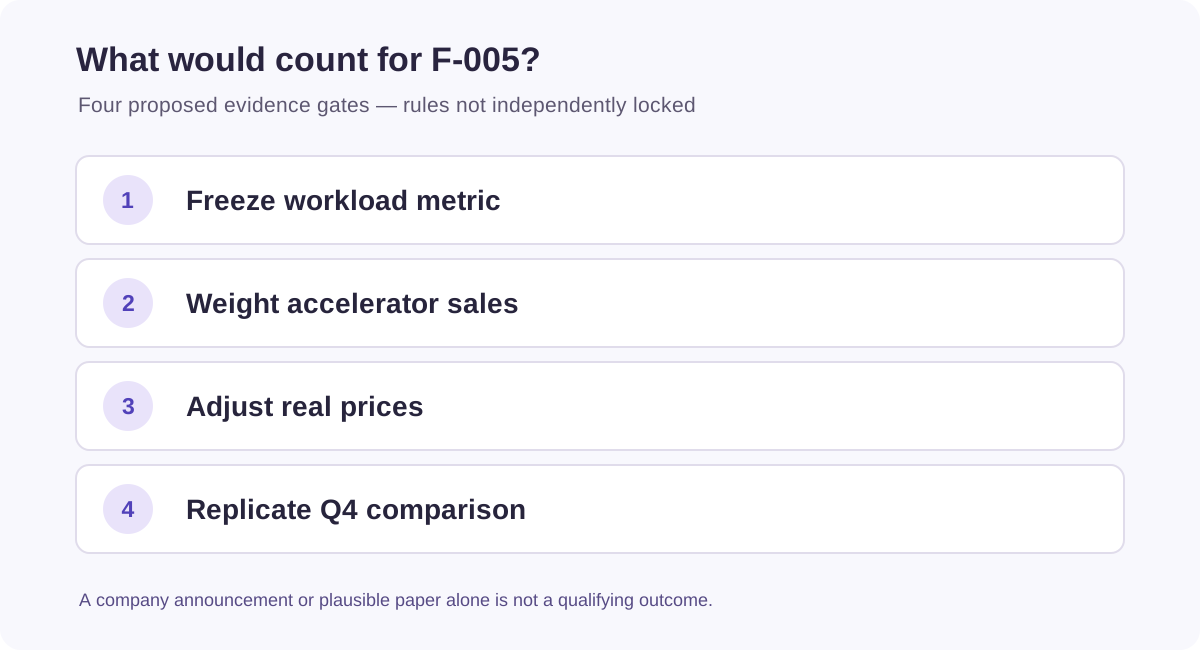
The proposed test compares Q4 2025 against Q4 2030 using consistent arithmetic precision, hardware classes, purchasing weights and prices expressed in real 2025 dollars. If the underlying series is replaced, the substitute metric must be frozen before adjudication, not picked after the outcome is known.
Required part of the proposed evidence path; one step alone cannot settle the question.
Required part of the proposed evidence path; one step alone cannot settle the question.
Required part of the proposed evidence path; one step alone cannot settle the question.
Required part of the proposed evidence path; one step alone cannot settle the question.
The historical forecast record above contains the complete original draft criteria. Those historical rules are not being retrospectively changed by this expanded explanation.
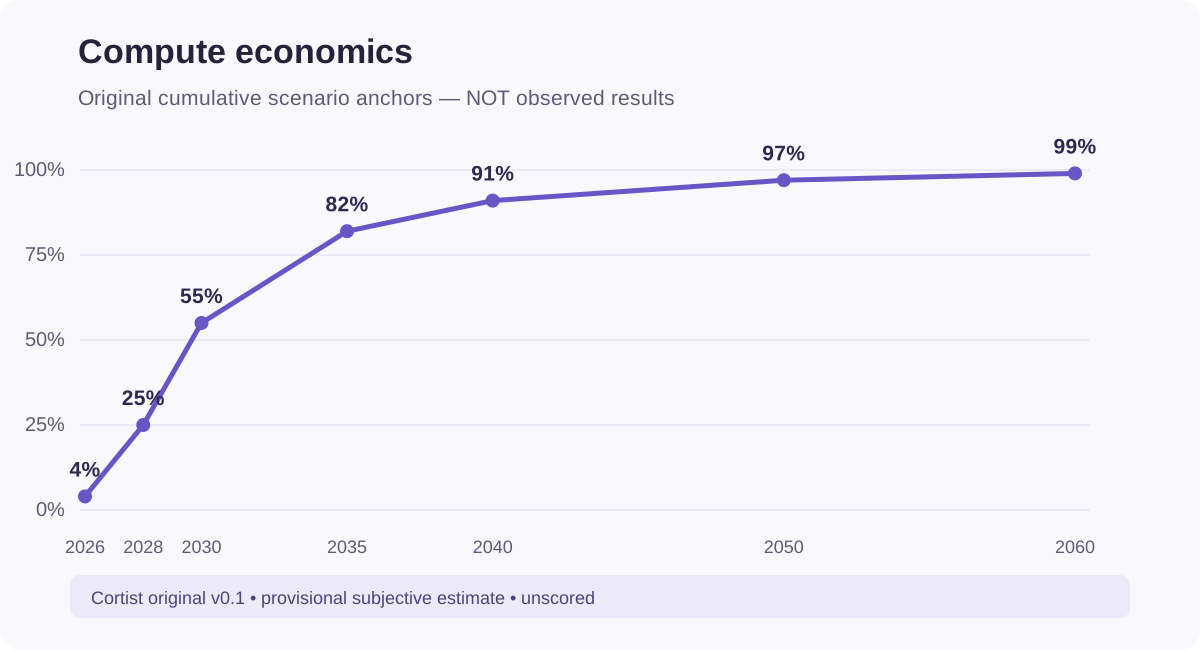
Updated independent spending-weighted accelerator series, documented transaction pricing and reproducible performance measurements would matter. The plotted future percentages are Cortist's scenario assumptions and cannot be interpreted as observed hardware performance growth.
An announcement, a source-attributed observation, an independent replication and a formally resolved forecast are separate types of evidence. Cortist should preserve the difference when judging later developments. Until the rules are independently frozen, this question cannot add a legitimate score to a forecasting track record.
No. It is a draft probability assigned to a future Q4 2030 comparison.
A cherry-picked flagship does not represent spending-weighted performance per dollar across the market.
An equivalent metric would need to be specified and reviewed before any legitimate forecast resolution.
These source documents were already cited in the original forecast. The links support contextual review; their presence is not an independent replication or confirmation of an outcome.
Inspect the original machine-readable F-005 v0.1 forecast record
Substantive explanatory update: 29 October 2026. Historical data, original publication dates, probabilities, sliders and scoring eligibility are unchanged.
Will spending-weighted AI accelerator performance per inflation-adjusted dollar in Q4 2030 be at least five times its Q4 2025 value under a consistent independently auditable metric?
An independent reviewer must approve precise datasets, sampling or evaluation thresholds and adjudication rules. No retrospective revision of the event is permitted for formally scored versions. The current draft remains unscored.
Epoch AI measured roughly 49% average annual improvement in chip performance per dollar since 2023. That spending-weighted trend moved in steps as new generations entered purchasing mixes rather than rising smoothly. It also differs from the cheapest available single chip. Fivefold growth between the selected quarters is a testable extrapolation, not a fact already observed.
A valid measurement must freeze arithmetic precision, workload relevance, inflation-adjusted prices, shipment weighting and the hardware class included. If the underlying Epoch AI series is retired, Cortist would require a prospectively specified equivalent before this draft is eligible to be scored. Vendor peak-throughput numbers are not interchangeable with an independent system-wide benchmark.
Cumulative scenario anchors: 2026: 4% · 2028: 25% · 2030: 55% · 2035: 82% · 2040: 91% · 2050: 97% · 2060: 99%. These are subjective assumptions, not an empirically calibrated estimate. They should be challenged with independent evidence, not interpreted as precise forecasts.
Historical spending-weighted data, not an assurance of future 5× improvements.
Read original evidence ↗2028 planned production timeline; manufacturer roadmap, not outcome.
Read original evidence ↗Manufacturer platform claims require measured price-performance validation.
Read original evidence ↗Initial 55% probability documented on 26 October 2026. A later adjustment would require a separate new snapshot, archived assumptions and sources.
Read research background, uncertainties and use the interactive year slider.