
- Michael Drolet, Oleg Arenz and Jan Peters submitted Whole-Body Humanoid Control via Stochastic Motion Tokenization to arXiv on 27 October 2026; the paper notes acceptance to Humanoids 2026.
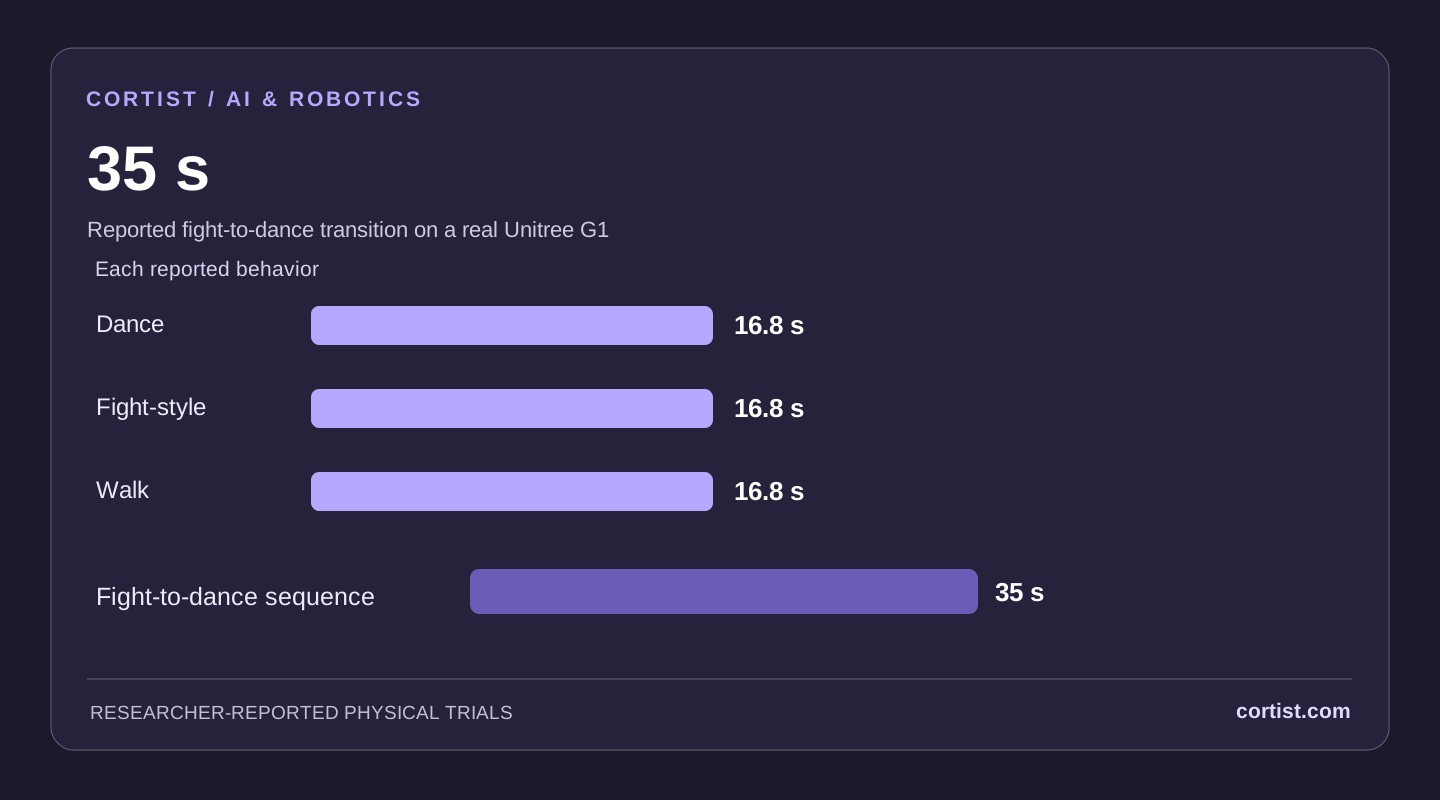
- The authors report dance, fight and walk sequences of 16.8 seconds each and a 35-second fight-to-dance sequence executed by a physical Unitree G1.
- The result concerns conditioned whole-body motion generation and tracking. It does not test eight hours of independent industrial work, mixed factory tasks or operational reliability.
The Signal
A humanoid robot can be visually impressive without being a general-purpose worker. The researchers behind Whole-Body Humanoid Control via Stochastic Motion Tokenization address a specific control problem: how to turn a compact high-level behavior instruction into a plausible, executable sequence of full-body movement.
Their method produces discrete motion representations for a tracking controller. Instead of asking a low-level velocity controller to invent every step, a higher-level system supplies information about the intended motion ahead. The authors show a Unitree G1 executing dance, fighting-style and walking sequences, including a 35-second transition from fighting-style movement to dancing. These are author-reported physical robot demonstrations rather than independent industrial field tests.
The Shift
The interesting distinction is between motion continuity and task completion. Making a robot move through a controlled transition matters for agility, but the experiment does not establish that the robot can recognize an unfamiliar industrial objective, handle materials, recover from production errors or operate through an entire work shift.
Motion tokenization also changes the interface between planning and tracking. A controller that knows what kind of movement is coming can prepare transitions, while a narrow command such as 'move at this velocity' gives less context. Whether that benefit extends to contact-rich manipulation, cluttered workspaces, long-duration reliability and safety remains a separate research question.
The Cortist Lens
Cortist's F-003 forecast asks whether a humanoid can complete repeated eight-hour industrial shifts across mixed tasks without concealed human teleoperation. A 35-second behavior transition is not the same measurement. It should enter the evidence record as a locomotion and motion-control milestone, not as an achieved shift or a probability update.
An evaluation relevant to F-003 would predefine tasks and environments, disclose interventions and resets, publish raw duration and failure logs and involve outside evaluators. Short benchmark demonstrations can inform the broader evidence picture, but they should never silently change the forecast's original v0.1 assumptions.
Independent reproductions with unforeseen transitions, contact-rich manipulation, failure and recovery rates, and sustained operation under a preregistered industrial protocol.
An identifiable physical robot control advance with a measured 35-second sequence—not evidence of a fully autonomous eight-hour shift.
Does a robot complete repeated, independently verified eight-hour industrial shifts without hidden teleoperation? These reports do not meet that specific target. Read the unchanged provisional forecast and evidence rules →
Primary sources and evidence limitations
These figures come from the researchers or companies cited below. Cortist has not independently reproduced the trials or audited operational logs. The reported findings do not resolve F-003 or change its provisional probability. See our editorial and correction rules.
Original conference-accepted research paperDrolet, Arenz and Peters; arXiv preprint submitted 27 October 2026