
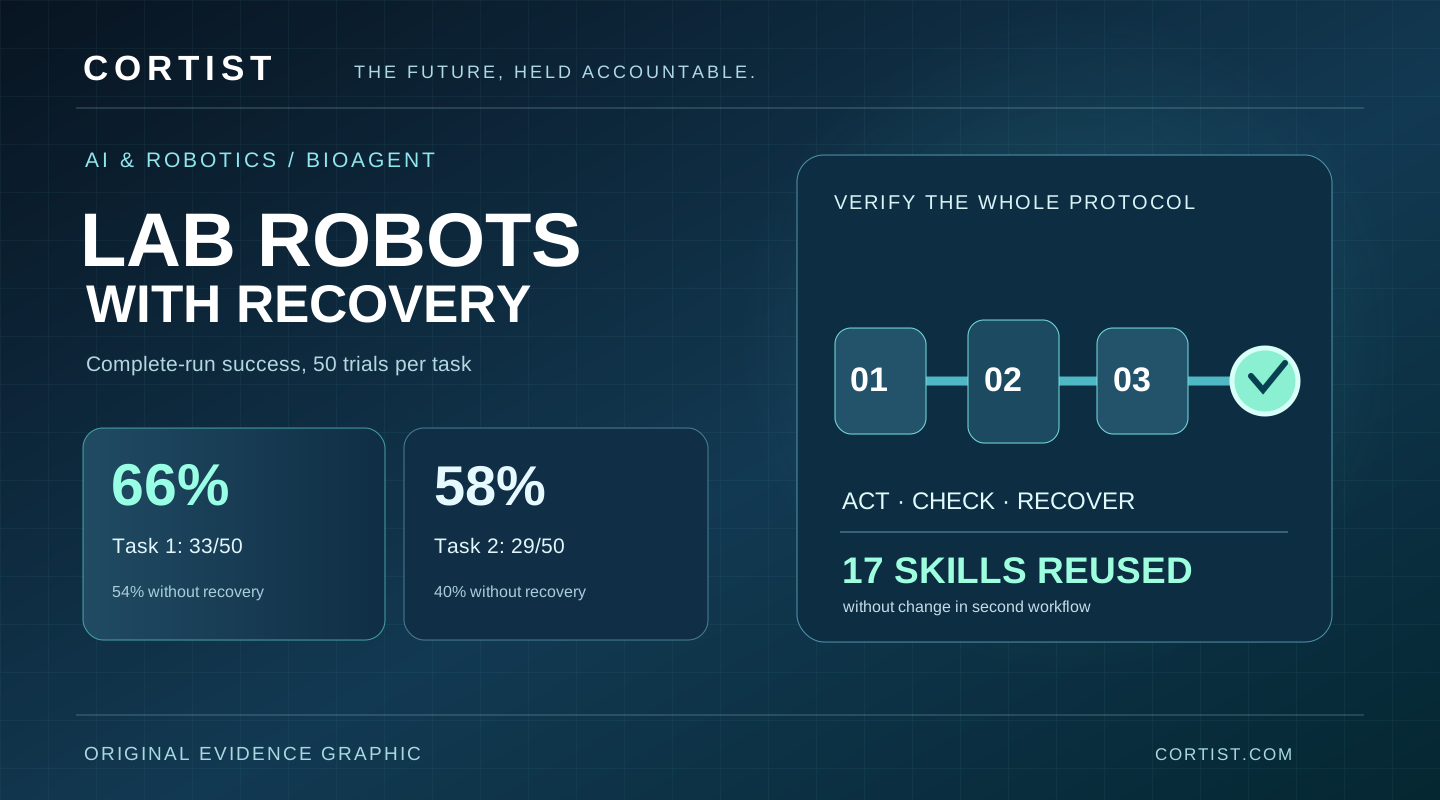
- An arXiv robotics preprint submitted 30 October 2026 evaluates BioAgent on two dual-arm lab tasks with 20 and 31 ordered skill invocations.
- Across 50 runs per task, full protocol success with recovery is 33/50 (66%) and 29/50 (58%). Without recovery it is 27/50 (54%) and 20/50 (40%); the observed differences are 12 and 18 percentage points.
- On the second protocol, 17 previously validated skill types are reused unchanged, two implementations are revised and five new types are acquired. Human-reviewed requirements and teaching remain parts of the system.
The Signal
The gap between a robot performing a single laboratory motion and completing an experiment is much larger than a demonstration video suggests. Biological protocols are long chains of dependent actions: after an unexpected spill, a different tube orientation or a partially completed transfer, a plausible next motion may corrupt the sample instead of repairing the workflow.
BioAgent, described in an arXiv robotics preprint submitted on 30 October 2026, addresses that problem through a library of validated skills and task packages. A planner identifies which requirements can already be satisfied and where a new capability needs to be learned. A monitor checks preconditions, outcomes and experimental state before allowing a step, retrying, restoring the state or terminating the procedure. The goal is not unrestrained improvisation; it is execution constrained by the requirements of the protocol.
The reported tests use dual-arm laboratory workflows with 20 and 31 ordered skill invocations. With retry and precondition restoration enabled, BioAgent finishes 33 of 50 runs for the first task, and 29 of 50 for the second—66% and 58% complete-task success. These numbers measure whole-workflow completion in the authors’ setup, not the accuracy of scientific conclusions or new biological discoveries.
The Shift
The recovery comparison is the most informative part of the experiment. Without autonomous recovery, the same two protocols succeed in 27 of 50 runs (54%) and 20 of 50 (40%). Adding retry and restoration improves the observed success rates by 12 and 18 percentage points respectively. The second task is still less reliable than the first despite benefiting more from recovery.
One recovery strategy retries a step only when the state still permits repeating it. Another calls existing skills to restore a missing precondition—repositioning an object, for example—before proceeding. The distinction is important in wet laboratories because a repeated liquid transfer can change the dose or contaminate a sample. A robot that finishes every motion but violates terminal checks is not counted as a completed protocol.
The skill-acquisition record is also concrete. The first workflow begins with an empty validated library. When the second task arrives, the system reuses 17 skill types unchanged, modifies two implementations and obtains five new types. That suggests transfer between related procedures, but not arbitrary autonomous capability growth. Human review of requirements and teaching for missing behaviors remain inside the development process.
Atomic skills are evaluated separately: among 25 skills tested over 50 autonomous trials each, reported success spans 84% to 100%, with 17 skills passing all 50 trials. Those strong component numbers do not imply comparable whole-protocol reliability. Many individually reliable actions compounded into a long workflow can still yield a high final failure rate, particularly where errors alter downstream conditions.
The Cortist Lens
Cortist follows autonomous science under an especially demanding evidence criterion: agents must do more than propose an experiment, describe a result or operate a robot under supervision. The work has to be demonstrably valid, reproducible and, for claims of novel discovery, independently reproduced. BioAgent is evidence for progress in laboratory orchestration, state-aware recovery and skill reuse. It is not independent proof of a new scientific discovery.
The results also complement our PaperBenchX review, which assessed whether scientific coding agents can reproduce published computational experiments. BioAgent instead focuses on embodied laboratory execution with a real robot. A 66% complete-task rate in one study and 13/93 strict reproducibility successes in another cannot be directly compared: the tasks, tools, scoring rules and denominators differ.
One open question is robustness outside the chosen equipment, materials and workflows. Validity checks that work in a documented 20-step protocol may not capture the full variability of real laboratories. The authors provide two principal task demonstrations and repeated trials within their environment; an independent group would need to reproduce the skill definitions, teaching budget, apparatus, terminal checks and recovery decisions before making broader claims.
The most useful next evidence would be unseen lab protocols, cross-laboratory transfers, detailed failure logs and biological measurements showing that a completed robotic procedure produced the intended valid experiment. That is the line between an impressive robot system and credible scientific autonomy.
Independent replication on a separate laboratory setup; completely unseen protocols; failures before and after state-restoration; amount of human teaching; valid end-to-end biological outcomes, not only the count of executed motions.
State-aware recovery matters, but long-chain lab autonomy remains fragile. BioAgent’s repeated 50-run tests show bounded progress—not a general-purpose autonomous scientist.
Primary sources and evidence limits
This is a research preprint and an author-run robot evaluation, not a certified laboratory deployment or independently reproduced biological result. Rates are task- and setup-specific.
See our editorial standards. Reported claims and independently verified outcomes are distinct.
BioAgent original robotics preprintZhang and colleagues, arXiv:2610.41383, submitted 30 October 2026Lead author’s robotics project and research portfolioResearcher-maintained contextual page; not an independent validation of the 2026 trial