
Stanford AI Index 2026, Science
Shows fast scientific AI progress and poor reproducibility on demanding tasks.
Read original evidence ↗Will an independent scientific team reproduce a genuinely novel natural-science discovery made predominantly by an autonomous AI research system by 31 December 2035? This forecast uses a provisional subjective 40% initial estimate and awaits independent review of its rules.
Recorded: 26 October 2026. Version: v0.1. Not independently locked, calibrated or scored.
This is an original provisional v0.1 subjective probability, not a measured or independently locked forecast. The stored draft and any historical numbers remain unchanged.
Novel, independently reproduced discovery. A company announcement is not a substitute for independently verifiable evidence.
Scientific creativity has several levels that are easy to conflate: answering textbook questions, producing plausible hypotheses, generating a publishable manuscript and discovering something genuinely new about nature. F-006 is concerned with the last level, and only when a separate team can reproduce the core empirical finding.
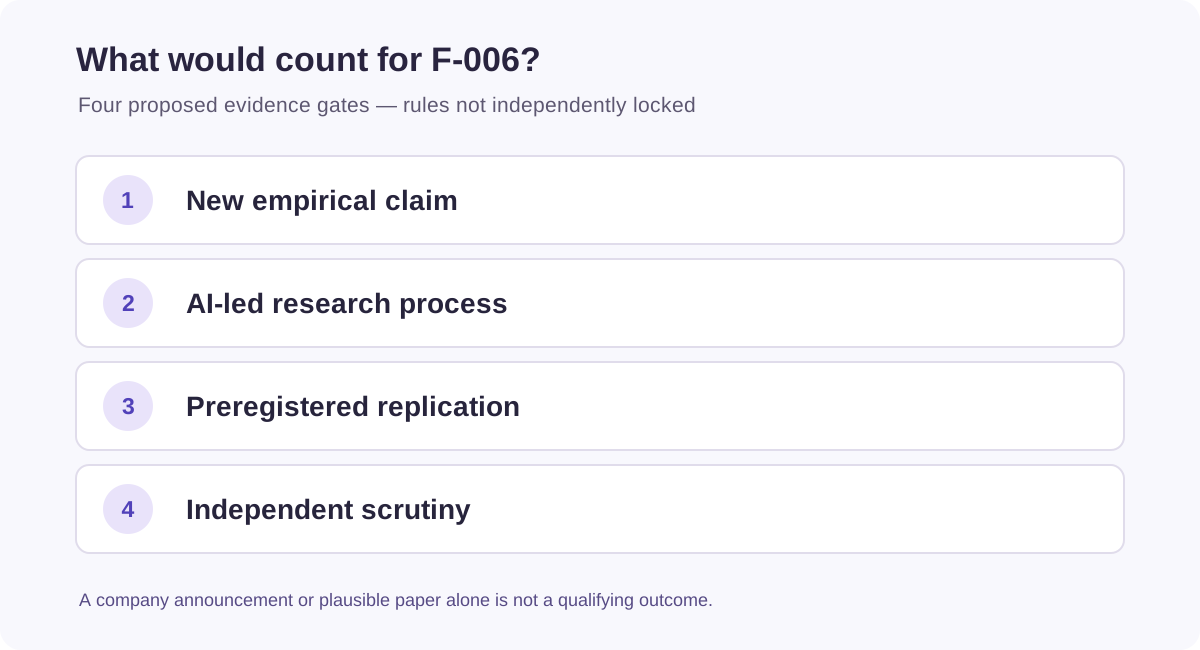
A peer-reviewed AI-written paper, improved science benchmark score or unreplicated laboratory claim is relevant evidence of activity but not sufficient to count as a reproduced discovery. Similarly, an AI may support researchers without acting as the predominant autonomous researcher required in this question.
The proposed resolution would examine the experiment's originality, the AI system's role in forming the hypothesis and planning and interpreting the work, and an independent preregistered replication. Experimental logs are central: they show what the AI actually did and whether humans performed the decisive research steps.
Required part of the proposed evidence path; one step alone cannot settle the question.
Required part of the proposed evidence path; one step alone cannot settle the question.
Required part of the proposed evidence path; one step alone cannot settle the question.
Required part of the proposed evidence path; one step alone cannot settle the question.
The historical forecast record above contains the complete original draft criteria. Those historical rules are not being retrospectively changed by this expanded explanation.
Evidence worth following includes separately replicated AI-generated findings, detailed experiment and data records and transparent disclosure of failures. For forecast integrity, the definition of novelty and the standard for independent replication must be decided before the provisional 40% could be scored.
An announcement, a source-attributed observation, an independent replication and a formally resolved forecast are separate types of evidence. Cortist should preserve the difference when judging later developments. Until the rules are independently frozen, this question cannot add a legitimate score to a forecasting track record.
No verified YES outcome is recorded. The rules are still provisional, and published laboratory claims do not automatically meet the independent replication standard.
Not by itself. The proposed question requires a genuinely new empirical finding, an AI-led research process and independent reproduction.
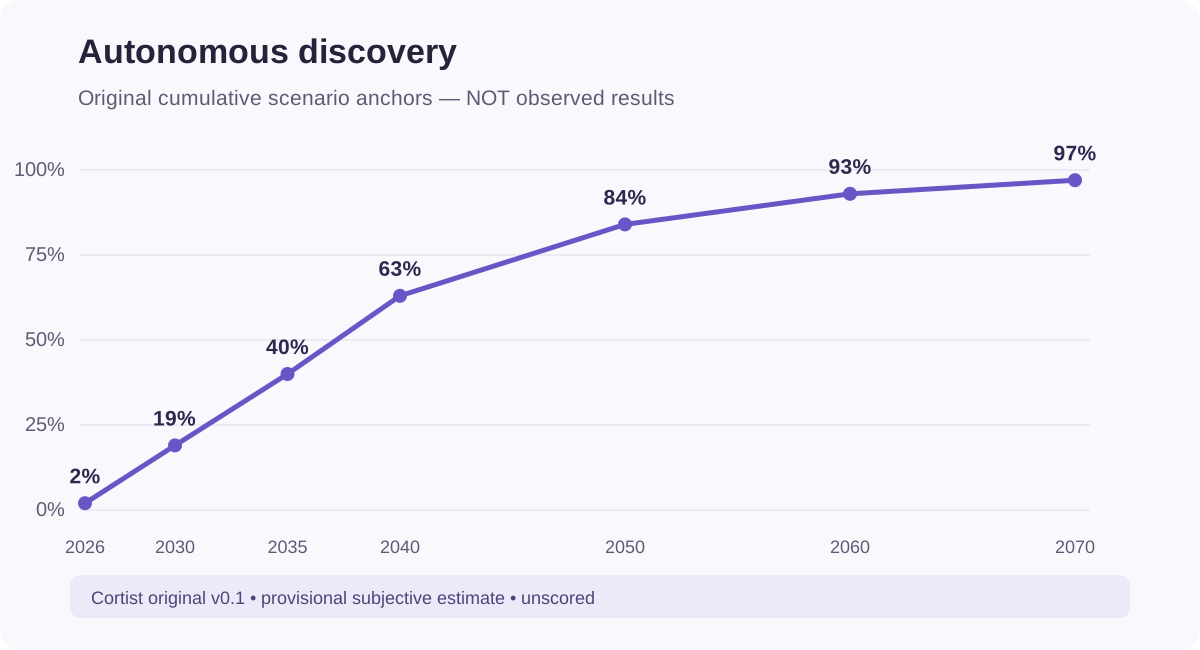
No. It is Cortist's subjective 2035 scenario estimate, preserved in its original v0.1 record.
These source documents were already cited in the original forecast. The links support contextual review; their presence is not an independent replication or confirmation of an outcome.
Inspect the original machine-readable F-006 v0.1 forecast record
Substantive explanatory update: 29 October 2026. Historical data, original publication dates, probabilities, sliders and scoring eligibility are unchanged.
Will an independent scientific team reproduce a genuinely novel natural-science discovery made predominantly by an autonomous AI research system by 31 December 2035?
An independent reviewer must approve precise datasets, sampling or evaluation thresholds and adjudication rules. No retrospective revision of the event is permitted for formally scored versions. The current draft remains unscored.
An AI model passing scientific question-answering benchmarks demonstrates knowledge and reasoning under test conditions; it does not establish a new natural phenomenon. Cortist separates solving existing problems, generating hypotheses and independently reproducing a novel empirical discovery. Each stage requires different evidence.
Peer review, patents, a news release or a published paper can be useful indicators but are not sufficient to resolve this question. Independent researchers need to repeat the central empirical result, not merely say that the AI paper sounds plausible. Publication bias, contamination from existing work and experimental leakage require explicit review.
Cumulative scenario anchors: 2026: 2% · 2030: 19% · 2035: 40% · 2040: 63% · 2050: 84% · 2060: 93% · 2070: 97%. These are subjective assumptions, not an empirically calibrated estimate. They should be challenged with independent evidence, not interpreted as precise forecasts.
Shows fast scientific AI progress and poor reproducibility on demanding tasks.
Read original evidence ↗Benchmarks have jagged performance and do not prove independent scientific discovery.
Read original evidence ↗Independent compilation of research progress and limitations.
Read original evidence ↗Initial 40% probability documented on 26 October 2026. A later adjustment would require a separate new snapshot, archived assumptions and sources.
Read research background, uncertainties and use the interactive year slider.