
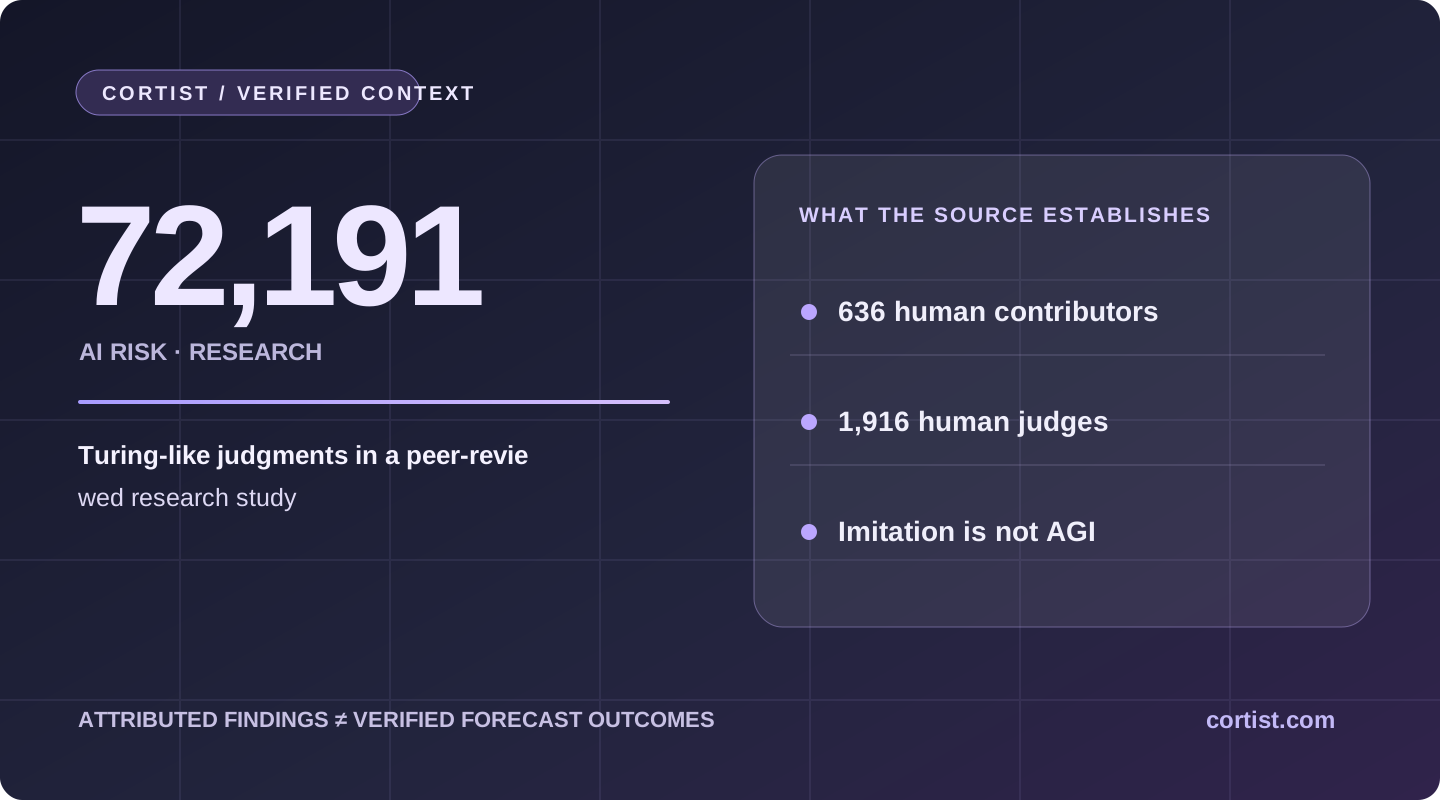
- Nature Human Behaviour published the peer-reviewed study on October 26, 2026; researchers analyzed 72,191 Turing-like trials involving 1,916 human judges and 10 AI judges.
- The benchmark drew on 636 human contributors and 37 AI agents across language and vision tasks, including conversations, word associations and image tasks.
- The researchers explicitly say these tests do not measure general intelligence. Results vary across tasks and test setups, including whether safeguards or feedback were present.
The Signal
Can a person tell when an answer was written by an AI? A peer-reviewed Nature Human Behaviour paper published on October 26 tests that question more systematically than a viral chatbot demonstration. The researchers built a benchmark of 36,499 responses drawn from 636 human participants and 37 AI agents across six language and vision tasks. They then ran 72,191 Turing-like judgments with 1,916 human judges, alongside comparisons using AI judges.
Some models' answers were difficult for people to distinguish from human-generated responses under the tested conditions. In conversational experiments, even older systems sometimes produced highly human-like exchanges. The authors also found that trained machine judges could outperform human judges in several of the tasks. Those results are specific to how responses were collected, sampled, judged and presented.
The Shift
The important boundary is easy to miss: being mistaken for a human is not the same as being correct, reliable, autonomous or generally intelligent. Both a person and a model can give the same wrong answer. The study's authors explicitly say their work is not intended to establish general intelligence, and they stress that there is no single universal Turing test.
The paper also includes follow-up conditions with differences in safeguards, interaction format and feedback. A detection rate in one setup is therefore not a dependable estimate of deception across the internet. The models, people and tasks in this research should not be treated as representative of every deployment in 2026.
The Cortist Lens
Cortist would record this as published, peer-reviewed evidence on AI imitation and detectability—not as an AGI milestone or an observed real-world impersonation incident. If a product claims its AI can convincingly pass for a person, the checkable question must specify the model, task, judge population, prevalence of AI responses and error rates.
For accountability, both mistakes matter: genuine people falsely labelled as bots and machines falsely labelled as people. An independent reproduction using new models, tasks and pre-specified protocols is more useful than an unsupported claim that an AI has passed 'the' Turing test. No Cortist forecast is resolved or reweighted here.
Independent replications with newer systems, task-specific false-positive and false-negative rates, safeguards disclosed and judges recruited beyond one study setting.
A rigorous benchmark for human-likeness, not a measured threshold for AGI or a universal estimate of online impersonation.
Sources & editorial boundary
These are source-attributed research findings and dated organizational statements. Cortist has not independently reproduced the experiments or certified their outcomes. Read the editorial rules and the current versioned structural inventory. That inventory checks source-link presence and published file hashes, not independent scientific replication or external source availability.
Nature Human BehaviourPeer-reviewed original study, published October 26, 2026DOI recordPersistent publisher identifier for the version of record