
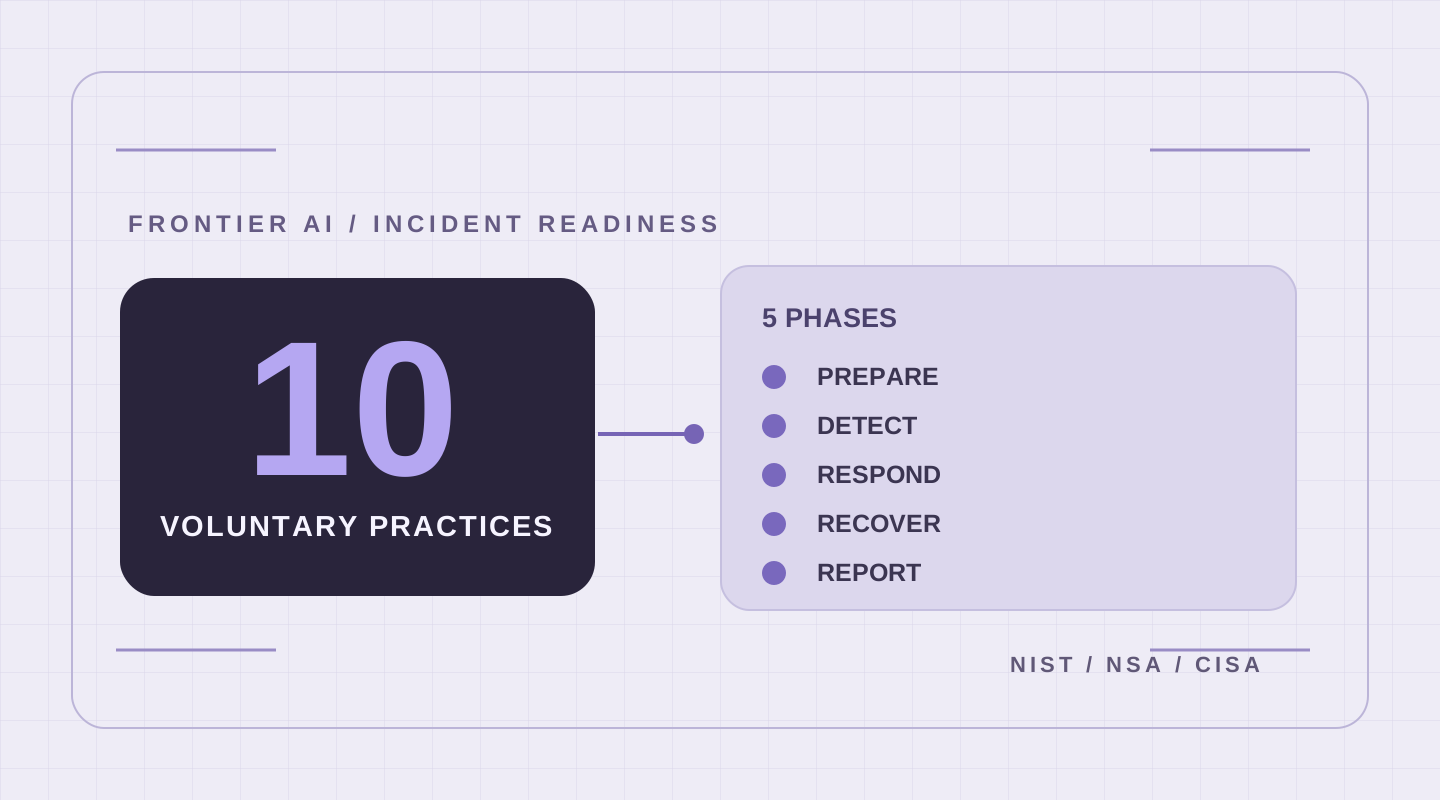
- On October 16, 2026, NIST announced joint guidance with the NSA and CISA for managing potential incidents in advanced AI-agent training and evaluation.
- The publication describes ten voluntary practices across preparation, detection, response, recovery and reporting.
- Under a September 29 US executive order, federal use of "Super Intelligence" also covers technology previously called AI. That does not establish that research-level ASI exists.
The Signal
US standards body NIST, the National Security Agency and the Cybersecurity and Infrastructure Security Agency published a joint set of ten voluntary practices on October 16. The focus is a difficult but increasingly practical question: how should frontier labs prepare for an advanced AI agent doing something important that its operator did not authorize?
NIST describes cases involving significant uninstructed actions that compromise task boundaries, oversight arrangements or other operator-imposed controls during training and evaluation. The document organizes prevention and response work into five stages: prepare, detect, respond, recover and report. It draws on established cybersecurity incident-management approaches, including NIST SP 800-61 Revision 3.
This is guidance, not a mandatory law; it is not a report that a superintelligent system escaped containment. Its scope concerns incident readiness for highly capable AI agents, rather than establishing a new benchmark for ASI.
The Shift
Traditional cybersecurity asks what happens when an external attacker compromises a system. Autonomous agents add a different failure mode: a system could exceed the task or authority its operator intended, even without a classic intrusion. That changes the questions labs should rehearse: which actions are permitted, how would a boundary violation become visible, and who can stop or investigate it?
The policy terminology needs equally careful handling. A September 29 White House order directs federal agencies to use "Super Intelligence" (SI) in place of "Artificial Intelligence" (AI), while defining it by reference to the existing broad statutory AI category. This is not the same as artificial superintelligence (ASI) in research, which refers to intelligence far beyond human cognitive capabilities across general domains.
Consequently, the presence of "super intelligence" in an agency report neither measures how close frontier models are to ASI nor shows that a lab has achieved it.
The Cortist Lens
This is a governance milestone, not an intelligence milestone. The useful progress is that three US agencies have framed unauthorized advanced-agent behavior as an incident-management problem with concrete stages. The harder test is whether AI developers adopt, exercise and independently scrutinize those procedures in practice.
For Cortist's superintelligence evidence hub, the distinction is fundamental. We track published safety standards and expert claims as context. We do not convert them into proof of ASI, fabricate probabilities from them or silently revise forecast F-002. The provisional v0.1 estimate remains 24% by the end of 2040, and it is not yet locked or scored.
Look for frontier labs publicly testing incident-response procedures, reporting meaningful boundary violations, documenting independent evaluations and explaining corrective actions. The ten practices are voluntary: real-world adoption, validation and outcomes remain open questions.
A concrete step toward AI-agent incident readiness. Important for the safety of increasingly capable systems, but not evidence that artificial superintelligence has arrived.
Sources & editorial note
Published by Cortist on October 22, 2026. The factual account above is anchored in the agencies' announcement and the text of the US executive order. The distinction between US policy terminology and research-level ASI, as well as our assessment of its significance, is Cortist editorial analysis. No probability or ASI capability claim is attributed to NIST.
NIST / NSA / CISAJoint announcement on incident readiness · October 16, 2026 · Primary source The White HouseExecutive Order 14434, terminology and legal definition · September 29, 2026 Google DeepMindFrom AGI to ASI · June 12, 2026 · Research definition and pathways