
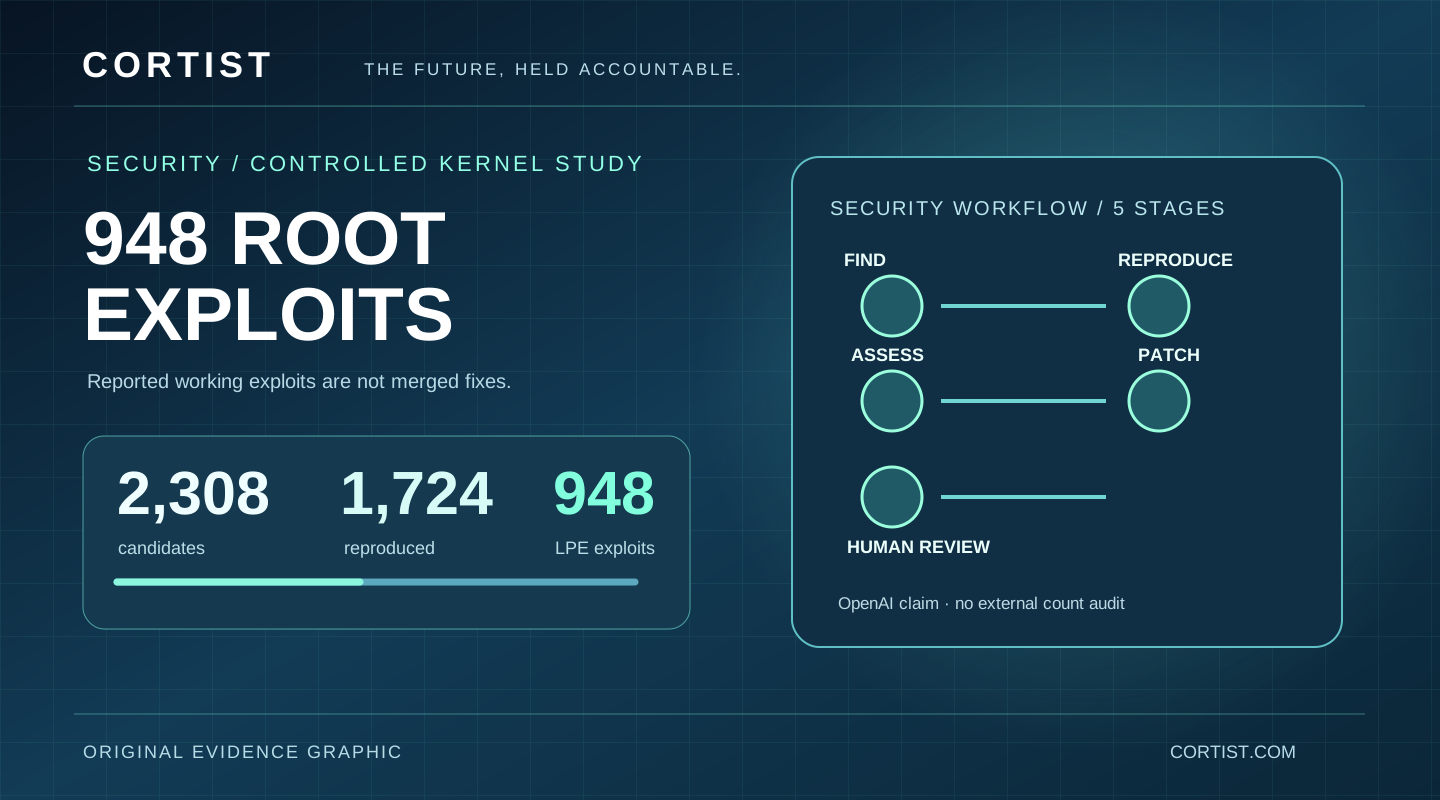
- OpenAI’s November 4 security report describes a mid-October experimental pipeline that identified 2,308 candidate Linux-kernel findings, dynamically reproduced 1,724 and generated 948 working local privilege-escalation exploits in a specific tested Linux distribution.
- OpenAI reports $1,213,430 in API credits for the campaign, or approximately $1,279 per demonstrated local privilege-escalation exploit. Those are company-reported API costs, not the full economic cost of a security program.
- The system generated candidate patches and human researchers reviewed and reported findings. The 948 figure is not the number of independently merged, deployed and verified kernel fixes.
The Signal
What does an AI cyber agent prove when it produces a working exploit? OpenAI published a detailed account on November 4, 2026 of a large Linux-kernel security research campaign. A prototype used cooperating agent roles to find risky code, triage possible vulnerabilities, reproduce faults in isolated machines, evaluate exploitability, prepare candidate patches and route results to human researchers. The headline figure was 948 working local privilege-escalation exploits. It is a claim about demonstrated exploits in a particular research setup, not a count of software updates already protecting users.
The work was performed in mid-October against a then-current Linux kernel. According to OpenAI, Scout agents first narrowed attention to 5,034 audit targets comprising approximately 2.8 million lines of code, roughly 7% of the codebase. Analyst agents then produced 2,308 deduplicated candidate findings within 12 hours. That first pass cost $316,549 in API credits. Candidate findings are leads, not automatically confirmed vulnerabilities, so the next stage matters more than the initial number.
In isolated virtual machines using an instrumented kernel, the triage system reportedly reproduced 1,724 findings, approximately 74.7% of the candidates. A further exploitability assessment using protections typical of a Linux distribution generated 291 information-leak proofs of concept and 948 working local privilege-escalation exploits. The campaign’s reported end-to-end API bill was $1,213,430. OpenAI also reports finding at least ten previously unknown exploitation techniques in a sampled analysis; that claim awaits outside scrutiny.
The Shift
The material change is the scale and continuity of the research workflow. Earlier coverage of autonomous cybersecurity often focused on an agent completing a narrowly bounded challenge. Here, multiple agent roles move findings through discovery, reproduction, exploitability assessment and candidate repair. OpenAI describes this as an experimental security workflow with human researchers in the reporting loop. It does not claim to have replaced the Linux maintainer process, nor does it publish an independent audit certifying every final result.
The difference between detecting a flaw and protecting a user is substantial. A crash in a sanitizer-enabled kernel may be a promising clue. A working exploit on the tested system is stronger evidence of a particular security failure. A candidate patch is another intermediate artifact. The user-protection milestone comes only when a correction survives review, is merged into appropriate upstream or distribution branches, is deployed, and is verified not to introduce new regressions. Cortist therefore does not equate the number of exploits with the number of confirmed fixes.
OpenAI itself highlights the speed of existing maintainer activity. During a ten-day interval surrounding the scan, it observed 61 local privilege-escalation flaws already patched upstream, 43 with staging patches and 299 being discussed publicly. Those overlapping processes matter when assessing the pipeline’s incremental value: a finding may have been discovered independently, reported concurrently or already fixed by the time the automated result reaches a maintainer. Such overlap is not a model failure, but it changes the interpretation of novelty.
The company calculates a hypothetical bounty valuation using historical contest payouts. That is not revenue received, an asset value, or proof that maintainers would have accepted the same number of submissions. Its reported cost per exploit likewise excludes all organizational expenditures beyond the stated API credits. A fair comparison with human research would need a common vulnerability definition, equivalent hardware and staffing costs, follow-up time, duplicate handling and independently adjudicated outcomes.
The Cortist Lens
For Cortist, the evidence is stronger than an unsupported vendor claim because the report separates candidate findings, dynamic reproductions, working exploits and the patch workflow. Nonetheless, the source remains the company that ran the experiment. The model used in the larger run was not named as a publicly released product, and third parties cannot reproduce the result from the press narrative alone. Exactly which kernel revisions and distribution configurations each exploit targets would be essential for independent assessment.
The significance for AI autonomy is dual-use: systems capable of finding flaws at this throughput can support defenders, while similar techniques could increase the speed of offensive research. This observation does not establish that deployed models can bypass real corporate defenses or operate without permission. OpenAI used controlled evaluation environments and described responsible reports to the kernel community. We do not reproduce exploit mechanics, payloads or actionable attack sequences.
The result also illustrates a broader weakness in capability headlines. A single success metric invites readers to confuse three separate gates: can the agent generate an apparently valid artifact, does a human or independent evaluator confirm the artifact, and does it produce the intended downstream effect? For Linux security, those translate to exploit reproduction, reviewer validation and a merged or shipped fix. The differences are relevant to Cortist’s existing AI-agents and cyber-agent forecast coverage.
The next public evidence should be a documented, deduplicated set of security advisories and accepted fixes, ideally with an independent maintainer statement and patch-state timestamps. Those records would support a more defensible measure of useful defensive output per dollar than extrapolating a market value from bounty competitions.
Count of distinct accepted reports and upstream commits; independent validation of exploit uniqueness and reproducibility; patches merged versus still proposed; deployment across affected Linux distributions; total human triage and patch-review costs; changes between tested and currently maintained kernel versions.
The strongest reported result is 948 working exploits in a controlled kernel study. It is not evidence that 948 flaws are already fixed for Linux users. Verification must follow the exploit through maintainer review and deployed patches.
Sources, provenance and limits
Primary quantitative results come from OpenAI’s own November 4 report. Outside publications covering the announcement do not independently audit the exploit set or patch status. No proof-of-concept code is reproduced here.
Source attributions refer to the underlying publication or reporting, not an independently repeated Cortist experiment. Review our editorial standards and research methodology.
A thousand fewer paths to rootOpenAI, original security research report, 4 November 2026Security reporting on the 948-exploit claimThe Hacker News, 5 November 2026; independent coverage of the announcement, not external exploit verification