
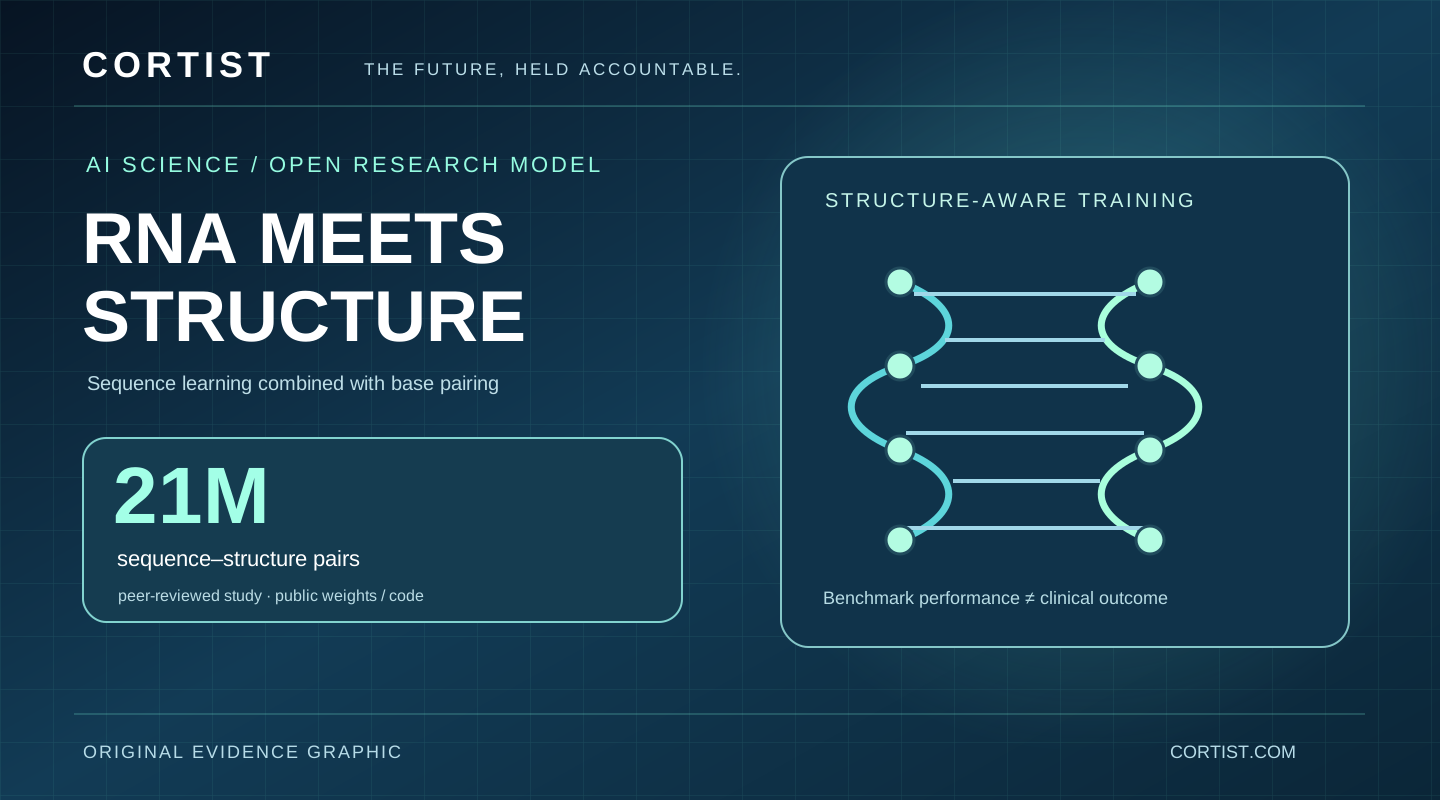
- A peer-reviewed Nature article published 4 November 2026 reports structRFM, an RNA foundation model trained on 21 million RNA sequence–structure pairs and designed to combine sequence features with base-pairing information.
- The authors report strong zero-shot homology, secondary-structure and selected tertiary-structure results. Their adapted Zfold system is described as comparable with AlphaFold 3 on specified CASP15, CASP16 and RNA-Puzzles benchmarks, not universally superior.
- The research article links open model weights, source code and data. Availability supports reproducibility, but a GitHub release does not by itself establish clinical effectiveness or the precise licensing status of every underlying dataset.
The Signal
Can a model understand RNA more effectively if it learns not only the letters in the molecular sequence but also which nucleotides are paired? Researchers published a peer-reviewed Nature paper on November 4, 2026 proposing structRFM, a structure-guided RNA foundation model. Its training data combine 21 million RNA sequence–structure pairs, and its learning objective explicitly encodes base-pair interactions. The work is a concrete example of a scientific foundation model becoming more specialized and more transparent than a general language-model demonstration.
RNA molecules are not merely strings of A, U, G and C. Pairing between nucleotides shapes secondary structures, which in turn influence folding and molecular function. Previous approaches often used sequence-only objectives or incorporated noisy structural labels in ways that made transfer to new tasks difficult. StructRFM seeks to learn several kinds of representation at once: sequence-level, individual-nucleotide and paired-position information that downstream predictors can adapt to different problems.
The authors introduce a pair-matching training operation, a dynamic masking strategy and MUSES, an ensemble method for generating secondary-structure information from multiple sources. That design is important because a large number of sequence–structure pairs does not necessarily mean 21 million experimentally determined structures. Some structural supervision is computationally inferred; errors and biases in training labels can carry forward into prediction.
The Shift
The paper reports promising generalization across several tasks. StructRFM performs strongly in zero-shot RNA homology classification and secondary-structure prediction, and it improves some functional inference benchmarks. A tertiary-structure adaptation named Zfold reportedly improves three-dimensional structure predictions and secondary structures extracted from them. These are model evaluations on defined biological datasets, not autonomous wet-lab discovery or therapeutic trials.
The AlphaFold 3 comparison deserves a precise boundary. Nature describes performance comparable to AlphaFold 3 across particular RNA structural evaluations, including CASP15-natural, CASP16 and RNA-Puzzles. The paper’s supplementary detail identifies small evaluation sets: 8 RNA targets from CASP15-natural, 13 from CASP16 and 20 from RNA-Puzzles. That is meaningful technical evidence, but the sample size and selection rules matter. It would be misleading to write that structRFM has replaced AlphaFold 3 for all biology.
An unusually useful aspect is the research distribution. The article points to a public GitHub repository containing code and checkpoints and to a Zenodo dataset archive containing the 21-million-pair training collection. The availability of these materials lets independent researchers inspect interfaces, weights and data provenance rather than relying solely on a proprietary API. Reproducibility still requires checking exact versions, model licenses, benchmark scripts, evaluation splits and compute requirements.
Open distribution also makes the scientific record more assessable, but it is not a blanket declaration that all scientific input datasets carry identical permissions. Different upstream biological databases may have their own attribution and access terms. Cortist describes the release as open weights and publicly shared code and data; it does not infer that every component has a verified OSI-approved software license without examining the repository’s actual license files.
The Cortist Lens
Cortist evaluates scientific AI by the chain from a model output to an independently checkable result. StructRFM has stronger methodological support than a company launch post because the peer-reviewed paper provides benchmark methods, sample definitions and original research artifacts. Even so, publication in a major journal does not independently replicate every number, and a benchmark improvement is not the same as a new medical treatment.
The work is particularly relevant to the boundary between AI for scientific prediction and AI as a scientist. Better RNA embeddings can support downstream structure and function research. They do not show that a system chose a hypothesis, designed a real biological experiment, generated a clinically useful molecule or independently validated a finding. Those are different milestones with distinct evidence requirements.
For independent verification, the highest-priority follow-up is to rerun reported benchmark comparisons using archived checkpoints and unmodified evaluation protocols. Tests on newly released RNA families can probe generalization beyond familiar training distributions. Separate experiments should quantify how uncertain structural labels affect performance, and whether models remain reliable for long RNAs or unusual families where existing structure predictors degrade.
For users choosing scientific open models, useful questions include whether the weights can be downloaded, the data can be recreated, the code has a clear license, tasks were separated from training and test leakage, and performance can be measured on independent biology targets. StructRFM’s public materials create an opportunity for that scrutiny. The paper itself is not proof that such scrutiny has already been completed by an independent team.
Independent reproduction of zero-shot and RNA 3D results; external evaluations on novel RNA families; full data-provenance and license review; leakage-resistant benchmark splits; long-RNA reliability; downstream experimentally validated biology discoveries derived from the published model.
A 21-million-pair RNA model with public weights is a meaningful open-science development. Its benchmark results are not clinical evidence, and comparisons with AlphaFold 3 apply to selected RNA test sets.
Sources, provenance and limits
The quantitative evidence comes from a peer-reviewed Nature article authored by the model developers. The stated open availability is sourced to the paper and public project repository; Cortist has not conducted an independent benchmark rerun or audited every license.
Source attributions refer to the underlying publication or reporting, not an independently repeated Cortist experiment. Review our editorial standards and research methodology.
An open structure-guided RNA foundation model for generalizable predictionZhu, Li, Chang et al., Nature, original peer-reviewed study, published 4 November 2026structRFM source code, weights and benchmarksResearch group’s public project repository; availability does not itself imply external validationUniversity research announcement republished by CASChinese Academy of Sciences / University of Science and Technology of China, 5 November 2026; institutional description of the study