
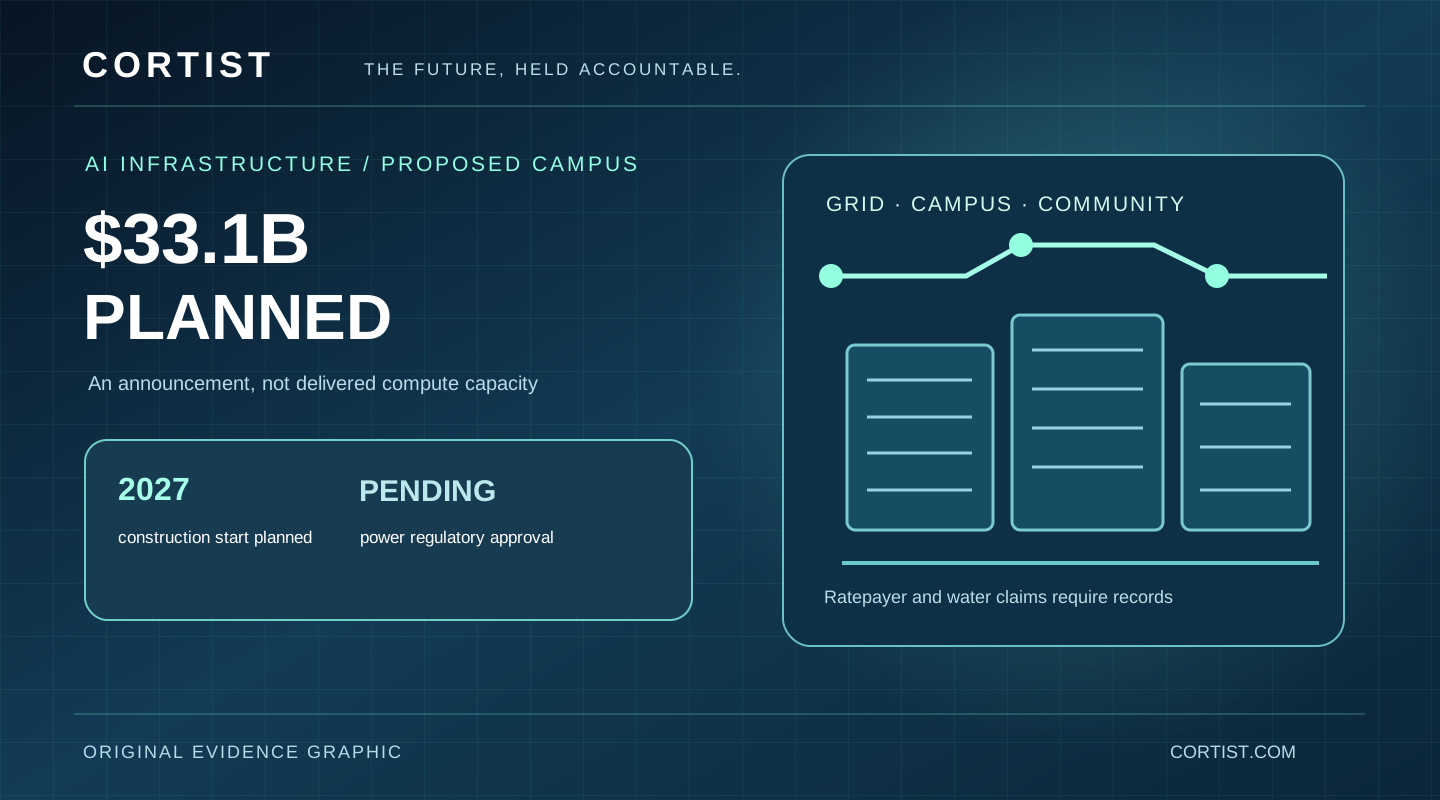
- On 4 November 2026, cloud infrastructure provider Lambda announced it would be the end user of Cloverleaf Infrastructure’s proposed Red Clay data-center campus in Lowndes County, Alabama, with estimated investment of $33.1 billion.
- The company says construction could begin in the first quarter of 2027, take up to five years and support more than 1,000 construction jobs and over 225 permanent roles. These are plans and projections, not jobs already created.
- Alabama Power would supply the project, subject to regulatory approval. Promised ratepayer protections, closed-loop cooling, long-range tax receipts and $10 million in community investment require verification against binding agreements and later outcomes.
The Signal
The AI infrastructure boom is moving from headline spending commitments to questions that are harder to answer: who will supply the electricity, who will pay for grid upgrades and what measurable benefits will reach nearby communities? Lambda announced on November 4, 2026 that it plans a $33.1 billion data-center campus in Lowndes County, Alabama, known as the Red Clay Technology Center. Cloverleaf Infrastructure has prepared the site, and Lambda is presented as the intended operating customer. This is a major proposed development, not a finished facility or an amount already spent.
The announcement describes a planned start of construction in the first quarter of 2027 and a build-out that could last up to five years. More than 1,000 construction jobs are projected across development and over 225 full-time positions are anticipated in operation. Those figures reflect company and project estimates. Cortist does not treat future staffing as a reported employment outcome or projected tax receipts as realized public revenue.
The public release forecasts more than $2.8 billion in local tax revenue through 2049, including more than $1.6 billion for Lowndes County Public Schools. It gives $3.4 billion as the projected combined state and local figure. The timeframe extends for more than two decades, so it is essential to track assumptions about site completion, facility operations, valuation and tax provisions rather than accepting a large aggregate number as an immediate community benefit.
The Shift
The electricity arrangement is central. Lambda says Alabama Power would serve the campus after regulatory approval, and it commits to paying the full cost of its electricity and required grid infrastructure through upfront financial provisions intended to protect existing ratepayers. A company pledge matters, but it is not the same as a final regulator-approved tariff, transparent cost-allocation methodology and observed utility bills. Independent review should establish whether the infrastructure and operating costs are actually segregated as described.
Water and land use require similar care. The release promises closed-loop cooling, cooperation with agricultural-water partner N-Drip and a goal to return at least as much water to the community as the campus consumes. These are design and stewardship commitments, not meter readings from an operating facility. Net-water calculations should specify which water sources, baseline, accounting boundary and time period are used, and whether local ecosystems benefit from the proposed offsets.
The project’s community package includes a stated $10 million investment through a community benefits agreement involving the Central Alabama Community Foundation. Separately, independent local reporting describes residents’ opposition and litigation challenging how county development and tax agreements were approved. Those complaints are allegations, not judicial findings. They nevertheless make public access to documents, transparent hearings and enforceable commitments relevant to evaluating the proposed social benefits.
The planned economic impact must also be kept distinct from proven AI demand. A future campus can have a named customer and ambitious financing and still face construction, interconnection, regulatory and demand risks. Neither the $33.1 billion estimate nor an announcement of a power supply relationship establishes the amount of completed compute, installed accelerators, operational megawatts or utilization that will ultimately materialize.
The Cortist Lens
For Cortist, this announcement is an opportunity to make infrastructure forecasts falsifiable. The narrative is commonly framed as a single huge dollar figure, but the important records are milestones that can be checked independently: building permits, utility rate rulings, grid connection dates, verified capital spending, construction headcounts, post-opening jobs, water withdrawals and realized tax payments.
The case connects AI & Energy with AI Chips & Compute and AI & Economy. Infrastructure spending might increase computing capacity, but useful work per dollar and economic productivity are later outcomes. A campus that breaks ground is more concrete than an unapproved proposal, and a delivered megawatt is more concrete than a power-demand forecast. Treating those stages separately prevents an announced project from being counted as operating supply.
The local dispute deserves neither sensationalism nor omission. The company highlights jobs, ratepayer protection and community benefits; opponents raise concerns about public process and resource impacts. The evidence burden applies to both sides. Court filings and any eventual judicial decisions should be checked directly, and independent measures of grid and water effects will matter more than broad assurances in a press release.
Several crucial variables remain unspecified or unverified in the release, including the final approved utility structure and measured water use at full operation. Cortist cannot infer the campus’s future electricity demand or environmental balance from the headline investment alone. Nor is the existence of a community-benefit commitment proof that every planned dollar has already been distributed.
Regulatory decision on Alabama Power service and ratepayer terms; financing and first construction permits in 2027; actual utility and water disclosures; implementation of the $10M community benefits agreement; litigation outcomes and public process; realized jobs and tax receipts compared with the original 2049 projection.
Lambda’s $33.1B figure is an announced estimated campus investment. Power approval, delivered AI capacity, local tax gains, ratepayer protections and water stewardship are future claims that require dated public evidence.
Sources, provenance and limits
Investment, jobs and tax figures originate in Lambda and Cloverleaf announcements and remain prospective. Local reporting describes lawsuits and opposition; their allegations are not treated as court findings. No current electricity consumption or operating capacity is claimed here.
Source attributions refer to the underlying publication or reporting, not an independently repeated Cortist experiment. Review our editorial standards and research methodology.
Lambda to build new data center in Lowndes County, AlabamaLambda, primary corporate announcement, 4 November 2026Project developer’s Red Clay announcementCloverleaf Infrastructure, primary developer announcement, 4 November 2026Independent local reporting on Red Clay and legal challengesWSFA 12, 4 November 2026; reports on allegations and opposition, not a court ruling