
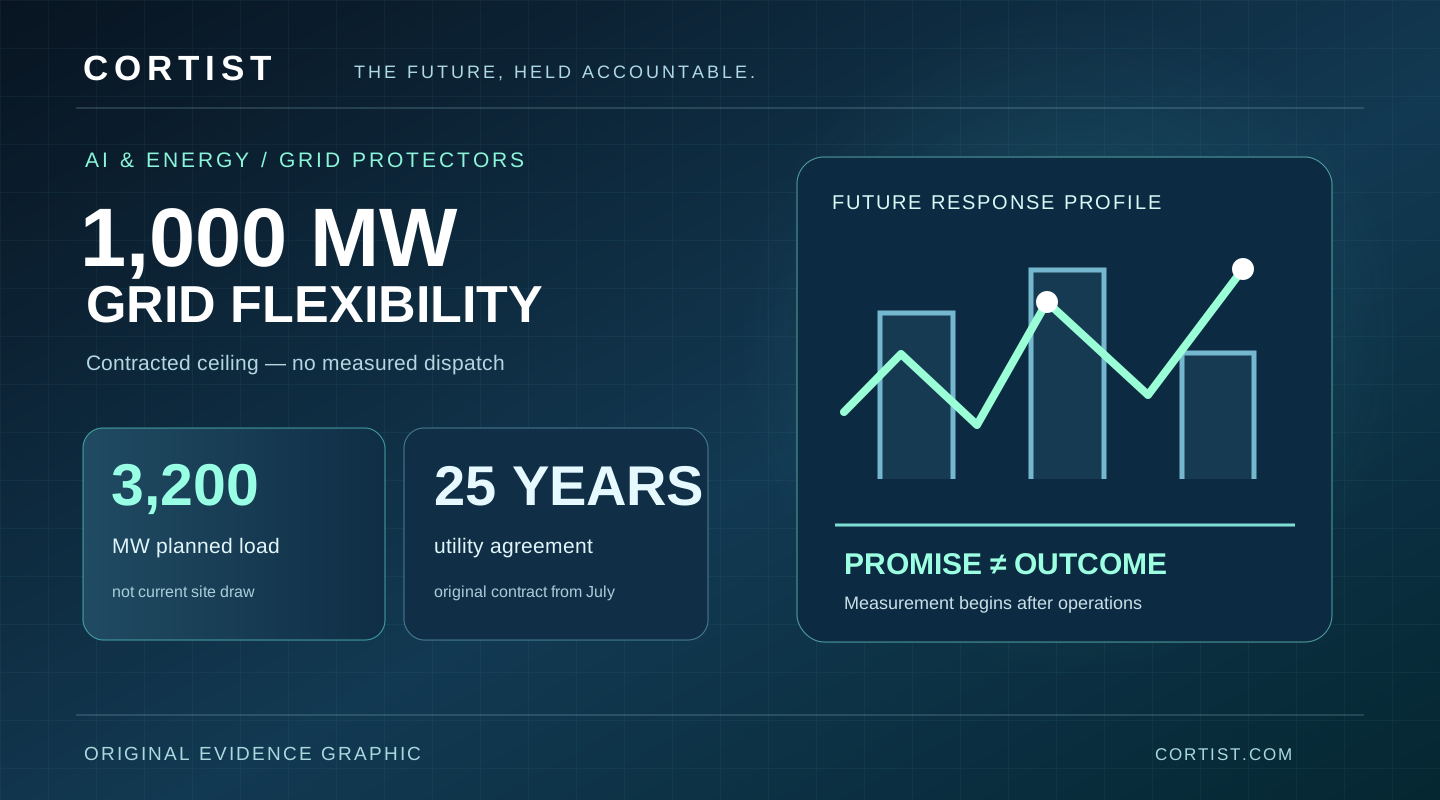
- OpenAI announced its Grid Protectors program on 2 November 2026 to plan power-demand reductions at future AI compute sites during grid stress.
- Georgia Power’s original 22 July 2026 release says the planned Effingham County site could need approximately 3,200 MW and has agreed to provide up to 1,000 MW of flexible demand response over a 25-year arrangement.
- The site is still under development. The 1,000 MW is an agreed maximum response capability, not a public record of electricity already shed during an emergency; the company’s 700,000-household comparison is an average-demand equivalence.
The Signal
AI data centers have become part of the electricity planning problem they are now promising to help solve. On 2 November 2026, OpenAI announced Grid Protectors, a national effort to design future compute campuses that can reduce grid demand during periods of stress. Its most concrete example is a planned site in Effingham County, Georgia, served by Georgia Power.
OpenAI says the Georgia arrangement allows up to 1,000 megawatts of flexible demand reduction. The utility’s own announcement from 22 July 2026 documents the underlying 25-year agreement, a planned facility requirement of approximately 3,200 megawatts, and a utility option to reduce power delivered to the site at certain times. The agreement itself predates the new national program, so the November announcement is an expansion of the model, not the first disclosure of the Georgia contract.
The difference between capacity and performance matters. A utility may have a contractual right to curtail load long before a data center is operating at full scale. OpenAI estimates that the maximum 1,000 MW response is equivalent to the average electricity use of roughly 700,000 households. That comparison explains scale; it does not establish that the campus has already supplied those households, or that a particular emergency event was successfully handled.
The Shift
Demand response is not the same as generating new electricity. If a facility temporarily reduces its consumption, electricity that would otherwise have served the data center may instead be available to other users. The real operational questions are how much demand can be reduced, how quickly the campus responds, how long the reduction persists and whether the site can restore demand without creating a second peak.
There are also competing power-system effects. A campus that draws large amounts of power all year can help utilities spread fixed grid costs across more electricity sales. It can also require new generation, transmission, substations and local infrastructure. OpenAI says it will cover its own service and infrastructure costs; Georgia Power separately says its customer-protection framework requires long-term contracts and financial assurances. These are contractual structures and company claims, not a comprehensive, independently published assessment of household bills.
OpenAI also outlines possible storage and on-site generation options for future locations, but the November release gives no completed national deployment inventory or independent performance series for these alternatives. The Georgia pilot remains a planned facility, and further program commitments are to be released as local arrangements are finalized.
One number is especially easy to misread: the Georgia utility announcement cites approximately 3,200 MW of expected site power demand against a ceiling of up to 1,000 MW of curtailment. That does not mean the facility will always draw 3,200 MW, nor that 1,000 MW will be available in every emergency. The ceiling is an option under specified conditions, not a continuously delivered public benefit.
The Cortist Lens
Cortist’s evidence standard separates policy promises, signed agreements and demonstrated public outcomes. The Georgia Power document provides stronger corroboration than a vendor press release alone because the counterparty describes the obligation in its own words. Yet the existence of a contract does not demonstrate dispatch performance or lower realized rates for other customers.
The new initiative also changes how readers should interpret AI infrastructure scaling. Reliability and affordability are not automatically guaranteed by larger data centers, even if the operators include grid services in their design. Effective demand response depends on coordination with the utility, site operations, backup-energy choices, environmental effects and transparency about who pays for new assets.
For comparison, Cortist has covered the International Energy Agency’s grid-policy work and Bloom Energy’s on-site power claims. Those sources examine different parts of the same system: total expected consumption, fuel and generation options, utility costs, local constraints and emergency flexibility. None can be reduced to a single headline megawatt number.
Public accountability would improve if OpenAI and Georgia Power publish actual calls for curtailment, measured delivered reductions, response durations, frequency, energy shifted, grid costs and customer-rate effects once operations begin. Until then, a 1,000 MW agreement is an important testable commitment rather than a proven reliability outcome.
Project construction and operational start; tariff and regulator filings; verified MW actually curtailed; duration and rebound load; dispatch frequency; generation emissions and independent evidence of reduced customer costs.
Up to 1,000 MW of load flexibility is a measurable promise, but it is not operating evidence. The real test will be a dated utility dispatch record, not a household-equivalence graphic.
Primary sources and evidence limits
OpenAI’s November 2 release describes an announced program and a previously disclosed Georgia Power agreement. This article does not claim an operating curtailment test has been independently observed.
See our editorial standards. Reported claims and independently verified outcomes are distinct.
OpenAI launches Grid Protectors programPrimary OpenAI program announcement, 2 November 2026Georgia Power’s original Effingham County agreementUtility-counterparty primary release, 22 July 2026; 3,200 MW site load and up to 1,000 MW flexible response