
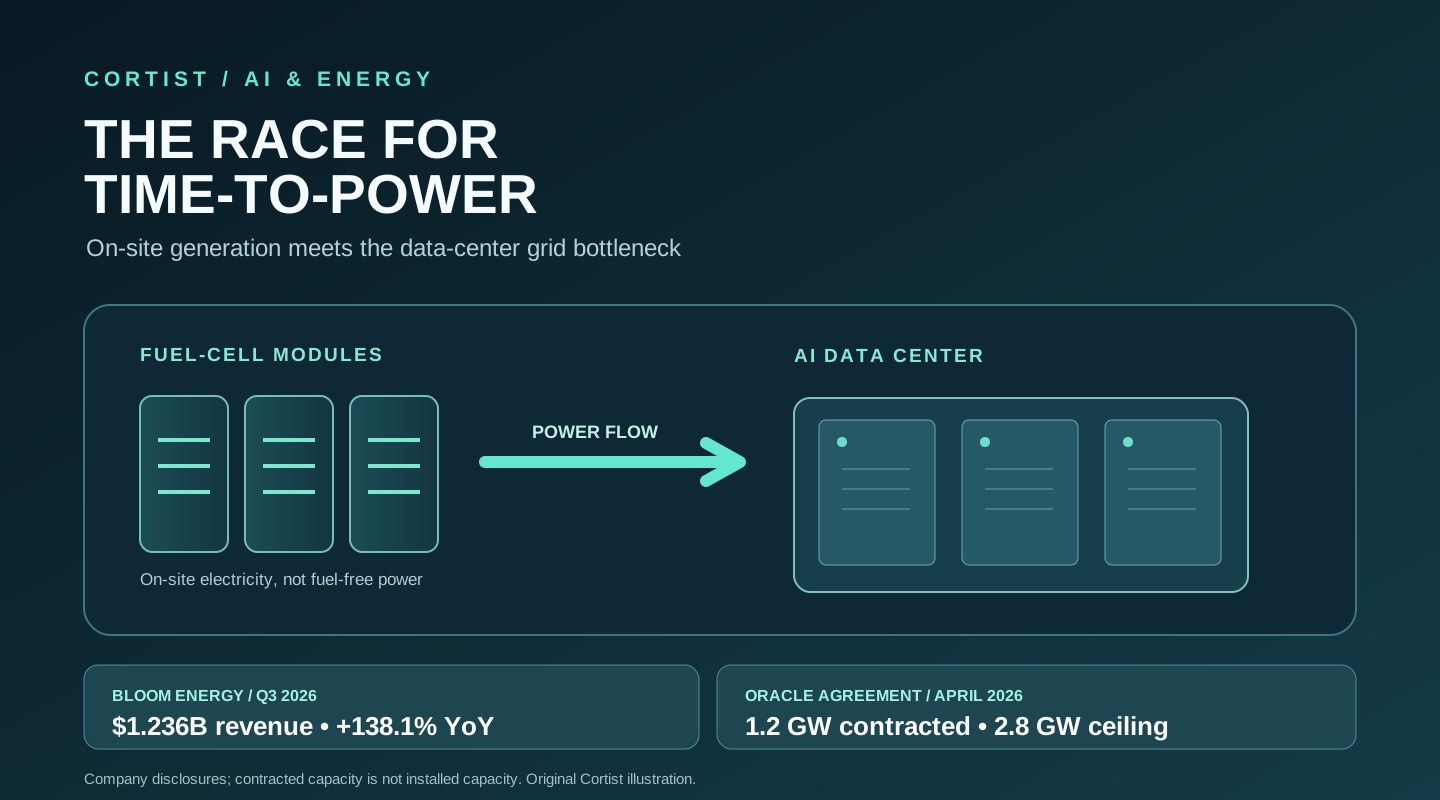
- Bloom Energy reported third-quarter 2026 revenue of $1,235.8 million, up 138.1% from the comparable quarter a year earlier.
- Bloom raised its full-year 2026 revenue guidance to $4.4 billion–$4.6 billion; these are company-wide figures, not an independently measured AI-data-center revenue total.
- An April agreement with Oracle envisaged up to 2.8 GW of fuel-cell systems, with an initial 1.2 GW contracted. The maximum is not equivalent to delivered capacity.
- Rystad Energy’s June 2026 forecast of a roughly $30 billion data-center fuel-cell market in 2030 is a projection, not a realized outcome.
The Signal
The latest measurable development in the AI-power buildout comes from an electricity supplier rather than a model laboratory. On October 22, Bloom Energy reported third-quarter revenue of $1,235.8 million, a 138.1% year-on-year increase. Product revenue reached $1,073.6 million, up 179.4%, and the company raised its 2026 revenue guidance to $4.4 billion–$4.6 billion. Those figures describe Bloom’s whole business, not a separately audited AI-only segment.
Why does this belong in an AI publication? Operators building high-density data centers need reliable electricity before expensive computing hardware can be put to work. Long grid interconnection queues have encouraged some developers to investigate electricity generated on site. Bloom makes solid-oxide fuel-cell systems, which convert fuel into electricity electrochemically rather than through a conventional combustion turbine.
The new quarterly results offer evidence that a supplier in this market is scaling sales. They do not, by themselves, establish how much of the growth was caused by AI workloads, how many megawatts are already operating at data centers, or whether customers’ electricity costs and emissions are lower than alternatives.
The Shift
An important commercial reference predates the earnings report. On April 13, Bloom and Oracle announced a master agreement under which Oracle intended to procure up to 2.8 gigawatts of fuel-cell systems. The announcement identified an initial 1.2 GW as contracted, with deployment under way. The larger number is a ceiling in an agreement, not evidence that 2.8 GW is already installed or operating.
Bloom pointed to a prior Oracle installation completed in 55 days as an example of fast deployment. A single successful project does not determine the timetable for a 100-MW-scale facility that may still need site approvals, natural-gas connections, transformers and other electrical equipment. Grid independence is not infrastructure independence.
For context, Rystad Energy’s June 25 analysis modeled data-center fuel-cell market revenue rising from roughly $2.8 billion in 2025 to about $30 billion by 2030. It also cited grid connection delays of three to six years for large US loads. These are analyst estimates published months before the October earnings, not fresh October observations or commitments by all operators.
The Cortist Lens
The commercial opportunity is a response to a scheduling problem: developers may value time to power as much as the electricity tariff. But the evidence must be separated into four categories: company revenue already reported, contracted capacity, maximum framework capacity and modeled future market demand. Mixing them makes the growth story look more certain than it is.
Fuel cells can use natural gas today and potentially other fuels as supply develops. Local air-pollutant and combustion characteristics differ from gas turbines, but lifecycle greenhouse-gas outcomes depend on fuel production, methane leakage, equipment efficiency and what generation would otherwise supply the site. An on-site system is not automatically zero-carbon merely because it is hydrogen-capable.
Rystad also flagged supply-chain concentration and materials risks, including scandium used in some solid-oxide designs. Its estimate that around 40% of projected US data-center capacity in 2030 could pursue dedicated on-site generation is a modeled possibility, not a census of projects. The relevant comparison is ultimately delivered, reliable power at an acceptable total cost and environmental impact.
For Cortist’s AI & Energy research hub, this is meaningful infrastructure evidence but not a resolution of the 2030 US data-center electricity question. That forecast concerns national electricity consumption under defined measurement rules; supplier revenue and contracted capacity do not tell us the observed 2030 share.
What to Watch
The next useful evidence is physical: commissioned fuel-cell capacity, operational availability, fuel mix, verified lifecycle emissions and actual interconnection times. Investor filings can help distinguish order books from revenue recognized and from capacity that has passed acceptance tests. Grid operators’ records can reveal whether on-site generation relieves congestion or merely shifts costs to other infrastructure.
Watch also whether manufacturing capacity grows without severe materials bottlenecks, and whether the rapid growth in sales translates into durable project economics. The October 22 earnings strengthen the case that AI-era electricity constraints are creating a real supplier market. They do not settle whether on-site fuel cells will become the dominant or most sustainable response.
Sources & editorial note
Published October 24, 2026. Bloom’s results and Oracle capacity are company-reported figures. Rystad’s market and grid estimates are third-party analysis, not observed 2030 outcomes. The distinction between contracted, installed and delivered power is Cortist’s editorial interpretation.
Bloom Energy · October 22, 2026Primary Q3 financial results, revenue growth and full-year guidanceBloom Energy · April 13, 2026Original Oracle agreement: up to 2.8 GW; initial 1.2 GW contractedRystad Energy · June 25, 2026Analyst forecast and assumptions on fuel-cell market demand and grid delays