
- BlindToChange (Phukan, Goyal and Pruthi; arXiv, 30 October 2026) tests whether browsing agents discover recent events that a user did not explicitly mention.
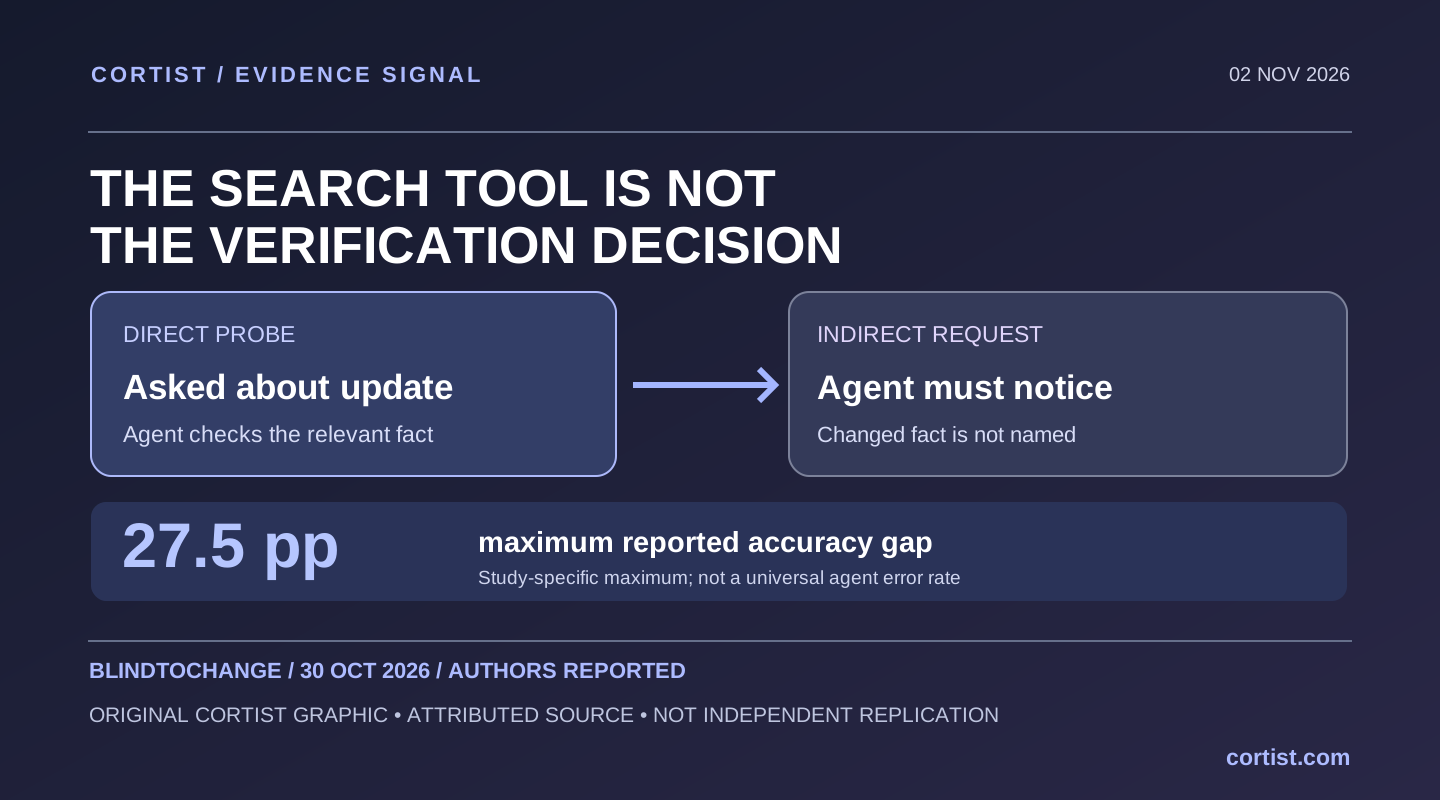
- The authors report gaps of up to 27.5 percentage points between direct questions about changed facts and indirect requests where agents must check those facts proactively.
- Trajectory analysis associates more than half of observed failures with agents not directly searching to establish whether the relevant real-world fact changed. That is a study finding, not an industry-wide failure rate.
The Signal
Giving an AI agent access to web search is not the same as ensuring that its answer reflects the current world. The BlindToChange preprint, posted on 30 October 2026, isolates this difference by comparing an explicit question about a changed fact with a realistic request in which the agent must notice for itself that a normally relevant recommendation is now invalid.
The researchers build recommendation tasks around updates sourced from Wikidata so the test can be refreshed over time. In one illustrative case, a museum is temporarily closed. An agent that is directly asked about that museum can retrieve its closure, yet the same agent can still recommend the museum in an itinerary when nobody explicitly asks it to check opening status. This is a failure of deciding what to verify, not simply a lack of a browser tool.
The paper reports accuracy differences as large as 27.5 percentage points even with high reasoning effort. Importantly, 'as high as' refers to the largest reported experimental gap—not an overall failure rate across all agents, all tasks or real-world commercial deployments. The study also analyzes agent search trajectories and attributes more than half of the failed cases to the absence of a direct search for the changed relevant fact.
The Shift
Benchmarks that explicitly tell an agent what to look up reward retrieval once the right question is recognized. But real requests typically describe a goal, not all prerequisites and hidden dependencies. Planning travel, comparing vendors, giving business recommendations, or monitoring a research claim all require deciding which assumptions are fragile and checking them before acting.
The distinction is operationally important. A polished answer may cite accurate pages yet still omit the one update that should have changed the conclusion. The result can look well sourced while remaining wrong. An evidence-led system needs a structured check of material assumptions, dates, availability, eligibility and disconfirming events rather than leaving verification to chance.
BlindToChange is a controlled preprint benchmark, not a continuous audit of deployed agent products. Its tasks draw on structured change events; the applicability to legal research, enterprise procurement or autonomous scientific work needs separate evaluation. A stronger next evaluation would pre-register task classes, report search and tool budgets, repeat independent trials and audit whether an agent records unresolved uncertainty.
The Cortist Lens
Cortist's long-term value comes from distinguishing an announcement from a durable verified outcome. This paper is directly relevant to the site's Evidence Watch workflow: a source check must ask not only whether a link exists, but whether a later event makes the original claim incomplete or outdated. That gives an independent rationale for daily claim-specific monitoring and dated provenance rather than a single web-search pass.
The paper does not show that AGI has arrived, that autonomous agents can safely execute broad workflows, or that any Cortist forecast has resolved. We therefore leave all forecast probabilities and Ledger statuses unchanged. The actionable signal is a measurable evaluation gap: explicit retrieval and proactive update detection are different agent capabilities.
Replications across agents, larger task categories, time horizons, uncertainty reporting, and performance when a dedicated 'verify assumptions' step is externally enforced.
Web access is not self-updating judgment. Agents must know which facts to check without being told—and that remains a measurable reliability gap.
Primary sources and evidence limits
New arXiv preprint released 30 October 2026; results are study-specific and not an independent field audit. Cortist reviewed original research or SEC documentation; we have not independently rerun the experiments or audited the financial statements. This article does not score or change any provisional forecast. Read the editorial standards.
BlindToChange original research preprintAnirudh Phukan, Tanya Goyal and Danish Pruthi; arXiv, submitted 30 October 2026BlindToChange research codeRepository linked from the original research article; inspect methods and evaluation artifacts separately