
The short answer
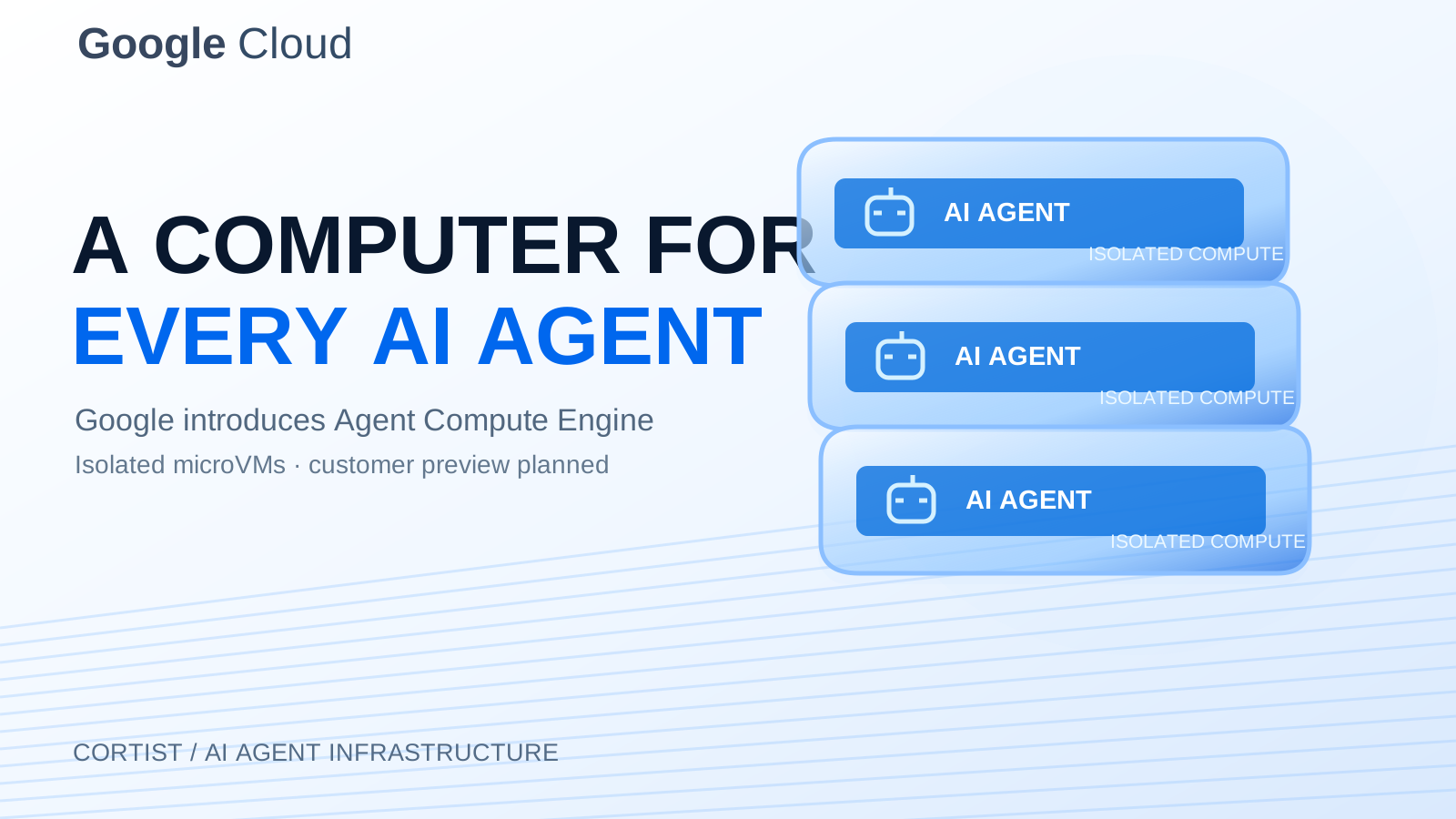
Google announced Agent Compute Engine on October 22, 2026, as a purpose-built computing service for AI agents that execute code, browse websites and work across sessions. Google's design puts each agent in an isolated micro-virtual machine, keeps longer-lived credentials outside the sandbox, and supports suspension and resumption when an agent is waiting. The architectural ambition is significant. But the customer service is not yet generally available: Google says a preview is planned for the coming months.
The announcement is about the software and security infrastructure around an AI model—not a new frontier model or proof that autonomous agents can operate safely without supervision.
Why agents need different infrastructure
A chat model typically consumes a prompt and returns a response. An autonomous agent may instead run dozens of tool calls, inspect files, launch code, wait for approvals, resume later and access business systems. That workflow needs a temporary or persistent computer, with operating-system resources and clear limits on which networks, files and secrets it may reach.
Conventional containers and virtual machines can run these tasks, but managing large numbers of short-lived, irregular and sometimes idle sessions creates operational pressure. According to Google, Agent Compute Engine grew out of the infrastructure demands of its own Gemini agent systems and internal evaluation pipelines. Its proposed optimization is not simply faster inference; it is the lifecycle of the execution environment that sits around inference.
What Google announced
In Google's description, an agent receives a dedicated microVM with its own guest kernel and workspace. The service uses Google's Titanium infrastructure and Cloud Hypervisor-based isolation, while agent identities and outbound access decisions are mediated through platform security controls. Google says that enduring application credentials do not live inside the guest environment. Short-lived identities, network mediation and policy checking are intended to limit the consequences of an agent or tool being compromised.
Google also describes checkpoint and restore. When an agent is waiting for a person, a model response or another service, its microVM can be suspended and the underlying resources reused. The idea is to keep the workspace and context while avoiding continuous active-compute consumption. For organizations running many periodic or asynchronous agents, that scheduling model could matter at least as much as a raw speed benchmark.
Persistence matters for longer jobs, too. Google describes attached storage that can preserve an agent's files across steps and potentially days. But a persistent workspace is a security and governance object: who may resume it, whether credentials are still valid, and how an administrator can inspect or revoke its capabilities are part of the design—not optional afterthoughts.
A related project: Agent Substrate on GKE
Google's announcement also covers Agent Substrate, an open-source runtime for Kubernetes environments. This is related to Agent Compute Engine, but it is not the same product. Google reports high-density and low-latency results for Agent Substrate, including up to tenfold compute density relative to its stated traditional-compute comparison and less than 500 ms suspend-and-resume latency in a 200,000-agent benchmark setup.
Those figures are Google-reported tests for Agent Substrate under specified conditions, not independently audited performance of Agent Compute Engine. They should not be transposed into promised customer pricing, universally faster task completion or a guaranteed tenfold cost reduction.
The deeper shift: permission becomes infrastructure
Google is also extending agent governance across environments through tools such as Agent Gateway, Registry, Identity and observability integrations. The company describes short-lived identities, policy-controlled outbound access and tracing of model and tool calls. Some cross-cloud and endpoint functions are planned for future previews, rather than available to every customer today.
This reflects a real operational change. An agent's ability to perform a task no longer depends only on the model's instructions. It also depends on executable permissions established outside the model: which tools are registered, which network endpoints can be contacted, whether an approval is required and what evidence of its actions is recorded.
For Cortist's AI Agents coverage, this is relevant to the transition from promising autonomous demonstrations to governable production systems. It also connects to AI & Energy: more efficient resource sharing could reduce wasted compute, but Google has not supplied the independent, comparable energy data needed to quantify a real-world electricity benefit from this announcement.
What remains uncertain
The largest question is practical availability. Google's October 22 post says Agent Compute Engine is expected to enter preview in the coming months. Enterprises should not interpret the release as a service they can universally buy and deploy today. Pricing, region coverage, quotas, integrations and customer-facing reliability figures still require verification as the preview opens.
The second question is security evidence. Hardware-backed separation, credential brokering and policy logs are promising design decisions, but they do not demonstrate that every possible sandbox escape, information leak or operator mistake has been prevented. Independent adversarial testing, transparent failure reports and operational recovery processes will matter more than architecture diagrams alone.
The third is actual task economics. A fair evaluation should include completion rates, startup time, idle costs, storage and networking, staff oversight, rejected actions, recovery from failures and the total cost of an accepted result. The best benchmark might be a representative multi-hour workflow, not an isolated VM activation.
What to watch next
Track the first customer preview, documented availability and pricing, independent isolation tests, measurable time-to-resume at realistic load, and evidence that organization-wide identity rules work across mixed agent frameworks. Google will need to show that its sandbox design is both safe and operationally economical outside its own infrastructure.
Cortist take: The next layer of competition in agentic AI may be the computer that gives models controlled hands, not only the model itself. Google's announcement is a substantial architectural direction, while broad availability and independent performance evidence remain open.
Frequently asked questions
Is Google Agent Compute Engine available today?
Google announced it on October 22, 2026 and said it targets a preview in the coming months. The announcement does not establish general customer availability.
Is Agent Compute Engine itself an AI model?
No. It is proposed computing infrastructure for hosting the execution environments of AI agents. The underlying language or reasoning model is a separate component.
Does Google's tenfold density claim apply to Agent Compute Engine?
Not directly. The published up-to-tenfold density figure is associated with Google's separate Agent Substrate runtime and its comparison conditions, not an independently verified Agent Compute Engine benchmark.
Primary sources
- Google Cloud — Introducing Agent Compute Engine and expanded agent governance (Oct 22, 2026)
- Google Cloud — Inside Agent Compute Engine: a technical deep dive (Oct 22, 2026)
Editorial note: Cortist distinguishes original-source facts, company claims and interpretation. This is source-based analysis, not independent technical replication. Original Cortist image is conceptual artwork, not a product screenshot or measurement.