
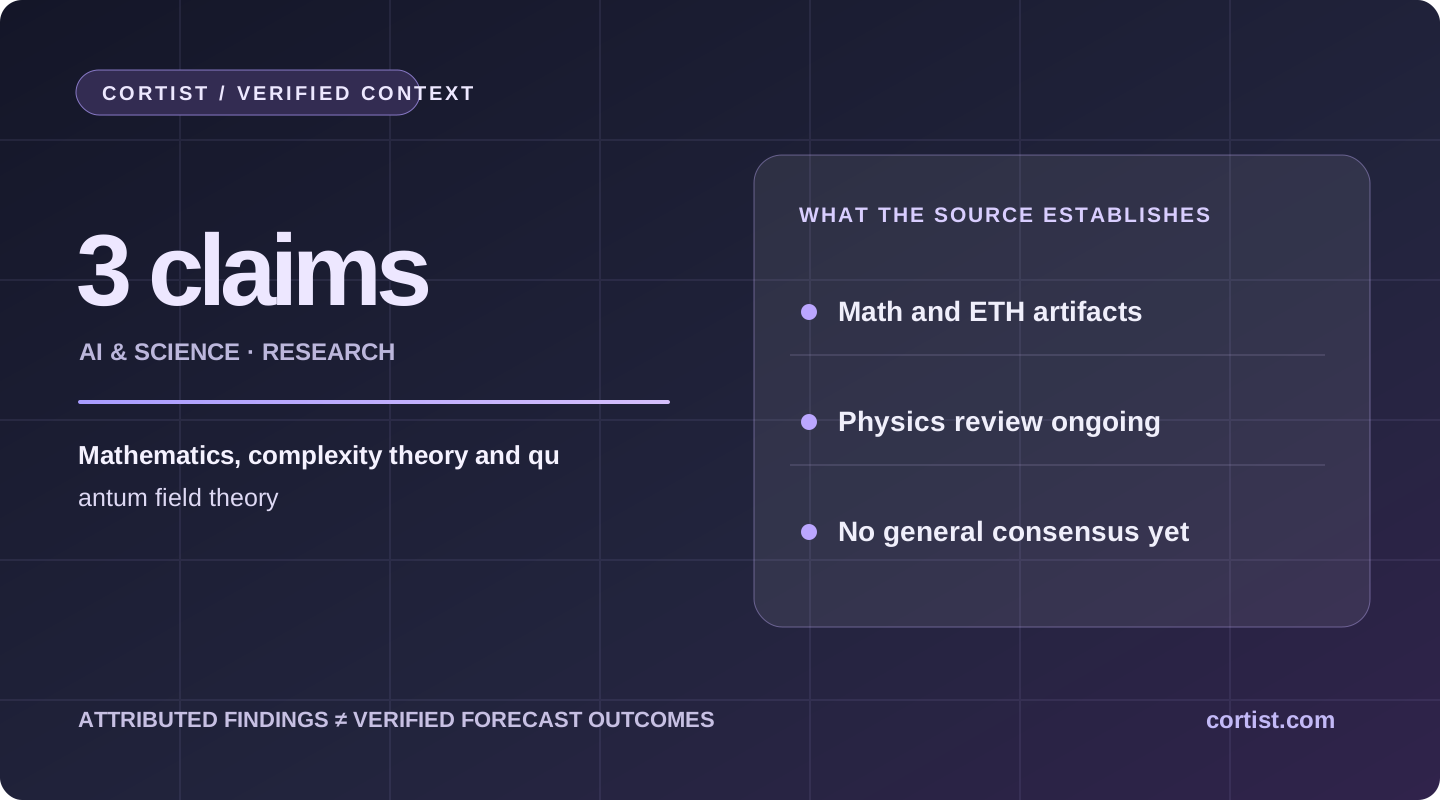
- On October 26, OpenAI announced proposed results in local smoothing/Kakeya mathematics, the Exponential Time Hypothesis (ETH) and quantum field theory.
- OpenAI says natural-language outputs and Lean formalizations are public for the mathematics and ETH claims; an external group led by Impagliazzo, Paturi and Williams is organizing independent scrutiny of the ETH result.
- For the physics work, OpenAI said an expert group led by David Gross requested that its AI-produced materials be withheld during initial assessment. Publication and independent consensus are distinct from the company's announcement.
The Signal
On October 26, OpenAI presented three AI-produced research results in mathematics, theoretical computer science and physics. The announced claims are unusually consequential: a general-dimensional local-smoothing result with implications for the Kakeya conjecture, a reported refutation of the Exponential Time Hypothesis, and mathematical existence claims involving quantum field theories.
The company describes a different disclosure strategy for each. It released model-written proof materials and Lean formalization for its mathematical and ETH claims. For computational complexity, an external group involving Russell Impagliazzo, Ramamohan Paturi and Ryan Williams will examine the ETH material and coordinate community review. For physics, a group led by David Gross will study the work before releasing materials.
The Shift
Availability of a formal proof artifact is a meaningful step toward reproducibility, but it is not identical to a broadly understood, independently accepted scientific result. Proof assumptions, formal statements, correctness of the encoding, relevance to the informal conjecture and expert examination all matter. OpenAI itself describes the manuscripts as raw research data awaiting scientific interpretation.
The ETH claim is about asymptotic computational complexity under particular definitions. It does not establish P = NP, and it is not evidence of a practical speedup for today's software, chips or medicines. Nor does an AI-lab announcement by itself confirm that the physics results meet the broader field's standards.
The Cortist Lens
Cortist should distinguish three separate events: a company publicly announces a claim, inspectable technical artifacts become available, and independent domain specialists verify that the artifact settles the intended question. These milestones must not be collapsed into a single 'AI solved science' outcome.
The most valuable next record is not a headline probability about when science is solved. It is a dated evidence chain: exact statements and proof versions, named reviewers, openly available artifacts, unresolved critiques and eventual independent consensus or counterexamples. None of these announcements resolves Cortist's numerical AI & Science forecast.
Monitor the open examination of the ETH proof, independent reviews of the mathematics artifact, public disclosure and evaluation of physics materials, and corrections or new versions of any of the proofs.
Three significant announced research claims, with materially different verification stages. Authority comes from following the external examination, not endorsing the headline.
Sources & editorial boundary
These are source-attributed research findings and dated organizational statements. Cortist has not independently reproduced the experiments or certified their outcomes. Read the editorial rules and the current versioned structural inventory. That inventory checks source-link presence and published file hashes, not independent scientific replication or external source availability.
OpenAI research announcementPrimary company statement, October 26, 2026, including its own disclosure limits