
- The team described its work publicly on October 21, 2026, using GPT-Rosalind-powered agents.
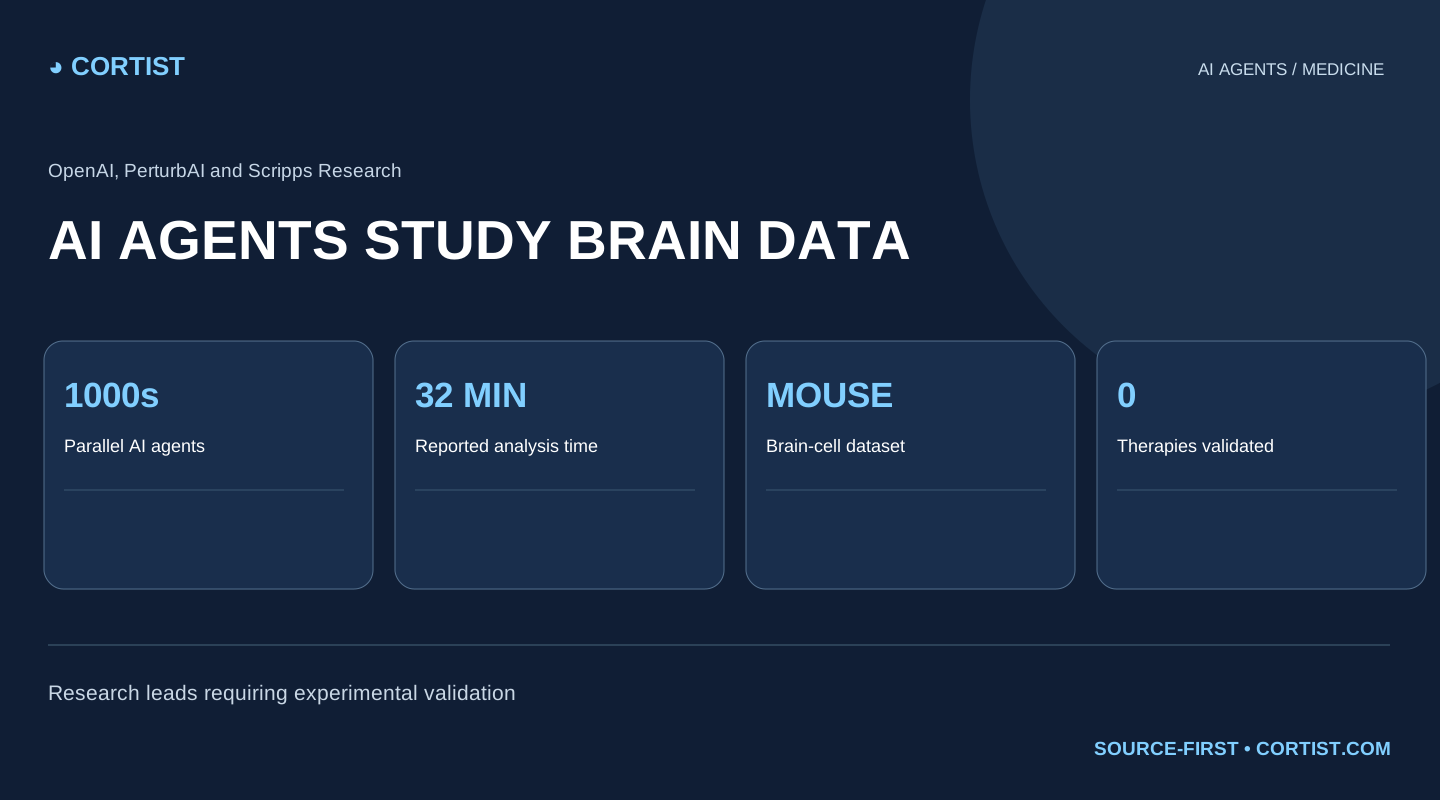
- Thousands of agents analyzed existing perturbation data from millions of mouse brain cells and associated literature.
- The reported 32-minute run generated a reasoning atlas and hypotheses for experimental follow-up.
- The work did not demonstrate a new clinical treatment or establish general AI-agent reliability.
The Signal
OpenAI, PerturbAI and Scripps Research reported using thousands of parallel AI agents to examine an existing whole-mouse-brain gene-perturbation atlas. Announced October 21, the project used GPT-Rosalind agents to connect changes in measured cells with scientific literature and propose possible biological explanations. The organization reported completing the large-scale analysis in 32 minutes.
The goal was to build a reasoning atlas linking genes, cellular effects, publications and possible mechanisms. That is a useful research output, but not an independently established new therapy. Scientific hypotheses, however compelling, still require targeted experiments and replication before they can support medical claims.
The Shift
The team compared distributed agents with a single agent at a large workload. In its account, the single agent cited 11 references while the distributed setup cited more than 700. Blinded human experts reportedly preferred distributed-agent interpretations 75% of the time. These are study-specific comparisons about coverage and quality judgments, not evidence that all proposed mechanisms are correct.
Researchers highlighted differences in how Tsc1 and Tsc2 gene disruption affects some neuronal populations, and a possible link between DCTN1, cholesterol handling and neurodegeneration. Such findings could guide more focused follow-up experiments. Neither the existence of literature links nor an expert preference score substitutes for experimental confirmation.
The Cortist Lens
The result is relevant to Cortist’s AI Agents pillar page because it suggests one way to divide a complex data-and-literature problem into parallel, auditable tasks. System usefulness depends on model accuracy, tool access, task design, coordination, source selection and how outside assessors check the results. Parallel speed is not the same as reliable performance on every scientific problem.
In AI in Medicine, the distinction is more important still: proposing mechanisms in a mouse dataset is far from demonstrating patient outcomes. Our diagnostic-AI analysis applies the same rule to retrospective benchmarks. Research leads and proven treatments should never be conflated.
The reasoning atlas and linked research manuscript provide potential routes for independent review. Researchers should prioritize experimental checks, reproducible comparisons with strong alternative workflows, the cost of agent orchestration and the proportion of hypotheses validated under controlled laboratory conditions.
This study does not resolve Cortist’s A-001 eight-hour technical task-horizon candidate or M-001 drug-approval question. Both require their own event definitions and evidence. We therefore preserve all forecast histories and record this finding as a research report, not a scored milestone.
Distributed AI analysis can expand the number of research hypotheses scientists examine. Determining which hypotheses describe real biology remains an experimental task.
Questions readers ask
Research outcomes and company statements are distinguished from independent verification.
What did these AI agents actually study?
Existing mouse-brain gene-perturbation data and related scientific publications.
Did they find an Alzheimer’s or Parkinson’s cure?
No. They proposed mechanisms and research leads, not validated treatments.
Why use thousands of agents?
Agents can inspect many gene interventions and literature sources in parallel, potentially extending analytical coverage.
Does 32 minutes mean clinical research now takes half an hour?
No. It describes a particular data-analysis workflow; biomedical validation requires additional steps.
Sources and editorial note
Cortist separates original claims, external reporting and independent validation. See editorial standards.
OpenAI collaborative research announcement, Oct 21Primary report of study design, examples and comparison metrics.bioRxiv research manuscript, 2026Linked preprint; not evidence of approved clinical treatments.