
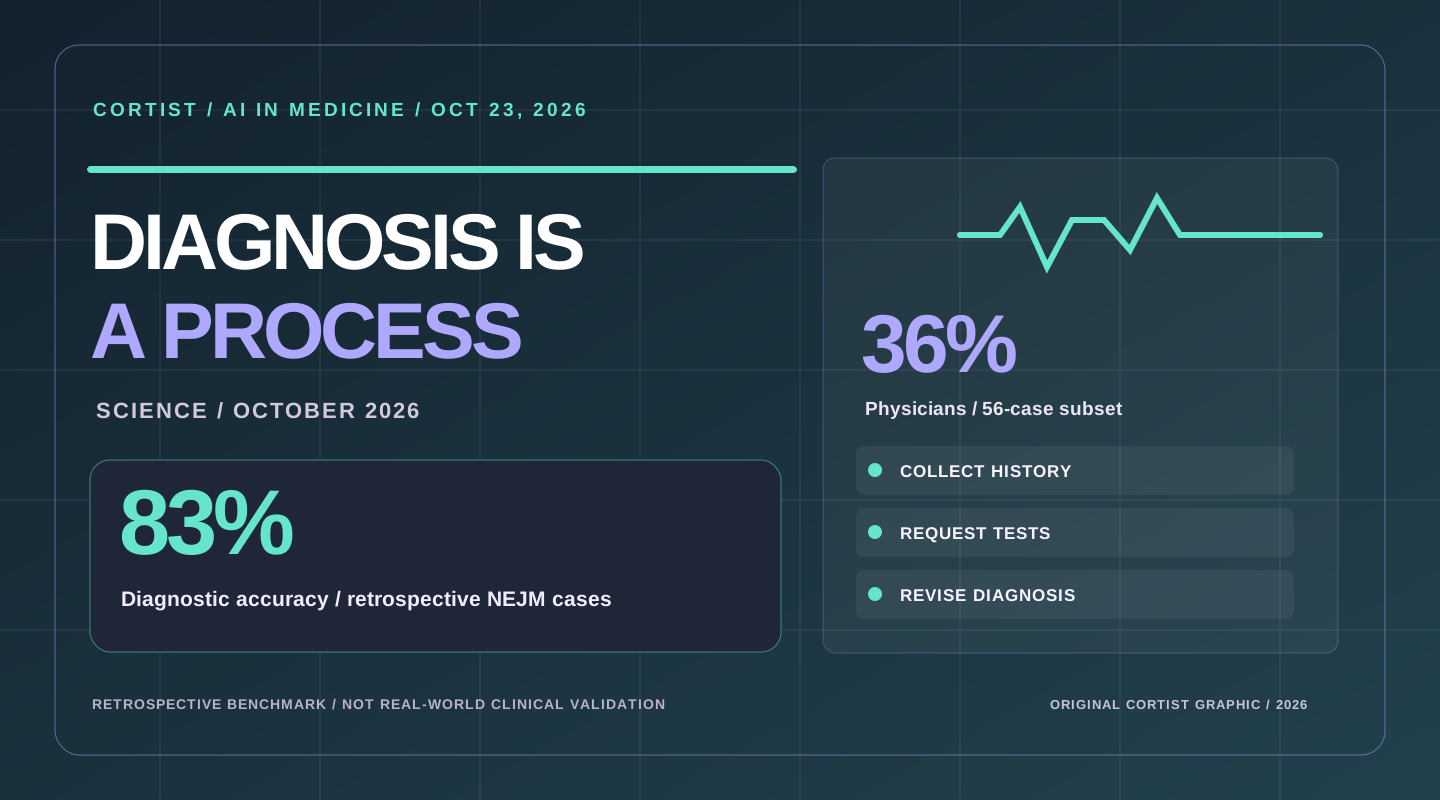
- Published October 22, 2026 in Science, the study evaluates stepwise diagnosis: choosing questions and tests, then reconsidering possible diagnoses.
- Microsoft reports about 83% accuracy across 304 complex NEJM cases, compared with roughly 36% for reference-assisted generalists and 22% for unaided generalists on a smaller 56-case physician comparison subset.
- In another retrospective emergency-department case set, the study reports about 80% versus 47% for participating physicians. It is not a prospective clinical trial.
- Microsoft funded the research, and its authors were Microsoft employees. Independent prospective patient-outcome evidence remains unavailable.
The Signal
Microsoft's AI team reported a striking result on October 22, when a paper appeared in Science describing its Diagnostic Orchestrator, MAI-DxO. The design is different from a medical model answering a multiple-choice question: it requests more information, chooses tests and updates its diagnosis as details emerge.
The study covers 304 complex clinicopathological cases drawn from The New England Journal of Medicine for the AI system. Critically, the comparison with generalist physicians used a much smaller subset of 56 cases, rather than all 304. MAI-DxO scored about 83% across the 304-case benchmark; physicians using references achieved around 36% on their allocated cases, and unaided physicians scored about 22%. These are unequal evaluation sets, not a head-to-head comparison over identical 304 cases. The study also did not assess specialist teams treating live patients.
A second evaluation based on MIMIC-IV-ED emergency cases reported roughly 80% accuracy for the system versus 47% for participating physicians. Case sets and comparator conditions differ. Taken together, the numbers show strong performance on a research benchmark rather than a reliable estimate of how doctors or AI will perform across clinical settings.
The Shift
MAI-DxO stages a debate among simulated medical viewpoints. It can request history, tests or additional examination details and weigh conflicting explanations before selecting a diagnosis. This tests a chain of clinical decisions, not just medical textbook recall.
The research also considers which tests the AI requests and estimates their costs. Microsoft says a cost-conscious variant maintained about 81% accuracy on complex cases while choosing less expensive investigations. But simulated workup charges are not actual medical bills. They exclude staffing, clinical follow-up, missed diagnoses, patient anxiety and the economic consequences of treatment.
The paper was produced by Microsoft researchers with company funding. Microsoft has said it will open-source components of its sequential diagnosis benchmark, which can enable scrutiny. But independent replication and live prospective evaluation remain separate milestones. The company plans to pursue clinical testing with Beth Israel Deaconess Medical Center; that does not mean a real-world safety or efficacy study has already reported results.
The Cortist Lens
The tempting headline is that AI 'beat doctors'. That would leave out the most important questions: were the comparators appropriate, did the case set represent real patients, and would the system improve outcomes without unsafe decisions? The physician comparison was conducted on a smaller 56-case subset rather than the AI's full 304-case set. It was retrospective and text-based, not a controlled trial against specialist teams in real clinical conditions.
A credible next evaluation should pre-register patient populations, compare with specialist-supported clinical care, measure missed dangerous conditions and validate the complete clinical workflow. Answer-key accuracy is necessary but not sufficient for safe use. Rates of wrong tests, delays, subgroup bias and patient harms need their own evidence.
For Cortist, this is meaningful AI in Medicine research, but not evidence that an AI-designed drug won FDA approval. Our separate 2032 drug-approval candidate retains its own resolution rules and has not been upgraded by this study.
Watch for independent replication of the sequential benchmark, prospective clinical trials with appropriate specialist comparators, subgroup and safety analyses, and any regulatory authorization. This standard news report is archived; it does not automatically change a forecast.
The benchmark evidence suggests a real advance in step-by-step machine diagnosis. Whether that translates into safer, better patient care remains untested.
Questions readers ask
Clear answers based on the currently available evidence, without overstating its scope.
Did Microsoft's AI outperform doctors?
In a controlled retrospective comparison, the orchestrator reached about 83% accuracy versus about 36% for individual generalist physicians with references. Clinical superiority was not established.
How many cases were involved?
The challenging New England Journal of Medicine benchmark used 304 retrospective cases. A separate emergency-department set produced another comparison.
Is this system approved for clinical diagnosis?
The cited paper reports research-benchmark performance, not a prospectively proven clinical product or an FDA authorization.
Does the study validate the 2032 drug-approval forecast?
No. Medical diagnosis and FDA authorization of a verifiably AI-designed new drug are different outcomes.
Editorial clarification, 23 October 2026: We now explicitly state that the AI and physician figures were obtained on different-sized evaluation sets. The physician group was assessed on a 56-case subset rather than all 304 NEJM cases. The reported percentages are neither a matched-sample 304-case contest nor evidence of improved live patient outcomes.
Primary sources and editorial note
Published October 23, 2026. Original reporting with direct attribution, clearly separated company claims, research findings and independent clinical or regulatory evidence. Archive class: Standard News. No dedicated ongoing watch is created, and no Cortist forecast is locked or resolved by this article.
Science: Sequential diagnosis study (DOI 10.1126/science.aeh7930)Scientific study / published October 22 2026Microsoft AI: Building Medical SuperintelligenceOriginal developer statement and evaluation detail / October 22 2026Reuters: Microsoft sequential diagnosis researchIndependent coverage / October 22-23 2026