
Will an AI-designed drug win FDA approval?
Will a novel therapeutic substantively designed with AI receive original US FDA approval before January 2033, with the design role independently documented?
Understanding the AI-designed medicine forecast
This is an editorial milestone candidate, not an approved official probability forecast. The proposed threshold and preliminary working model are not scored.
FDA approval plus verified design provenance. A company announcement is not a substitute for independently verifiable evidence.
What the original data does and does not say
Better molecular binding, a trial registration and a marketing authorization represent very different stages of drug development. The outcome tracked here is deliberately demanding: a novel therapeutic must reach actual US FDA marketing approval, and evidence must show that AI materially contributed to the design of the active therapeutic before candidate selection.
FDA AI-tool qualification, early clinical development and a drug company's description of itself as AI-powered do not demonstrate the required outcome. Without a sufficiently accessible molecular design trail, the approval may be real but the AI-design qualification remains unresolved.
What would make this claim checkable?
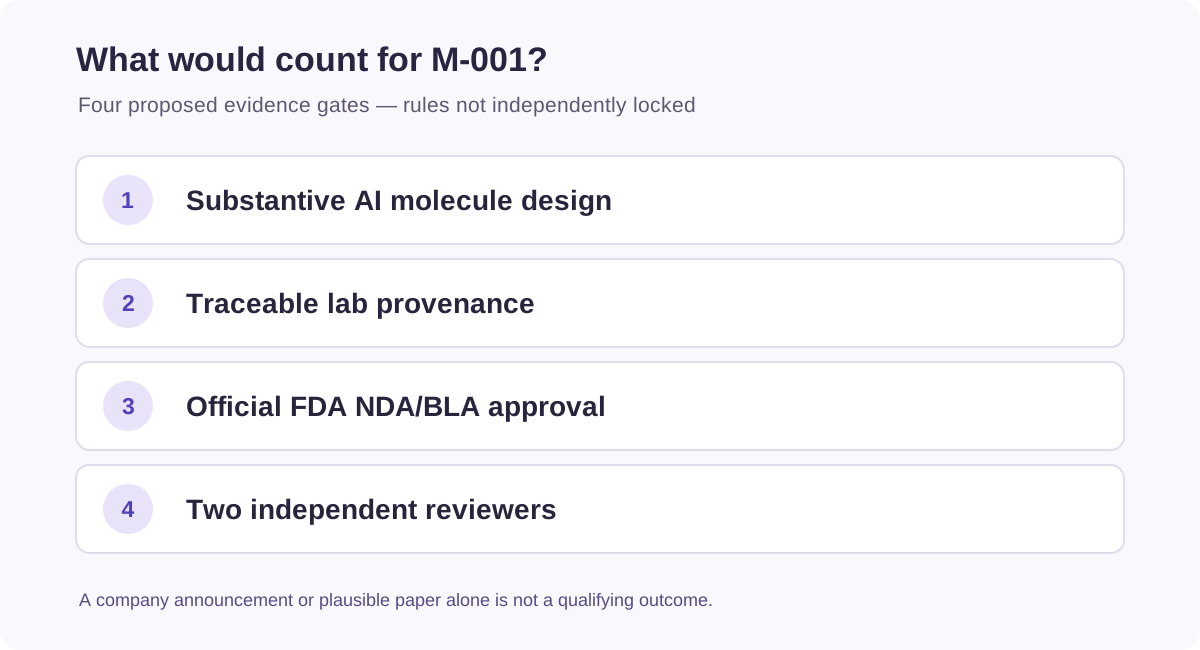
A qualifying record would combine the FDA's original NDA or BLA authorization with dated technical records, patents or independently inspectable research showing a substantive de novo AI design contribution. Two independent reviewers would need to examine the connection between the purported model work and the approved medicine.
Required part of the proposed evidence path; one step alone cannot settle the question.
Required part of the proposed evidence path; one step alone cannot settle the question.
Required part of the proposed evidence path; one step alone cannot settle the question.
Required part of the proposed evidence path; one step alone cannot settle the question.
The historical forecast record above contains the complete original draft criteria. Those historical rules are not being retrospectively changed by this expanded explanation.
What evidence could change the assessment?
Useful evidence will come from FDA approval databases, published molecular provenance and independent reviews of the design history. The page's illustrative probability model is not a locked official Cortist forecast and should never be mistaken for an observed clinical success rate.
An announcement, a source-attributed observation, an independent replication and a formally resolved forecast are separate types of evidence. Cortist should preserve the difference when judging later developments. Until the rules are independently frozen, this question cannot add a legitimate score to a forecasting track record.
Frequently asked questions
Does entry into a human trial count as FDA approval?
No. Trial authorization and actual FDA marketing approval are separate regulatory milestones.
Would any medicine from an AI company count?
No. A specific substantive AI contribution to the actual approved active therapeutic must be documented.
Is there an official Cortist probability?
Not yet. M-001 is an editorial candidate with unapproved quantitative illustrations.
Published supporting sources
These source documents were already cited in the original forecast. The links support contextual review; their presence is not an independent replication or confirmation of an outcome.
- Originally cited research source 1
- Originally cited research source 2
- Originally cited research source 3
- Originally cited research source 4
Explore original context
Substantive explanatory update: 29 October 2026. Historical data, original publication dates, probabilities, sliders and scoring eligibility are unchanged.
What is really
being measured?
A measurable future event needs clearer evidence than a technology headline.
There is a difference between AI assisting discovery, a candidate entering human trials and the FDA authorizing an effective medicine. The FDA approval is visible, but the contribution of AI to the active molecule needs separately verifiable documentation. Independent analysis of drug discovery notes that AI-designed marketing claims can outpace disclosed molecular evidence. The candidate requires both a therapeutic approval and a substantive, dated and independently auditable AI-design contribution.
Rules before
results.
Deadline: 2032-12-31 (end of day UTC). Proposed outcome and source rules remain subject to independent review.
Will a verifiably AI-designed novel drug receive FDA approval by the end of 2032?
Measurement: At least one eligible US FDA NDA/BLA approval with independently documented de novo AI molecular design
At least one new molecular drug or biologic receives original US FDA marketing authorization through an NDA or BLA by December 31, 2032, and independent documentation shows a material de novo AI contribution to the design of the active therapeutic candidate before laboratory synthesis or lead selection. Clinical trial registration, Fast Track designation, AI-supported diagnostics and merely AI-assisted data analysis do not qualify.
What would count as yes?
- FDA Drugs@FDA or a corresponding official authorization record establishes original approval for a new therapeutic active ingredient by the deadline.
- A dated, independently scrutinizable paper, patent trail and/or third-party audit identifies the candidate's actual AI-generated or AI-directed molecular design contribution.
- Two independent reviewers sign off that the qualifying contribution was substantive and occurred before the therapeutic candidate was selected.
What would count as no?
- A complete review of eligible original FDA approvals through December 31, 2032, finds no qualifying candidate with adequate independent provenance.
- Where design claims remain undocumented, do not count the product as a positive observation.
What must be resolved before locking?
- Define minimum acceptable provenance and the independent review panel before locking.
- If a drug is approved but the company cannot disclose enough design history, its qualification is unresolved; do not silently count a corporate press release.
- Set a latest adjudication and appeals date; clarify how accelerated FDA approvals and biologics are treated.
Important limitation: FDA AI-tool qualification, clinical trial entry or Fast Track designation is NOT a drug marketing approval; AI's design contribution must be independently documented.
Two hurdles, one outcome.
A transparent starting estimate. The figures are open to challenge and have not passed independent review.
A preliminary calculation, not an approved or locked Cortist forecast.
How the estimate was built
Drug discovery is progressing, but an AI-supported clinical trial is not the same as an approved medicine. Our estimate requires both a successful FDA decision and evidence that AI materially shaped the molecule.
Both inputs are provisional judgments, not clinical trial success rates. A Phase III study or a company's AI-design claim cannot by itself establish the milestone.
The sensitivity figures illustrate alternative modeling choices, not a confidence interval. View the full calibration comparison and the independent-review requirements before interpreting them as predictions.
Evidence before
the percentage.
Original sources and explicit caveats, not made-up probabilities or unverifiable extrapolations.
View the versioned machine-readable research candidate (JSON). Created October 23, 2026. These are not locked or scored predictions.
What readers
should know.
Is this a locked Cortist prediction?
No. It is an editorial research candidate. Cortist has not assigned a probability, independently locked the criteria, or made it eligible for scoring.
What evidence could still be missing?
Define minimum acceptable provenance and the independent review panel before locking.
Why might a claimed milestone not qualify?
If a drug is approved but the company cannot disclose enough design history, its qualification is unresolved; do not silently count a corporate press release.
What needs independent review?
Set a latest adjudication and appeals date; clarify how accelerated FDA approvals and biologics are treated.