
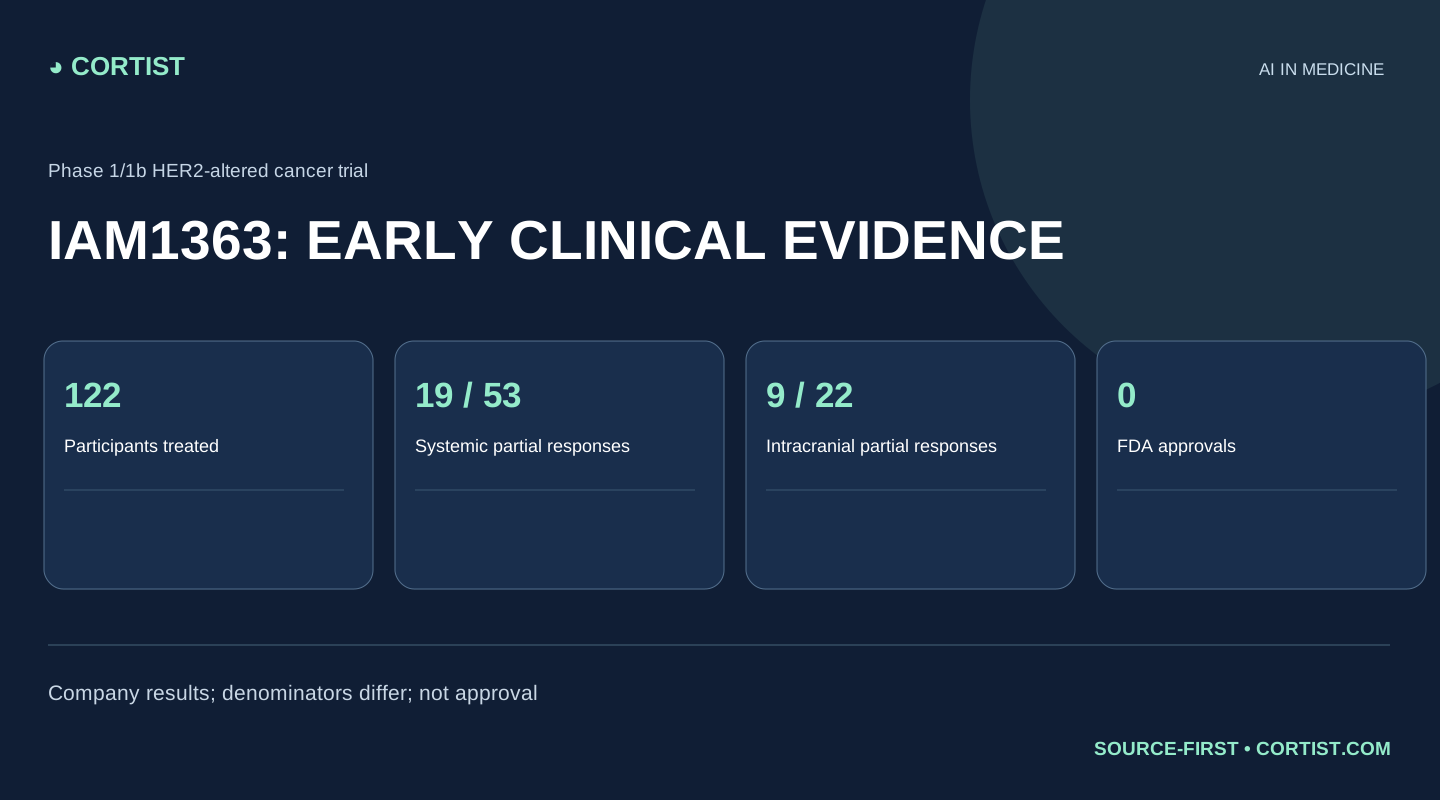
- IAM1363 is a HER2-directed investigational medicine in an ongoing Phase 1/1b trial.
- By August 31, 2026, Iambic reported 122 participants treated across four study parts.
- In defined subgroups, 19/53 had a systemic partial response and 9/22 an intracranial partial response.
- These preliminary company-reported results do not constitute FDA approval or randomized evidence of clinical benefit.
The Signal
Iambic Therapeutics released updated results for IAM1363 on October 26, following an ESMO 2026 poster presentation on October 23. The candidate is an investigational HER2 tyrosine kinase inhibitor discovered with the company’s AI-driven drug-research platform. Its ongoing Phase 1/1b study involves adults with advanced cancers carrying HER2 alterations.
At the August 31 data cutoff, 122 people had received IAM1363 in study Parts 1–4. The response percentages quoted in the press release use smaller, defined groups rather than all 122 participants. Among 53 eligible participants dosed at at least 960 mg, 19 (36%) had a systemic partial response. Among 22 in an intracranial assessment subgroup, nine (41%) had a partial response.
The Shift
The company reports preliminary activity in heavily pretreated patients, including some with brain metastases. It highlighted responses in certain HER2-positive breast-cancer patients who had previously received trastuzumab deruxtecan and tucatinib. These observations provide rationale for continued clinical research, but the small subgroups and lack of randomized comparison constrain what can be concluded about efficacy.
Among 68 participants receiving the recommended 960 mg daily monotherapy dose, Iambic reported grade 3 or higher treatment-related adverse events in 5.9%. It reported no grade 4 or 5 treatment-related adverse events. Safety follow-up, response duration and larger trial populations will matter before any wider claim of meaningful patient benefit.
The Cortist Lens
This development belongs in the Cortist AI in Medicine reference guide because it shows the gap between AI-supported discovery and a clinically approved medicine. The company describes its platform as molecular superintelligence, which is a product characterization, not independent evidence that general artificial superintelligence exists. A more useful question is what the candidate does in well-controlled trials.
Iambic says the project moved from initiation to clinical development in approximately two years. Without a comparable control group, this is not proof that AI reliably speeds every drug program. Cortist’s Reality Ledger and its analysis of diagnostic AI both distinguish preliminary performance from independently verified effects on health outcomes.
Trial identifier NCT06253871 provides a route to following enrollment and updates. Future evidence should address the duration of responses, safety in larger groups, outcomes in individual HER2 populations, comparator arms and eventual regulatory decisions. Intracranial response in difficult-to-treat populations remains a clinically important research question.
Cortist’s M-001 drug-approval candidate remains on HOLD. Data from Phase 1/1b do not satisfy an FDA approval event. No historical forecast probability is adjusted on the basis of Iambic’s October announcement.
The reported responses are a meaningful early clinical signal. They are not a drug approval, a controlled comparison or proof that AI discovery improves patient outcomes.
Questions readers ask
Research outcomes and company statements are distinguished from independent verification.
Is IAM1363 approved by the FDA?
No. IAM1363 is investigational and remains in a Phase 1/1b clinical study.
What does 122 participants mean?
It is the total treated across the reported study parts as of August 31, not the denominator for each response percentage.
What does 19 of 53 represent?
A partial systemic response in a specified eligible subgroup receiving at least 960 mg.
Does this prove AI makes better medicines?
Not yet. Early clinical activity supports further study but does not establish superior patient outcomes or approval.
Sources and editorial note
Cortist separates original claims, external reporting and independent validation. See editorial standards.
Iambic ESMO 2026 release, Oct 26Primary company report, denominators and trial limitations.ClinicalTrials.gov NCT06253871Study registration and subsequent status monitoring.