
OECD 2026, Digital technology diffusion
Adoption and productivity premia are partly explained by human and technology capital.
Read original evidence ↗By 31 December 2035, will at least two independent macroeconomic analyses attribute an additional one percentage point or more of annual US labor-productivity growth to AI over a common three-year observation period? This forecast uses a provisional subjective 35% initial estimate and awaits independent review of its rules.
Recorded: 26 October 2026. Version: v0.1. Not independently locked, calibrated or scored.
This is an original provisional v0.1 subjective probability, not a measured or independently locked forecast. The stored draft and any historical numbers remain unchanged.
+1 percentage point annual growth. A company announcement is not a substitute for independently verifiable evidence.
Widespread workplace adoption is not equivalent to a measurable national productivity acceleration. Employees might save time on narrow tasks without creating proportionate new output, while macroeconomic data can be moved by capital spending, business cycles and changes in the composition of work.
A single company claiming time savings, a national productivity jump or an investment boom would not establish the target causal contribution. The crucial distinction is between a measured change in output per hour and a defensible attribution to AI rather than other forces.
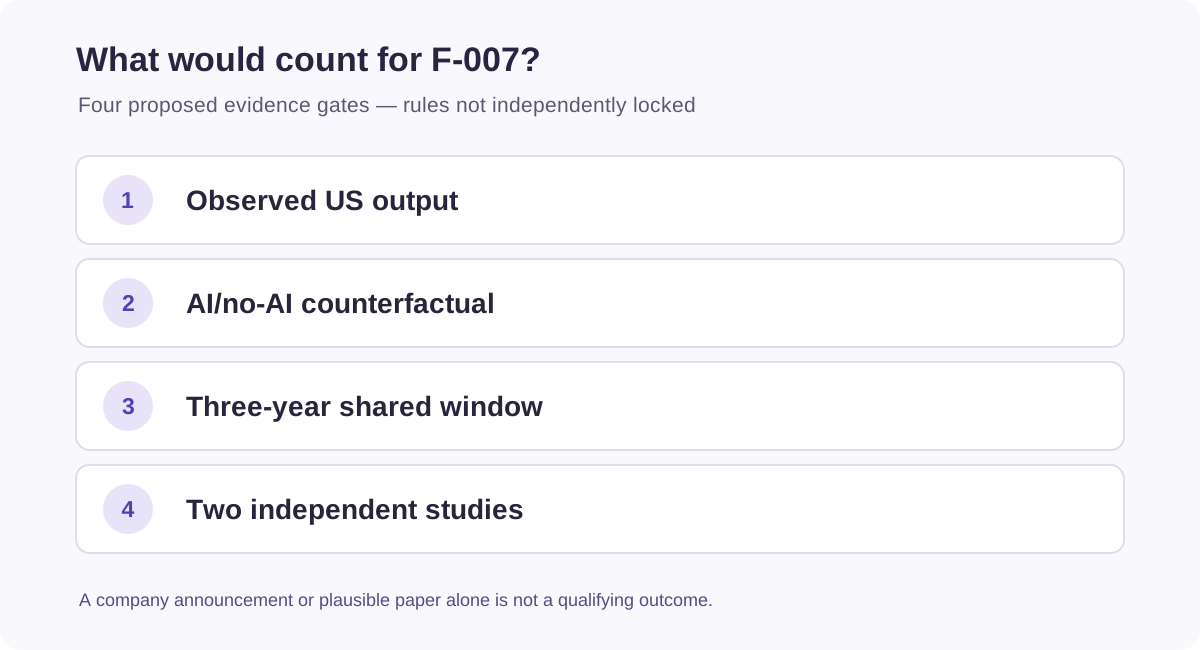
F-007's proposed test asks at least two independent qualified research groups to identify at least one additional percentage point of annual US labor-productivity growth attributable to AI across a comparable three-year observation window. Each study must explain the no-AI counterfactual and separate other influences.
Required part of the proposed evidence path; one step alone cannot settle the question.
Required part of the proposed evidence path; one step alone cannot settle the question.
Required part of the proposed evidence path; one step alone cannot settle the question.
Required part of the proposed evidence path; one step alone cannot settle the question.
The historical forecast record above contains the complete original draft criteria. Those historical rules are not being retrospectively changed by this expanded explanation.
Watch transparent productivity data, counterfactual methods, independent replications and whether studies can agree on a common three-year window. A future review should also clarify revisions to official productivity statistics. The 35% figure is not a statistical estimate from those future studies.
An announcement, a source-attributed observation, an independent replication and a formally resolved forecast are separate types of evidence. Cortist should preserve the difference when judging later developments. Until the rules are independently frozen, this question cannot add a legitimate score to a forecasting track record.
No. Adoption, labor productivity and causally attributable gains are different measurements.
No. The proposed outcome needs a common three-year observed window and two independent analyses.
No. It is a provisional probability for a future specified event.
These source documents were already cited in the original forecast. The links support contextual review; their presence is not an independent replication or confirmation of an outcome.
Inspect the original machine-readable F-007 v0.1 forecast record
Substantive explanatory update: 29 October 2026. Historical data, original publication dates, probabilities, sliders and scoring eligibility are unchanged.
By 31 December 2035, will at least two independent macroeconomic analyses attribute an additional one percentage point or more of annual US labor-productivity growth to AI over a common three-year observation period?
An independent reviewer must approve precise datasets, sampling or evaluation thresholds and adjudication rules. No retrospective revision of the event is permitted for formally scored versions. The current draft remains unscored.
Companies can invest heavily in AI, deploy new tools and report employee time savings without generating a proportional macroeconomic productivity gain. An increase in usage is not the same outcome as higher output per hour of work. Cortist tracks the difference between adoption, investment, firm-level experiments and national productivity statistics.
Productivity is affected by business cycles, ordinary capital deepening, wages, regulation, demographic change, training and measurement practices. A single estimated AI contribution could rest on unverified assumptions. The proposed F-007 test therefore calls for independent analyses using a documented no-AI counterfactual and comparable observed years.
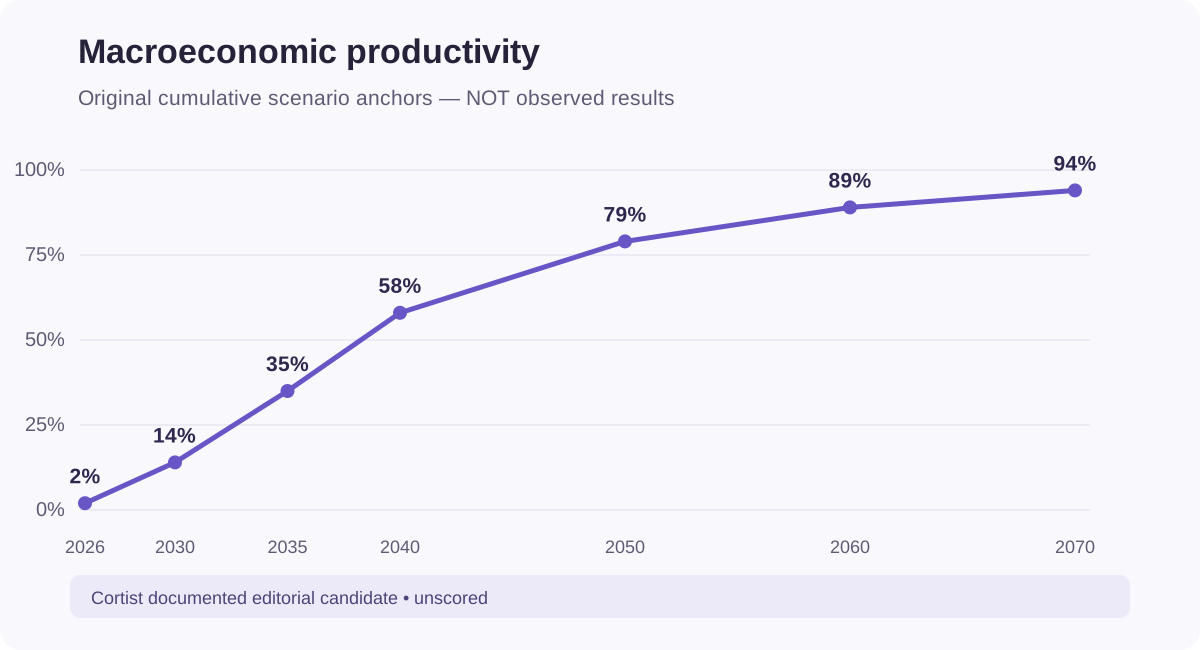
Cumulative scenario anchors: 2026: 2% · 2030: 14% · 2035: 35% · 2040: 58% · 2050: 79% · 2060: 89% · 2070: 94%. These are subjective assumptions, not an empirically calibrated estimate. They should be challenged with independent evidence, not interpreted as precise forecasts.
Adoption and productivity premia are partly explained by human and technology capital.
Read original evidence ↗Labor productivity context; observed growth cannot be attributed to AI without controls.
Read original evidence ↗AI investment contributes to growth but productivity attribution remains difficult.
Read original evidence ↗Initial 35% probability documented on 26 October 2026. A later adjustment would require a separate new snapshot, archived assumptions and sources.
Read research background, uncertainties and use the interactive year slider.