
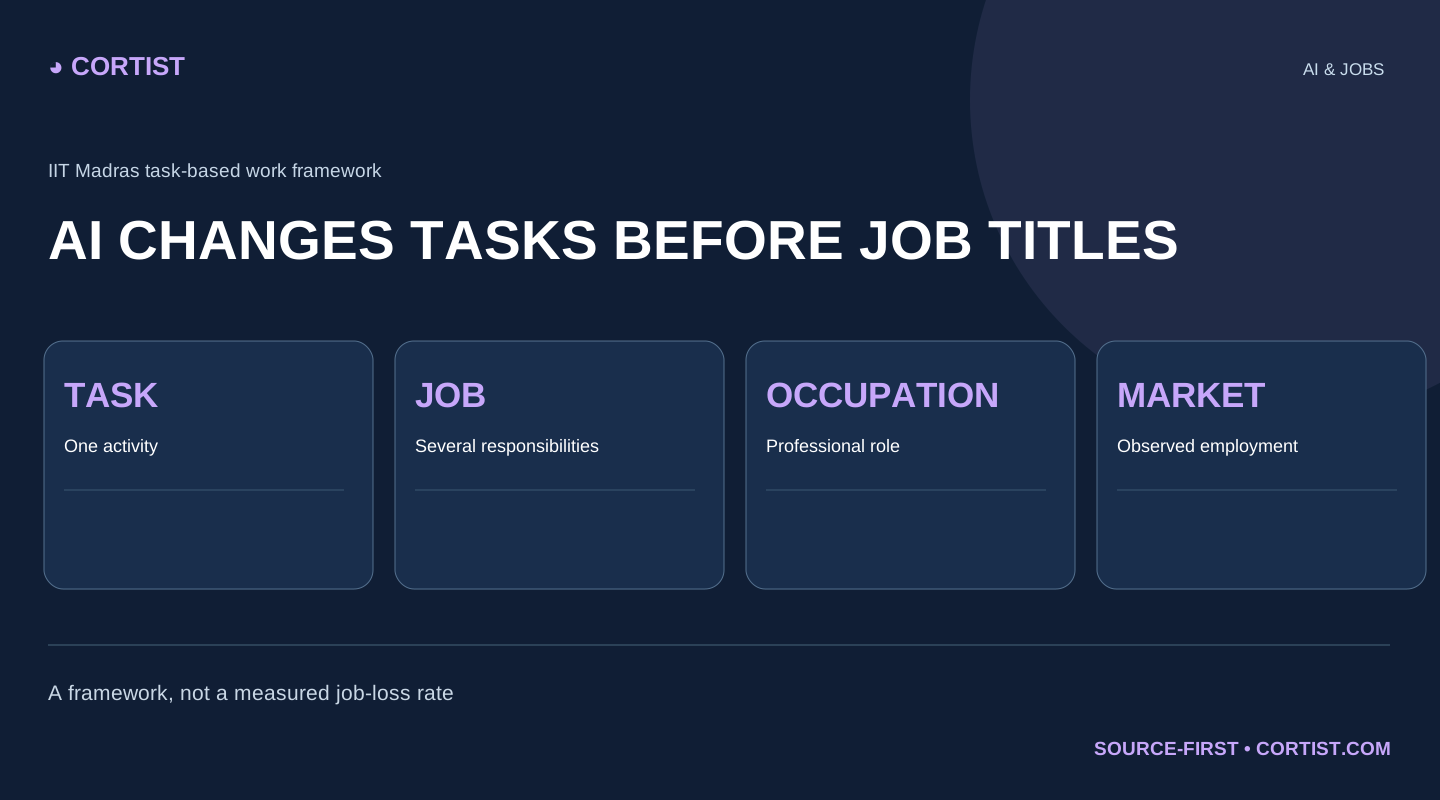
- IIT Madras CeRAI presents a framework covering tasks, jobs, occupations and labor-market outcomes.
- The framework discusses augmentation, redesign, displacement and new roles; it is not a measured national layoff rate.
- Implementation costs, employer choices, regulation and access to training can shape eventual employment effects.
- The paper does not prove all jobs are safe, or provide a causal count of AI-related displacement.
The Signal
Researchers at the Centre for Responsible AI (CeRAI), IIT Madras, propose reframing the debate about AI and jobs in India. Instead of starting with occupations supposedly destined to disappear, their newly reported whitepaper examines what happens to individual tasks inside an occupation. The release was reported on October 26, 2026, and the document is linked in the sources below.
Their task-based framework separates four different objects of measurement. A task is an activity. A job bundles several activities and responsibilities. An occupation represents related jobs. The labor market records employment, wages, hiring and transitions. AI handling routine customer-service inquiries, for example, does not automatically eliminate every customer-support position.
The Shift
The framework points to multiple outcomes: AI can assist people, replace some tasks, change the mix of responsibilities, create new specialist roles or contribute to displacement. Which pathway follows depends on technical cost, adoption decisions, safety rules, regulation and organizational design. Simply knowing that a benchmark model can perform an activity cannot reveal the eventual staffing decision.
A subtler long-term issue is the junior-to-senior career ladder. If routine entry-level tasks become automated, junior employees might have fewer opportunities to develop practical expertise even when a company retains similar overall headcount. That is a risk to investigate rather than a measured effect established by the framework itself.
The Cortist Lens
The publication supports a core rule of Cortist’s AI & Jobs reference guide: task exposure, adoption, measured hiring changes and causally attributable job losses are separate forms of evidence. Forecasting entire occupational disappearances from a product demonstration is unreliable. Longitudinal labor statistics and careful comparison groups matter more than the confidence of a headline.
The framework sits alongside Cortist’s reporting on workplace AI training inequalities and younger workers in exposed jobs. Our AI Agents page also explains why task-horizon reliability cannot be converted directly into employment displacement. Each study requires its own population and methodology.
Useful follow-up research would track task-level changes within firms, job postings, hiring and retention, wages and promotion pathways. Studies need to account for differences in regional economic conditions, industry demand, education and technology costs, as well as differences in who can access and use new tools.
Cortist’s J-001 question remains unquantified. The new IIT Madras framework is an important analytical contribution, not evidence that an employment forecast has resolved. The primary PDF could not be read directly through our retrieval route; this article therefore relies on the public release accounts cited below rather than claiming a complete independent review of its contents.
A benchmark measures technical potential. To understand work, research must then follow employer adoption, training and actual labor-market outcomes.
Questions readers ask
Research outcomes and company statements are distinguished from independent verification.
Does IIT Madras say AI cannot eliminate jobs?
No. It proposes analyzing task changes first; displacement remains a possible outcome depending on adoption and organization.
What is the difference between a task and a job?
A task is one activity, while a job combines many activities and responsibilities. Automating one task does not necessarily end the job.
Does the framework measure AI layoffs across India?
No. It is a conceptual framework and cannot be treated as a causal national count of job losses.
What should employers and policymakers monitor?
Track skills, hiring, wages, promotions, task redesign and workers’ access to learning opportunities.
Sources and editorial note
Cortist separates original claims, external reporting and independent validation. See editorial standards.
IIT Madras CeRAI whitepaper, original PDFOriginal report; direct PDF contents unavailable to this edition.Careers360, IIT Madras study, Oct 26Reporting on the CeRAI release and task-based approach.India Today, AI and Indian jobs, Oct 26Independent report on scope and conclusions.