
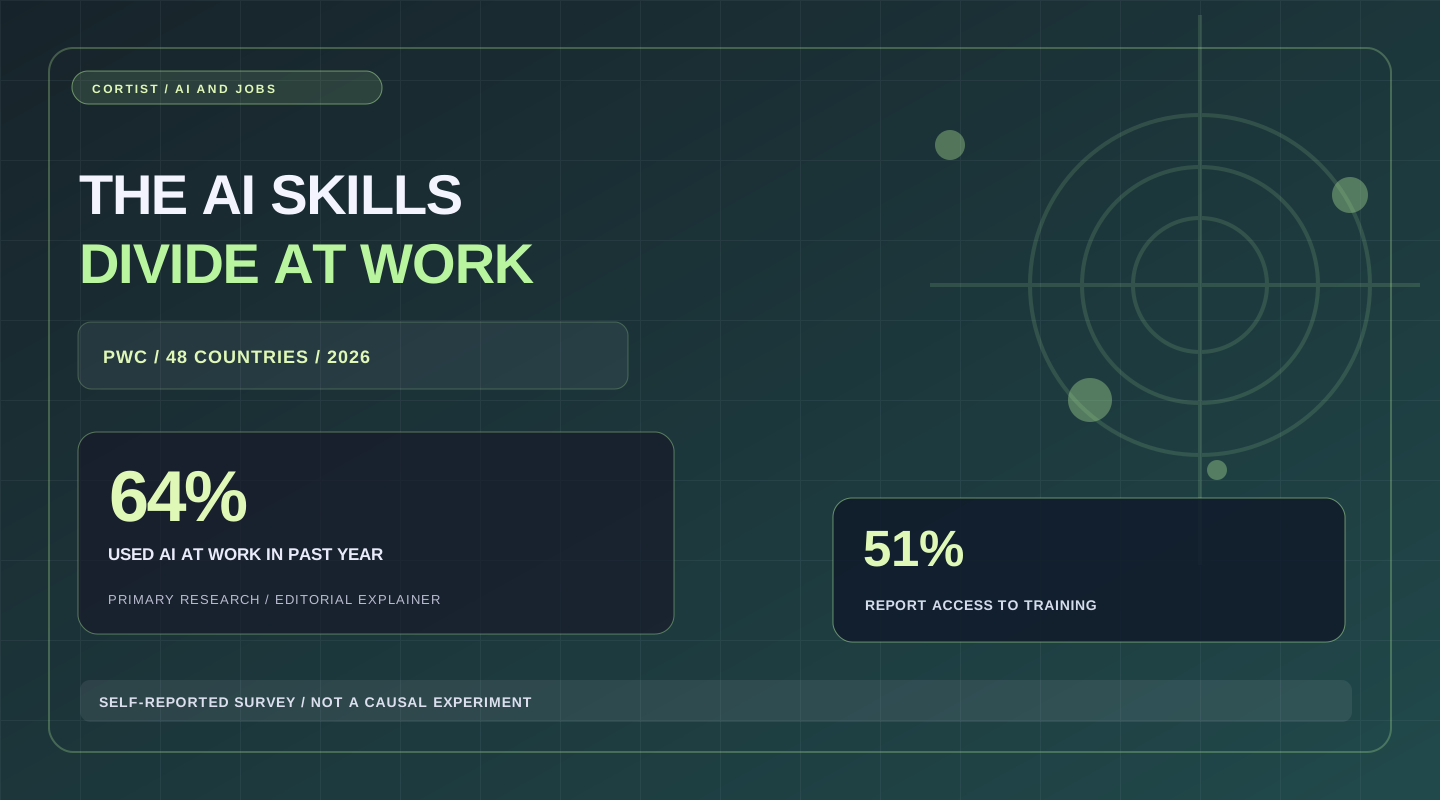
- PwC's September 29 Global Workforce Hopes and Fears Survey 2026 questioned nearly 50,000 workers across 48 countries and regions.
- 64% reported using AI at work during the prior 12 months, up 10 percentage points; daily generative-AI use rose from 14% to 22%.
- Only 51% said they had access to the learning and development they need, compared with 59% in the previous year.
- PwC groups 56% of respondents as its lower-AI-readiness 'engine room' segment. This is a survey classification, not the share of workers already displaced.
The Signal
The jobs debate often begins with a question about replacement. A new worldwide survey suggests a different near-term divide: who gets to learn and benefit as the tools spread? In its September 29 workforce report, PwC says 64% of respondents used AI at work in the previous year, an increase of ten percentage points. Daily use of generative AI rose from 14% to 22%.
But workers are not experiencing the transition equally. The share who say they have the learning and development resources they need fell from 59% to 51%. The survey draws on responses from nearly 50,000 people in 48 countries and regions, which makes it a broad snapshot of workplace perceptions, though still subject to survey wording, sampling and self-reporting limitations.
PwC places 56% of respondents in what it calls the 'engine room': workers who do not have especially scarce skills and are relatively early on the AI-learning curve. Only about two in five in that segment say they can access the development resources they need. This classification does not mean those workers are redundant or objectively unable to use AI.
The Shift
At the opposite end, PwC labels 14% of its respondents 'front-runners': workers with strong AI capabilities and skills employers value. Among this group, 29% say they are very or extremely likely to change employers in the coming year. That is an intention reported in a survey, not observed departures or a measured AI-induced turnover rate.
Daily AI users report more confidence in job security than infrequent users: 68% versus 57% in PwC's data. The gap is tempting to interpret as proof that using AI makes people safer. It is not. People with better access, stronger management support, different jobs or greater confidence may also be more likely to use AI each day. The direction of causality is unknown.
PwC also finds employees more concerned about economic volatility than AI taking over tasks, underscoring that work anxiety has several causes. Across the global sample, many employees face cost-of-living pressure, heavy workloads and uncertainty. Workers may be expected to adapt quickly even as formal training budgets, time and organizational support lag behind.
The Cortist Lens
An 'AI skills gap' is often framed as an individual worker failing to keep up. PwC's findings suggest an institutional question as well: who has protected time to learn, safe access to tools, supportive managers and opportunities to apply new skills? A workforce cannot be expected to rebuild itself solely through unpaid experiments after hours.
For employers, a more useful plan begins with job tasks, not vague mandates to 'use AI'. Give employees relevant training, measure output and error rates, explain what tools may be used with sensitive data, and track access across seniority and departments. Then examine whether benefits are shared through better working conditions or new opportunities rather than concentrated in a small group.
The survey does not establish how many jobs will vanish by 2030. It does reveal a plausible mechanism for inequality: people who already have scarce skills and organizational support may compound their advantage, while others encounter increasing expectations without comparable resources. That question belongs alongside employment data in Cortist's AI & Jobs research hub.
Look for later surveys using comparable questions, employer training investment, differences in promotion and pay, and independent evidence on whether learning access changes career outcomes. This is a standard archived news analysis, not a new probabilistic Cortist forecast.
The widening workplace AI divide is not just about who uses a chatbot. PwC's figures raise a harder question about unequal access to training and opportunity as businesses redesign work.
Questions readers ask
Direct answers based on what the evidence currently shows. A measured association is not a guaranteed forecast.
How many workers used AI at work in PwC's 2026 survey?
64% said they used AI at work in the past 12 months. That includes different frequencies of use and is a self-reported survey measure.
Does PwC say 56% of workers will lose their jobs?
No. The 56% refers to a survey segment PwC calls its 'engine room', defined by skills scarcity and AI-learning progress, not a prediction of redundancy.
Does using AI daily cause greater job security?
The PwC survey reports higher job-security confidence among daily users, but the association does not establish that AI use caused the difference.
What can employers do about the AI skills gap?
Offer task-specific training, reliable access, time to learn, responsible-use policies, quality checks and measurable opportunities for advancement.
Primary sources & editorial note
Source limitation: Self-reported survey results cannot by themselves establish causation or productivity growth. Read our editorial standards for attribution and corrections.
PwC 2026 Global Workforce Hopes and Fears findings, September 29 2026Primary publication, sample and detailed workforce segment definitionsInternational Labour Organization, Changing landscape of skills, August 13 2026Independent skills and work-organization contextILO review of empirical AI jobs impacts, June 2026Limits of measured productivity and employment effects