
- ADP Research's October 21 Canaries Dashboard update finds year-over-year employment down 0.5% across highly AI-exposed US occupations, versus growth of 1.0% for the least-exposed.
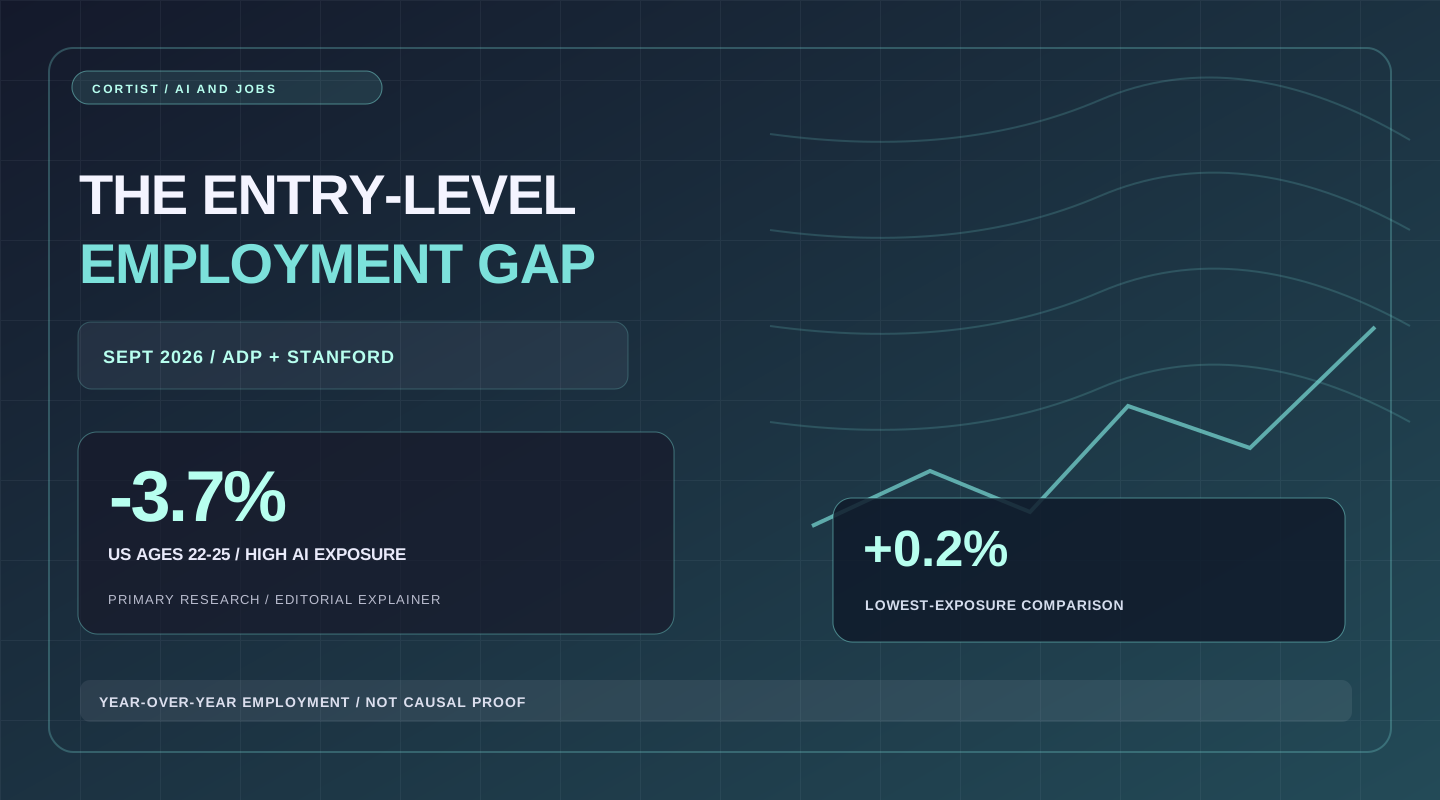
- Among workers aged 22 to 25, employment in highly AI-exposed roles contracted 3.7% year over year in September 2026; it rose 0.2% in the least-exposed group.
- Employment across all occupations among ages 22 to 25 fell 2.2% year over year in the same data.
- These are employment growth rates and group comparisons, not a calculation of jobs directly destroyed by AI.
The Signal
New US payroll figures released on October 21 by ADP Research and Stanford's Digital Economy Lab sharpen a disturbing question for people entering the workforce: is the first rung of the career ladder becoming harder to reach as AI spreads? The latest Canaries Dashboard update reports that employment in occupations rated highly exposed to AI shrank 0.5% in September compared with a year earlier. Jobs in the least-exposed occupations grew 1.0%.
The difference was sharper among employees aged 22 to 25. Within this age bracket, the high-exposure group saw a 3.7% year-over-year decline, while the least-exposed group edged up 0.2%. Across all occupational exposure levels, employment among the same young workers was down 2.2%. The dashboard reports 36 consecutive months of year-over-year declines for the young, high-exposure group, starting in October 2023.
These are measures drawn from ADP's private-sector payroll data. They describe differences between categories of employment, not a controlled experiment in which comparable workers were randomly assigned access to AI. That distinction matters because the same period contains economic uncertainty, industry-specific hiring swings, graduate-supply changes and decisions to pause hiring rather than dismiss existing workers.
The Shift
An occupation can be 'exposed' to generative AI when a substantial share of its tasks can plausibly be performed or assisted by models. Exposure is not a measure of actual AI adoption by every employer, and it is not the share of positions already automated. Software development and customer support are useful examples: a model may draft code or resolve a standard ticket without handling security, responsibility or complicated customer needs.
Stanford's October 21 explanation of its AI Economic Indicators reports a parallel pattern in software and customer-service employment and warns against over-reading subgroups that may not be representative. The researchers' August paper, using data through June, found young workers in highly exposed roles 19% below a comparative employment trend. That 19% level gap and the new 3.7% annual contraction are two different statistics. They must not be added together.
If employers automate routine entry-level assignments while retaining experienced staff to supervise systems, hiring can weaken before headline unemployment rises sharply. But the payroll data alone cannot tell how much of the divergence comes from substitution, complementarity, offshoring, cyclical changes or shifts in demand. A credible account needs matched employer adoption and occupational hiring data, not an automatic AI-causation label.
The Cortist Lens
Why should readers care? Entry-level work often teaches the tacit knowledge that later makes a person valuable: handling exceptions, writing for real audiences, diagnosing unfamiliar problems and understanding what a customer actually needs. If fewer people receive those opportunities, the long-term consequences could reach beyond one year's hiring figures. The present data raise that question; they do not settle it.
The most useful next indicators are independent vacancy series, hiring rates by age and occupation, pay, separations and the number of employers using AI intensively. Analysts should compare several data providers and measure whether exposed industries diverge after accounting for business cycles. A simple correlation, however attention-grabbing, is not the same as proving that an algorithm replaced a specific worker.
For prospective employees, a reasonable response is to learn how AI changes the tasks within a chosen occupation while developing domain-specific judgment and evidence of real work. For Cortist's AI & Jobs research hub, the standard is even stricter: any future probability about workforce displacement must define exactly which workers, which outcome, what deadline and what independent dataset would resolve the forecast.
Watch whether the next ADP and Stanford monthly updates sustain the divergence; whether independent US vacancy and hiring datasets confirm it; and whether employer-level AI adoption explains the pattern after controlling for other forces. This standard news report is archived, not placed into an automatic dedicated monitoring watch.
The September employment gap for young workers is an observable warning sign. It is not proof that AI has eliminated 3.7% of the jobs in those occupations, nor evidence of an economy-wide unemployment shock.
Questions readers ask
Direct answers based on what the evidence currently shows. A measured association is not a guaranteed forecast.
Did AI eliminate 3.7% of entry-level jobs in September 2026?
No. The 3.7% figure is a year-over-year decline in employment for US 22- to 25-year-olds in highly AI-exposed occupations within the ADP/Stanford data. It does not identify the cause of each employment change.
What does AI-exposed mean?
It describes occupational tasks that AI systems may automate or assist. It is not the percentage of jobs removed and does not necessarily measure actual tool use at every employer.
How does the 3.7% figure relate to Stanford's 19% result?
The 3.7% is a September year-over-year change for one group; the 19% is a gap relative to a less-exposed comparison trend using data through June 2026. They are different measures.
Which job indicators should people watch next?
Occupation-specific hiring, advertised vacancies, separations, wages and independent measures of AI adoption should all be checked together.
Primary sources & editorial note
Source limitation: AI exposure and changes in hiring are correlated observations, not proof that AI caused each job change. Read our editorial standards for attribution and corrections.
ADP Research Canaries Dashboard, October 21 2026Primary September US employment updateStanford HAI AI Economic Indicators, October 21 2026Research context and caveats on AI-exposed employmentStanford Digital Economy Lab paper, revised August 12 2026Working-paper methodology for early-career gapsILO empirical evidence review, June 2026Broader evidence about tasks, displacement and uncertainty